
Essays & Interviews
Mastering the Common App Essay: A Comprehensive Guide with Real Student Examples
The Common App essay is one of the most important parts of your college application journey in the U.S.—it’s your chance to let your personality shine and share the meaningful stories that go beyond test scores and transcripts. This personal statement helps admissions officers get to know the real you: your passions, your challenges, and what truly matters to you.
By the Zenith Education team
We know that applying to college can feel overwhelming, and writing the Common App essay is often one of the biggest hurdles. But don’t worry—this isn’t just another assignment. It’s a unique opportunity to tell your story in your own words and show why you’d be a great fit for the schools you’re applying to.
At Zenith Education, we understand how important—and sometimes tricky—this process can be. That’s why we’ve curated a collection of real essays from students who were accepted into top universities like Stanford, UCLA, Princeton, Johns Hopkins, and UC Berkeley. Each essay is paired with a detailed expert review from our founder, Serge Nader, to highlight exactly what made it stand out.
In this guide, we’ll walk you through the current Common App prompts, offer expert tips for crafting a memorable narrative, and explore standout essays that earned students spots at some of the most competitive schools in the world. Whether you're reflecting on your identity, sharing a challenge you've overcome, or diving into a topic you're passionate about, these examples will give you inspiration—and the confidence—to write your own winning essay.
What’s the Common App Essay All About (and Why It Matters)?
The Common App Essay, also known as the Personal Statement, is a 650-word piece that’s part of the Common Application, and it’s a key requirement if you’re applying to colleges through this platform.
As you start thinking about your personal statement, here are a few tips to keep in mind:
This essay is your chance to showcase the unique and personal parts of who you are, helping the admissions committee get to know you beyond just your grades, test scores, and extracurricular activities.
Since you can’t fit your entire personality into one essay, try to focus on one or two character traits that really make you stand out from the crowd.
Remember, you don’t need to have an amazing experience to write a great essay! Just pick something that truly matters to you and explain why it’s so significant in your life.
How Do You Format a College Essay (Without Overthinking It)?
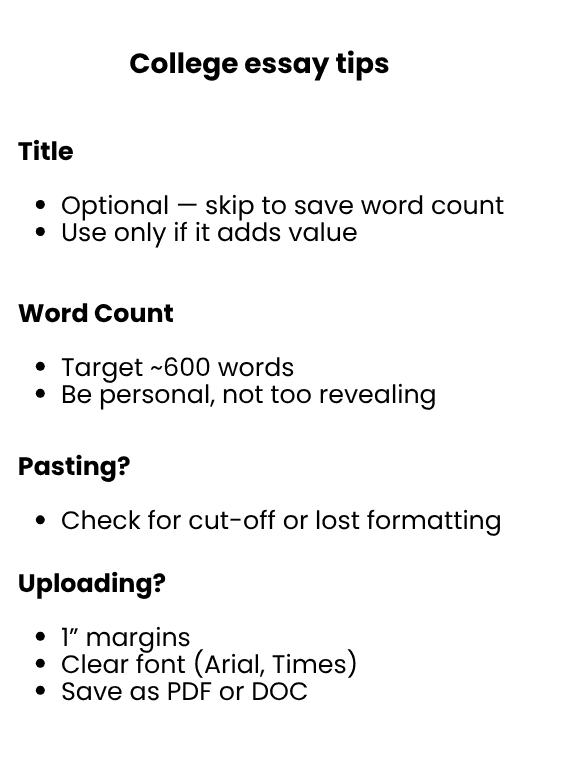
The main thing to keep in mind when writing your college essay is that content is king! Focus on making your ideas shine, while ensuring your essay is easy to read with a clean format and structure.
Title
You might not need a title for your college essay, and skipping it can even save you some word count! Plus, titles can sometimes box your essay into one interpretation, so if you do choose to use one, make sure it fits your theme. Remember to keep your font double-spaced and leave a little space between paragraphs to help with readability.
Word Count
If there isn’t a specific word count mentioned, a good target is around 600 words. It’s great to share personal stories, but be careful not to overshare, as that could set you apart for the wrong reasons!
Submitting Your Essay
When you’re ready to submit your essay and need to copy and paste it into a text box, here are a few tips to make sure everything goes smoothly:
First, double-check that your entire essay transferred over correctly. Sometimes, switching between different programs can lead to getting cut off or messing up your formatting, which you definitely don’t want!
Little details like bold and italics might not always work on every platform, but that can actually help keep your essay straightforward and easier to read.
If you’re attaching a document instead, be mindful of your formatting. Here are some simple guidelines to keep in mind:
- Stick with a standard 1-inch margin to keep things looking tidy.
- Use an easy-to-read font, like Times New Roman or Arial, so it’s simple for the admissions team to read your work.
- Save your essay in a format that’s accepted by the submission portal.
Let’s Break Down the Common App Essay Prompts

Here are the 7 Common App essay prompts you can choose from for your application:
- Some students have a background, identity, interest, or talent that is so meaningful they believe their application would be incomplete without it. If this sounds like you, then please share your story.
- The lessons we take from obstacles we encounter can be fundamental to later success. Recount a time when you faced a challenge, setback, or failure. How did it affect you, and what did you learn from the experience?
- Reflect on a time when you questioned or challenged a belief or idea. What prompted your thinking? What was the outcome?
- Reflect on something that someone has done for you that has made you happy or thankful in a surprising way. How has this gratitude affected or motivated you?
- Discuss an accomplishment, event, or realization that sparked a period of personal growth and a new understanding of yourself or others.
- Describe a topic, idea, or concept you find so engaging that it makes you lose all track of time. Why does it captivate you? What or who do you turn to when you want to learn more?
- Share an essay on any topic of your choice. It can be one you’ve already written, one that responds to a different prompt, or one of your own design.
What Makes a Winning Essay?
Crafting a personal essay for prestigious universities can be challenging. From choosing the right topic to determining how to express it, the essay portion of your college application presents many hurdles.
We’re here to assist you! Our team is here to guide you in creating an exceptional college application essay.
A great Common App essay should reflect your unique voice and personal experiences while keeping a few key things in mind:
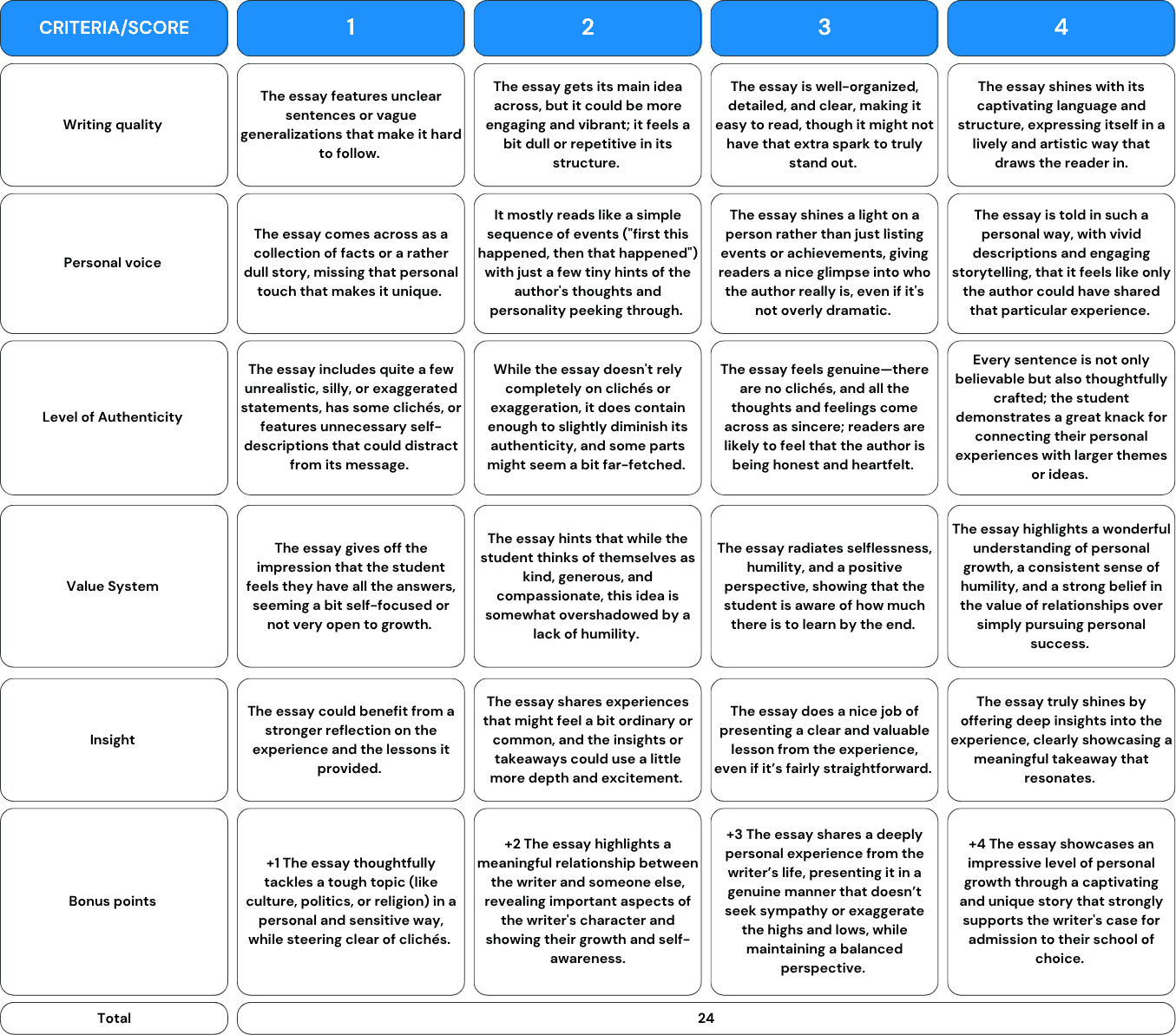
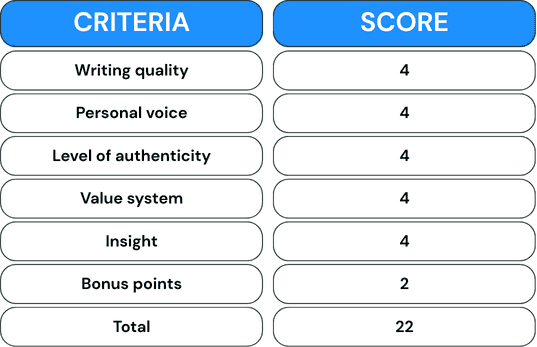
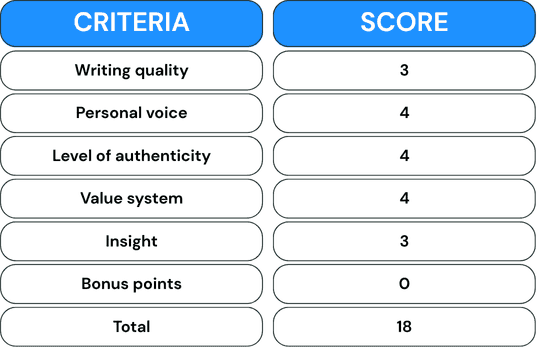
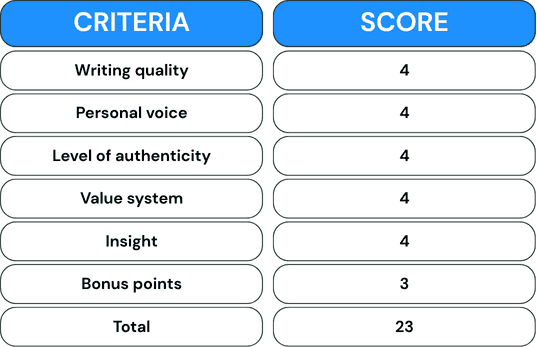
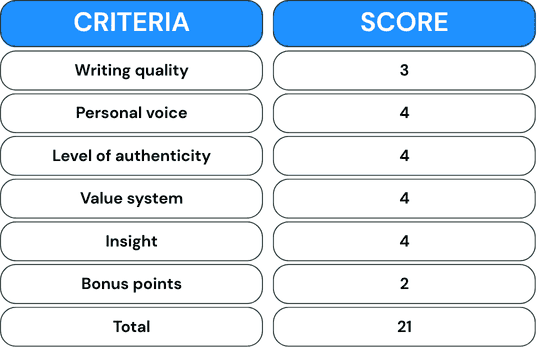
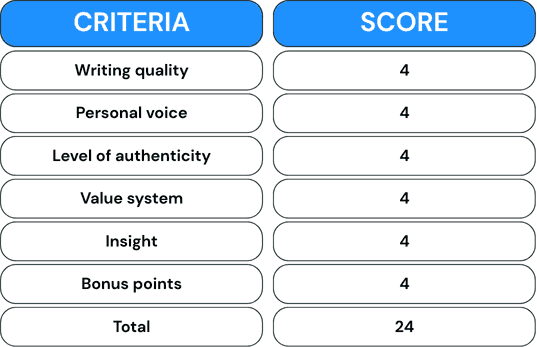
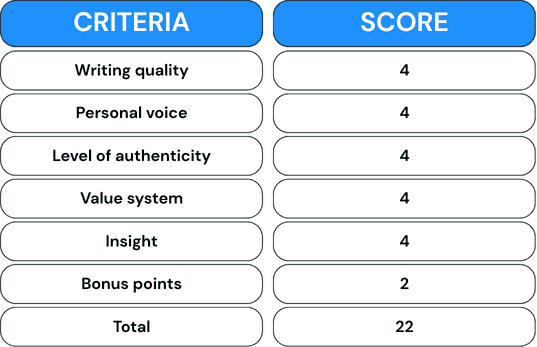
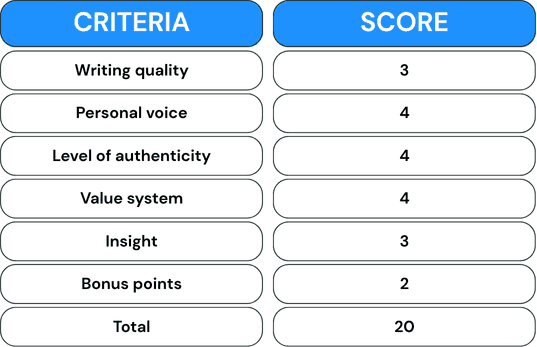
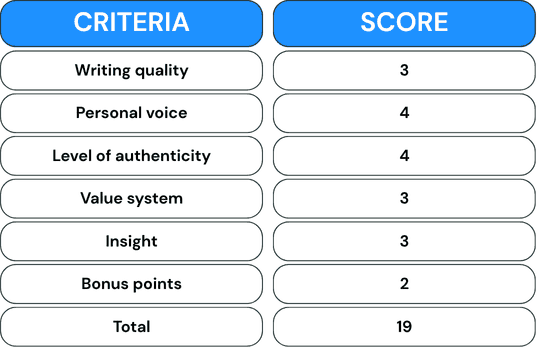
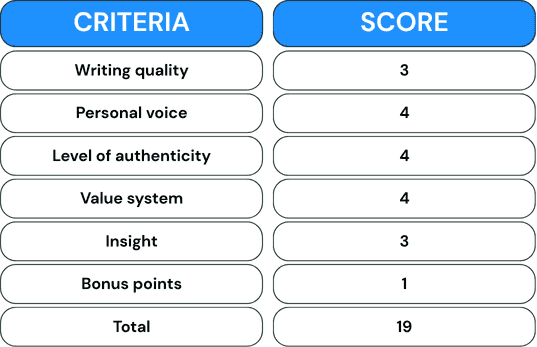
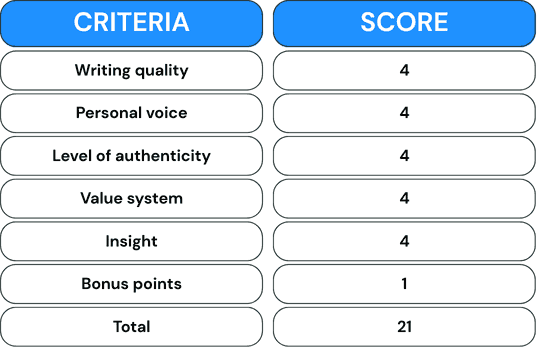
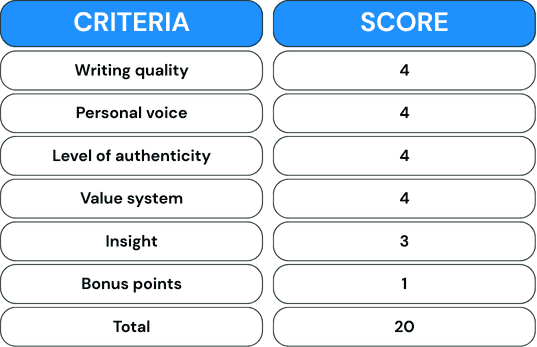
- Writing Quality: Aim for a piece that grabs attention with its language and structure! It should be interesting, creative, and engaging. Make sure your sentences flow well and are easy to follow.
- Personal Voice: Write from the heart! Your descriptions and storytelling should be so unique that it feels like only you could have written it.
- Level of Authenticity: Every sentence should feel genuine and thoughtfully crafted. Show your ability to connect your experiences to bigger issues or ideas in a meaningful way.
- Value System: Share your personal growth journey and keep a sense of humility. Highlight the importance of relationships over personal achievements.
- Insight: Make sure to include deep insights about the experiences you share, showing the valuable lessons you've learned along the way.
- Bonus Points: If you tackle a tough topic or explore an unusual idea in a compelling way, you’ll definitely stand out even more!
How Your Essay Is Scored (And What That Rubric Really Means)
Real Essays, Real Feedback: Learn from What Works
Let’s dive into each of the Common App prompts together and check out some real essay excerpts to spark some inspiration for your own writing!
Tackling Prompt #1: What It’s Really Asking (and How to Nail It)
Some students have a background, identity, interest, or talent that is so meaningful they believe their application would be incomplete without it. If this sounds like you, then please share your story.
Admissions officers are eager to learn what makes you stand out! Use this chance to share a part of your background, identity, or a passion that really defines who you are. Think of a story that only you can tell. If you’re looking for inspiration, you can check out some college diversity essay examples! Just remember to avoid those common topics or clichés. Make sure to connect your experience to how it has shaped your growth or your future goals. And don’t forget, working with a college essay advisor can be very helpful in fine-tuning your story and presenting it in the best light.
Sample Answer (Excerpt): "Every Sunday, I sat at the kitchen table with my grandmother, translating her stories from Urdu to English. At first, I did it so my younger siblings could understand her. But over time, I realized I was helping preserve parts of our family history that might otherwise be lost. These moments sparked my passion for language, and later led me to start a bilingual storytelling club at school. Through it, I’ve learned how language can be both a bridge and a home—and I hope to continue exploring that connection in college."
Examples
Seeds Of Immigration
The three, small, purple seeds sat on the brown soil. Ten feet from me I could see my grandpa with his yunta and donkeys. They were in unison: the two donkeys, the plow, and him. My grandpa commanded; the donkeys obeyed. I began to feel tired. Exhausted. My neck was being pierced by the Mexican sun as I dropped seeds for hours.
I can’t complain; I wanted to do this.
I placed three tiny seeds, imagining the corn stalk growing while the pumpkin vines wrapped around it; both sprouting, trying to bear fruit. I clenched a fistful of dirt and placed it on them. “Más,” my grandpa told me as he quickly flooded the seeds with life-giving dirt.
Covered. Completely trapped.
My grandfather has been doing this ever since he was a little boy. Fifty-five years later and he still works hard on the field. There isn’t much else to do in the small town of Temalac, Guerrero. All he could do was adapt; something my parents never did. They sacrificed everything and left their home, never to return again. With no knowledge of what would come tomorrow, with only their clothes on their backs, they immigrated to the US. They had to work on unknown soil, hoping their dedication will help sprout the new seeds they’d soon plant. They did this for me. They wanted me to worry about my education, not if there would be enough rain to satisfy the thirst of the crops.
I have a thirst.
A thirst to be the vessel for my family into a better future. I must be the crop that feeds them. All these thoughts rushed into my soul as I looked back down the aluminum bucket. I could never be a farmer. I’m grateful my parents were.
They planted a seed. A tiny seed with no instructions but to succeed. I’m the first-born son of two immigrant parents. I had a clean sheet to become anything. I could’ve fallen into my town’s influence, joined a gang, and become another statistic. Regardless of the dirt I come from, I began to sprout. Ever since I was eight years old I was entrusted with responsibilities. We were lucky that school was a three-minute walk; yet it was a stressful journey for a child. I had to wake up my brother, give him breakfast, make sure his clothes were ready, and that he was doing well in school.
Growing up, I always fell behind in school. I had to take summer classes to match my peers’ intellect; while others were reading to learn, I was merely learning to read. My parents weren’t able to teach me English; I grew up solely developing my Spanish accent. My bilingual brain hadn't yet matured and lacked the English tongue. Entrusting a child to be the translator-of-all-matters for his parents robs him of his childhood. I had to help my parents navigate an English system unknown to them. From the day I learned to speak I had to learn to advocate not just for myself, but for my parents.
I’m the type of person my family tree hasn’t seen. Staying in high school, getting good grades, and being a responsible individual are aspects that make people around me think that I have sprouted. But I have not yet bloomed into the being I wish to become. In fact, I have merely tunneled my roots onto the Earth; roots that have been solidified by the determination my parents instilled in me as a child. Nothing I ever accomplished was handed to me. It’s the fact that I have come this far without the advantages other students have that fills me with pride.
Review
This is a deeply reflective and poignant essay that captures the author’s personal journey with vivid imagery and a clear narrative arc. The author takes a unique approach by framing their experience around the metaphor of "seeds"—both literal and symbolic—as they explore their identity, the sacrifices of their immigrant parents, and their own personal growth. The essay effectively intertwines personal experiences with broader themes of responsibility, adaptation, and the pursuit of a better future.
The opening scene, with the description of planting seeds alongside the author’s grandfather, immediately engages the reader. The use of sensory details, like the "Mexican sun" and the physicality of the task, brings the moment to life. The author doesn’t immediately explain the significance of this scene, allowing the reader to stay curious about the connection between planting seeds and the larger themes to come. This moment sets the tone for the rest of the essay, grounding the reflection in a simple yet meaningful activity. This also earns the essay bonus points for taking a mundane task and using it as a vehicle for a profound exploration of identity and personal growth.
The essay shifts smoothly into a discussion of the author's family’s sacrifices—particularly their parents' decision to leave everything behind and immigrate to the United States. This transition from the grandfather’s labor to the parents’ journey is seamless, reinforcing the central metaphor of planting and growing. The author describes the feeling of "thirst" to succeed not only for themselves but for their family, showing how these values of hard work and dedication were instilled in them from a young age. This emphasis on responsibility is relatable and demonstrates a clear understanding of their parents' sacrifices.
One of the most compelling aspects of this essay is how the author describes their educational challenges. The personal story of falling behind in school and learning English while also becoming the "translator-of-all-matters" for their parents adds a layer of emotional depth. It’s a clear demonstration of the author’s maturity and resilience, having had to take on responsibilities far beyond their years. The phrase "Entrusting a child to be the translator-of-all-matters for his parents robs him of his childhood" is particularly striking and helps the reader understand the gravity of the situation, as well as the strength it took for the author to rise above it.
The author’s reflection on their journey—“I have merely tunneled my roots onto the Earth”—is a powerful metaphor for the process of personal growth. While the essay captures the pride the author feels for having come this far, it also reveals a humility that suggests they see themselves as still growing, still learning. This self-awareness is essential, as it balances the pride in their accomplishments with an understanding that there is still more to achieve. The desire to bloom and fulfill the potential planted by their parents is a fitting conclusion to the essay’s central metaphor.
Essay Score
Chicago
Chubby fingers outstretched and round cheeks flattened against the window, I leaned further into the plexiglass. Although I could feel a firm hand tugging at my shirt, urging me to sit back in my seat - at ten, I possessed little concept of manners (or sanitary awareness), both of which I abandoned as I refused to cease standing on the chair of the CTA train - at the moment, all that mattered was that I was soaring above the streets of Chicago. Eyes darting across the ever changing expanses of the city, I refused to lift my gaze in fear of missing anything.
For the first time, I was taking a trip in the belly of a gargantuan silver beast, known familiarly to most Chicagoans as the “L.” What distinguishes the L from its relatives - the Tube, le Métro, the MTA - is its ability to burst through concrete and asphalt streets to rise above, guided only by wood and steel, and glide through the towering skyscrapers that dot the Chicago skyline. It elevates and cultivates a sense of infinite wonder in its riders, from the all-too-serious businessmen I’ve caught gazing dreamily out the windows to the young children futilely yet passionately attempting to balance in the center of the car as the train weaves throughout the city. From that first ride to the present day, my fascination with the inner and outer workings of the L and its passengers has refined itself to an infatuation.
Each ride presents a chance to ponder the overlooked, to question the seemingly mundane: You can quantify the number of people that find themselves teeming through the L’s sliding doors, but can you quantify their experiences? Who is that woman, man, student, small rodent, and what is their story? I adopt the lenses of journalists, economists, marketers, sociologists, historians, and the mere fellow passenger to analyze: the placement of an ad for Planet Fitness adjacent to an ad for Pizza Hut, the change in the racial makeup of passengers as the train travels North to South, the origin of unassuming stains or abandoned books. More recently I pondered, if they say the beat of a butterfly’s wings can induce a hurricane halfway across the world, can a five minute train delay get me into college?
The L is a catalyst between my vim mind and the seemingly elusive outer world, a seventy-five cent silver chariot that I can ride to whatever adventure I see fit. Since that first ride, I persist in search of the optimal collection of train stops, forging a mental map of Chicago shaped by my life experiences - all accessible by a simple swipe of a ventra card. The multitude of train lines that branch from the L’s “Loop” are dotted with my discoveries. The boathouse, where I strain my vocal chords from hours of training (and hours of laughing with my teammates).
The school, where I test the waters of political responsibility, explore the depths of socioeconomic research, and conquer the wakes of edits delivered on my reporting for the newspaper. The small urban farm, located in a former project, that I help create and cultivate each spring and summer.
My thirst and and hunger for the knowledge of anything and everything was, and remains, insatiable. This train, this beating artery, pumping from the birthplace of the city to its outer reaches, is what quenches my thirst and satiates my hunger. Riding the L not only gave me the access to pursue rowing, a liberal education, and volunteerism; it forged a sense of adventurousness deep into the synapses of my nerves, a sense driving me into the intersections of journalism, student government, fashion, and aiding my beautiful city. That first L ride instilled the interests that lie within me, passions that subsist on experiencing life at its fullest and engaging my sponge-like intellectuality. I thrive on discovery; It defines who I am.
Review
This essay is a vibrant, imaginative, and sophisticated reflection that uses the Chicago “L” as both a literal and metaphorical vehicle for the author’s intellectual curiosity and personal growth. The metaphor of the train as a catalyst for discovery is woven masterfully throughout the essay, allowing the reader to travel alongside the author—not just through the city of Chicago, but through the evolution of their interests, personality, and worldview. It’s a creative and introspective approach that highlights both self-awareness and intellectual breadth.
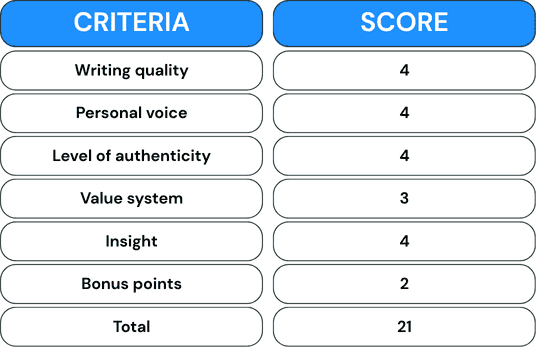
The opening scene with the “chubby fingers” and “round cheeks flattened against the window” is rich in detail and instantly places the reader into the mindset of a ten-year-old filled with wonder. It’s a playful, well-crafted image that avoids cliché and manages to be both charming and grounding. The reader is drawn in by the descriptive language and the emotional undertone of childlike fascination, a tone that is skillfully matured as the essay progresses. From this opening, the essay earns full marks for writing quality—it’s sharp, lyrical, and highly readable.
The author elevates a daily experience—riding public transportation—into a thoughtful exploration of identity, curiosity, and purpose. Their observations about fellow passengers, advertisements, and neighborhood shifts reflect a reflective and inquisitive nature. Rather than focusing on a single hardship or defining challenge, the author explores a consistent mindset of exploration and growth. This is a more abstract and intellectual angle than many Common App essays take, but it works because it’s supported by concrete detail and a strong, authentic voice.
What stands out particularly is the seamless weaving of personal experience with analytical insight. The essay demonstrates the author’s passion for journalism, politics, sociology, and service, all through the lens of the L train. It manages to avoid sounding like a resume or list of accomplishments because everything is grounded in a personal narrative. Even when the author references school, rowing, or volunteer work, it is always done in relation to how the train helped them access these parts of life—this indirect framing adds humility and depth.
The final paragraphs circle back beautifully to the theme of intellectual hunger and discovery. The essay’s conclusion is both poetic and grounded: the L, a beating artery of the city, mirrors the author’s intellectual and emotional pulse. This kind of conceptual cohesion is difficult to pull off, but the author does it gracefully, leaving the reader with a clear sense of who they are: curious, engaged, and shaped by place.
Essay Score
Tackling Prompt #2: What It’s Really Asking (and How to Nail It)
The lessons we take from obstacles we encounter can be fundamental to later success. Recount a time when you faced a challenge, setback, or failure. How did it affect you, and what did you learn from the experience?
Colleges really appreciate resilience and the ability to bounce back from challenges. This prompt gives you a wonderful opportunity to showcase how you’ve grown through tough times, while also allowing you to demonstrate your essay-writing skills.
Instead of focusing on the obstacles themselves, highlight the valuable insights you gained. Keep a positive vibe throughout, and show how you’ve overcome adversity. Be sure to share specific lessons you learned along the way.
Sample Answer (Excerpt): "As president of our school’s volunteer club, I was excited to organize our biggest food drive yet. But poor planning and lack of communication led to confusion—and we ended up collecting half of what we had the year before. I was crushed, but it pushed me to reflect, ask for feedback, and learn how to lead with more collaboration. The next semester, we rebuilt the team dynamic and nearly doubled our goal. That failure taught me that leadership isn't about doing everything—it's about listening, adapting, and growing with your team."
Examples
A Shakespearean Shambles
A “C+” might not constitute a technical failure, but for an honors student with a constant eye on my GPA, my grade on the English group project certainly felt like an “F.” I should start from the beginning. Last year, I was excited when my English teacher announced that she was assigning a group project for our Shakespeare unit. Each group would select a play to read, then put together a creative presentation to teach the rest of the class about the plot, themes, and other important devices. I became even more thrilled when I was paired with two friends who were as smart and motivated as myself. But while this combination seemed like the perfect formula for success, my partners and I learned that it takes more than brains to work well together.
My group’s first problem stemmed from one of the very things I thought would be a strong point: our motivation. It turned out that we were all so busy with our extracurricular activities and other demanding classes that it was difficult to find an available time to meet and get started on the project. Somehow field hockey practice, musical rehearsal, and AP European study group managed to inconveniently take up the majority of our free time. Consequently, our group did not even meet until the weekend before our presentation.
When we finally did get together, only two of us had read Othello in its entirety, making the other member’s ideas fairly irrelevant. We still managed to brainstorm how to retell the story of the Moor of Venice; but unfortunately, many of them were too outlandish and labor intensive to complete in what was now a short period time. (Perhaps we’ll get the chance to perform a Shakespearean rap with an attempt at beat boxing some other time.) Instead, we decided to simply each draw a poster outlining the plot structure of the five acts. Our overabundance of ideas ironically led us down the path of inaction and mediocrity.
On presentation day, it was clear that our group lacked cohesion. Having each designed our respective posters separately, nothing felt like part of the same project. We simply divvied up the play and summarized the major plot points. Our teacher certainly sensed this bland, siloed project, resulting in all three of us receiving a C+. While my other grades in the class were strong enough to bounce back from the low grade, I also managed to learn a few poignant lessons.
The first is the importance of prioritizing. Extracurricular activities are certainly worthwhile endeavors, but not at the expense of core academics. My classmates and I should have sacrificed an extra evening or two to give our project the time and attention it required. The second lesson I learned is to seize creative opportunities when they arise. Group projects and presentations are pretty rare and I know that my friends and I could have come up with an amazing, entertaining presentation if we had just budgeted enough time. The chance for collaboration is a gift and I intend to fully take advantage of it when the next opportunity presents itself. As the Bard himself wrote, all the world’s a stage, and I intend to make every exit and entrance from here on out as meaningful and lasting as possible.
Review
“A Shakespearean Shambles” is a well-structured and candid reflection on an academic misstep that becomes a moment of personal growth. The essay is compelling in its honesty, striking a strong balance between storytelling and self-awareness. The author doesn’t overinflate the significance of the event, nor do they shy away from admitting their mistakes—this straightforward, grounded tone earns the reader’s trust from the start.
The opening sentence, with its mention of a C+ feeling like an “F,” immediately places us inside the mind of a high-achieving student who holds themselves to a high standard. Rather than launching into melodrama, the essay takes a measured approach, setting up the situation with clear context and a touch of humility. The pacing is smooth and chronological, taking the reader through the formation of the group, the roadblocks that emerged, and the resulting disappointment.
The writing is clear and conversational, with moments of levity that bring out the author’s personality—particularly in the idea of a “Shakespearean rap with an attempt at beat boxing.” This moment adds charm and helps the reader imagine the kind of creative energy the author is capable of bringing to group work when conditions are right.
What elevates this essay is the clarity of the lessons learned. Rather than simply listing regrets, the author distills two thoughtful takeaways: the importance of prioritization and the value of creative opportunity. These reflections feel sincere and earned. The conclusion ties these insights together with a clever nod to Shakespeare, rounding off the essay with a sense of renewed motivation and growth.
While the scope of the essay remains focused on a single school assignment, that narrow frame allows for depth of reflection. The essay isn’t trying to impress with external accomplishments—it earns its impact through introspection and maturity.
Essay Score
My Father
One in three victims of a heart attack don’t show any symptoms before it happens. Ninety-five percent of cardiac arrests that occur outside a hospital are fatal. These are not merely statistics. A heart attack redefined my life on November 21st, [Date].
It was a warm autumn morning, and I was raking leaves with my Boy Scout Troop to fundraise for our high adventure patrol’s 50-mile hike to summit Mt. Washington in New Hampshire. I had left my house on my bike early, without telling my mom—she was asleep, and my dad was at work.
About an hour into raking, I saw my mother park nearby, and braced myself for a lecture about how my absence had freaked her out. No part of me imagined why she was actually there. Two words, delivered with the force of a Mack truck, “Dad died.” That morning on his routine break, his cardiac arteries became terminally obstructed. A heart attack and subsequent cardiac arrest ensued. That was it. No goodbye, no I love you, none of that.
From there, my mind spiraled downward into an emotional void. I began to question my entire life—and how my father played into it. What did I last say to him? Did he know how much I loved him? I wanted to pinch myself and end the nightmare. But no, it was real life. In the subsequent weeks, there was no clarity or closure. The path I was travelling on was engulfed by thick fog. I questioned everything about life as I knew it: why do bad things happen to good people?—what does life mean?—how can I move forward?—how can the universe be so cruel? Three years later, I’m still searching for answers.
My father was wise, reserved, hardworking, and above all, caring. I idolized his humility and pragmatism, and I cherish it today. But after his death, I was emotionally raw. I could barely get through class without staving off a breakdown.
Looking at my reflection in my dresser mirror one afternoon, I was examining my bloodshot, teary eyes when I noticed an old sticker of a black and white eye. When I was ten or eleven, I had gotten into trouble for playing video games too much, cursing, or some other youthful infraction. I was in my room as punishment after being scolded, when my dad came in. He placed this simple sticker on the mirror, and said, “Just remember, I’m always watching over you, no matter where I am.” When this happened, I knew he was being contextual about making sure I didn’t misbehave—but after his death, it seemed so omniscient and transcendental. When I look at that sticker, I know he’s with me.
One of my dad’s favorite adages was, “If you really think you’re doing your best—and it’s still not enough—make your best better.” When he would scold me about my grades, I always thought he was just being a “stickler,” demanding perfection. I know now that he was just encouraging me to do and be my best. His words have become my credo. During the entire year after his death, there were more than a few “firsts without dad”—first Christmas, first birthday, first Father’s Day, but also the first time I truly motivated myself. I think of my dad often, but never more than when I am pushing myself to succeed.
One in three victims are unaware they’re about to have a heart attack? Ninety five percent of cardiac arrest victims die? These statistics are just not good enough for me. As my dad would say, it’s time to make our best better to combat heart disease. My father is more than a statistic. His wisdom lives within me. When I face life’s obstacles, I know I can conquer them with him on my side.
Review
This essay is a powerful tribute to a lost parent and a moving reflection on grief, identity, and resilience. The author handles an intensely personal tragedy with emotional maturity and thematic clarity. The story is compelling from the very first line, and it builds toward a poignant resolution that honors the father’s legacy while clearly illuminating the author’s character and values.
The essay opens with striking statistics—delivered with journalistic precision—and immediately reframes them as lived experience. This structure pulls the reader in with a blend of urgency and intimacy. We’re not just being informed; we’re being invited into a turning point in the writer’s life. The moment of emotional impact, the abrupt delivery of “Dad died,” is rendered with devastating simplicity and honesty. The strength of the writing lies in its restraint—it doesn’t reach for melodrama, which makes it all the more heartbreaking.
From there, the essay transitions from shock and grief to deeper introspection. The foggy emotional aftermath, the reflection in the mirror, and especially the rediscovery of the sticker on the dresser mirror are beautifully rendered. This moment feels almost literary in how it repurposes a mundane object into a symbol of spiritual connection and healing. That detail elevates the narrative and brings both warmth and closure.
What’s particularly effective is the essay’s balance between pain and growth. The author doesn’t wallow in grief, nor do they rush to tidy it up with a too-perfect moral. Instead, they explore the ambiguity of loss with honesty: “Three years later, I’m still searching for answers.” That vulnerability shows emotional intelligence.
The final shift—from personal to purposeful—is skillfully done. The author ties their father’s legacy to broader themes of motivation, perseverance, and even public health advocacy. This subtle pivot reframes the essay as not just a memorial, but a manifesto of purpose, grounded in personal history. The ending circles back to the original statistics with renewed urgency, and now, with emotional stakes.
The result is a heartfelt and refined narrative that honors a parent’s life while confidently asserting the author’s own emerging voice.
Essay Score
Tackling Prompt #3: What It’s Really Asking (and How to Nail It)
Reflect on a time when you questioned or challenged a belief or idea. What prompted your thinking? What was the outcome?
Colleges are interested in seeing your critical thinking skills and bravery. Use this prompt to share a time when questioning a belief led you to grow or discover something new.
Be kind and respectful toward different viewpoints. Focus on what you learned and how it impacted you. Show how you can think for yourself.
Sample Answer (Excerpt): "In my family, there was always an unspoken rule: stability over passion. Pursuing a creative career was seen as risky and unrealistic. But after falling in love with filmmaking during a school project, I started to question that belief. I spent months learning editing software, writing scripts, and even entering local contests—quietly at first, then more openly. The more I created, the more I felt like I had found my voice. While my family still has doubts, I’ve learned to balance respect for their values with the courage to follow my own path. Choosing passion doesn’t mean rejecting tradition—it means expanding it."
Examples
No Longer Invisible
I wish I was invisible. I wish I was invisible. I wish I was invisible. One of my biggest fears has always been going to an unfamiliar place, but each time I have had the satisfaction of knowing that at the end of the day I can go home. I am a shy person, and it has always been difficult for me to adjust to a new environment. Transitioning from eighth grade to high school was especially difficult for me because my high school was, in fact, a boarding school, which meant that that feeling of satisfaction was no longer present at the end of the day but postponed to the end of the week. Living at LFA was a completely new world for me and nothing I had experienced could have prepared me for it.
With confused eyes and nothing less than a nauseous sensation in my stomach I entered my first day of high school. growing up, I had always gone to school with people who looked like me, sounded like me, and dressed liked me, but here I quickly learned that I was the minority. I was not alone in this. Two of my friends came to LFA with me and, with this in mind, my shyness and I did not think it necessary to make new friends. Besides being one of the only schools with its own ice rink and providing only the latest technology for its students, it suddenly hit me that my new home had countless possibilities, but, before those possibilities could be realized, I had to take initiative. I learned a very important lesson at LFA: you will only get out of life as much as you put into it. Stepping out of my comfort zone allowed me to discover an interest and skill for volleyball and hidden leadership as the captain of the JV team. I became a tutor and friend for young Hispanic students at the Nuestro Center, and they reminded me how important it is to give back to the community. After numerous all nighters, I developed a system where I could get all of my homework done and still be able to get involved with sports and extracurriculars without having to sacrifice any sleep time.
Towards the end of my sophomore year a family member's sickness unfortunately forced me to leave my school and return home. I left LFA and joined my new family, Mirta Ramirez Computer Science Charter High School. Containing a student body that was 99 percent Hispanic, I was no longer the minority. I had unconsciously become accustomed to the LFA way of life because, in my mind, this tiny mustard yellow building with no more than four windows could not possibly compare to my old home. I was right. no, my new home was not as big nor as fancy, but I discovered that was not a setback. Although the resources were not directly visible nor as easily accessible, I learned that obstacles did not exist for students there. Most, if not all, of the students had the same hunger for knowledge as I had.
This summer my school announced that the building which we had been using had fire code violations and we could not return to our building in the fall. Throughout the summer my school did not have a building and did not find one until a few weeks after school started. By that time I had already taken a decision to, once again, leave my home and join yet another family. What I realized on my first day at Josephinum Academy, was that my shyness had not tagged along and I was eager to go to school. The nauseous feeling had left my stomach and enthusiasm had entered. I had already gained and learned so much from the people I had met in my two previous schools that I could not wait to continue my journey and embark on yet another discovery.
The knowledge that I have gained from these three schools is something I will take with me far beyond college. My roommate, across-the hall mates, and classmates have influenced my life as much as i hope to have impacted theirs. It is evident to me that they have helped me develop into the very much visible person I am today. I have learned to step outside of my comfort zone, and I have learned that diversity is so much more than the tint of our skin. My small mustard colored school taught me that opportunity and success only requires desire.
I would be an asset to your college because as I continue on my journey to success, I will take advantage of every opportunity that is available to me and make sure to contribute as much as l can too. now I am visible. now I am visible. now I am visible, and I want to be seen.
Review
This essay delivers a deeply personal journey of transformation through the lens of educational transitions. It begins with a vulnerable, repeated phrase—“I wish I was invisible”—and uses this motif effectively to frame the writer’s emotional state and evolution. The piece is emotionally compelling, demonstrating the challenges of adjusting to new environments, confronting cultural displacement, and ultimately building self-confidence across three very different high school experiences.
The essay’s strength lies in its genuine voice and clear reflection on growth. The writer doesn’t simply list achievements but reveals internal change—learning to take initiative, lead, and adapt. They show how community, adversity, and diversity shaped their worldview. There’s clear insight in the contrast drawn between well-resourced and under-resourced schools, especially in the observation that “opportunity and success only requires desire.”
The authenticity, emotional progression, and message of empowerment stand out, leaving a lasting impression.
Essay Score
Challenging Bias about Ability
I see Sophia and wave, laughing at her leaps of excitement that brighten my day. Sophia grins up at me, pointing at her two missing front teeth, and I marvel at how grown-up she is becoming. Deciding to capitalize on her boundless exuberance, I suggest we work on her backstroke, her least favorite. Sensing her reluctance to lie flat on the water, I point out the purple monkey and the giraffe on the ceiling, coaxing her to relax on her back and practice a few kicks. I know that with this distraction, she will slowly uncoil her arms from my waist, gaining the confidence to float on her own. Beaming, I praise her courage, offering a congratulatory high-five. Proud of today’s improvements, I hand her the dreaded kickboard. Sophia’s dimples vanish as she vigorously shakes her head, inching away from the terrifying aqua board.
Recognizing this fear, I remember a trick she loved from the previous lesson. I promise to teach her how to do an under-water handstand, and in response, she tentatively grasps the board with one hand, while clinging to me with the other. I then challenge her to splash me as hard as she can with powerful freestyle kicks, and laugh as my face is soon drenched with water. Clapping, I marvel at her ability to propel herself without any assistance, and to celebrate, we belt out “Let It Go” from Frozen together. My giggles vanish and my heart aches as she begins to recollect the long needles from her latest hospital visit, but I am amazed to see that her laugh never ceases.
Sophia has special needs. Despite her mental challenges, her bubbly and infectious personality never fails to be an uplifting inspiration. I marvel at how this 10-year-old has learned to fully appreciate the life she has been given and cherish each precious moment. In and out of surgeries, hospitals, and clinics, she still exhibits an unparalleled enthusiasm for life.
Sophia’s determination coupled with her bright personality inspires me to embrace optimism in my life. I am passionate about enabling Sophia to break down any perceived obstacles and stereotypes in front of her and lead an active life, just like any other child. Though I go in each week as the teacher, I leave having been her student. Each evening after volunteering, I would lie awake, tossing and turning, wondering how I could do more for Sophia. Prior to volunteering, I often took for granted that I have sports and activity programs readily available. But with far more athletes than coaches in the program, why did more of my peers not volunteer? Why did more people not know about the special gifts people with disabilities radiate?
Yearning to share my experience with others, I founded a club at my school called HandiCapable, encouraging my peers to volunteer with people who have special needs through sports mentoring. I hope to encourage my school community to see that people with mental disabilities are people first, facing challenges like us all. I fought to change an underlying culture where people with intellectual disabilities are mocked or misunderstood in today’s society by spearheading a campaign to eliminate the word “retarded.” Breaking away from using hurtful and derogatory colloquialisms is the first step towards understanding and compassion, altering the way we think, speak, and ultimately act.
Sophia has taught me that nothing is insurmountable if you have courage, foresight and above all, a positive attitude. She has driven me to be more accepting of people who may seem initially quite different, but face challenges like I do. She has inspired me to be more appreciative of uniqueness, because everyone has an individual personality and perspective from which I can learn. Sophia has changed how I view the world.
Review
This is a deeply empathetic and powerful essay that beautifully showcases the writer’s relationship with Sophia, a child with special needs. From the very first paragraph, the storytelling is vivid, tender, and emotionally resonant. The narrative voice is warm, and the essay maintains strong engagement throughout, balancing anecdote with meaningful reflection.
What stands out most is how the writer allows Sophia to shine in her own right—she is not a prop for the author’s growth, but a vibrant, inspiring individual. The writer demonstrates maturity and introspection, using specific, heartwarming moments to explore larger themes like inclusion, bias, and advocacy.
There’s a clear arc of transformation: from volunteer to advocate, from witness to changemaker. Founding the HandiCapable club and initiating a campaign to eliminate harmful language show initiative grounded in values and purpose. The final reflection is emotionally rich and intellectually grounded, tying the essay back to personal growth and a broader understanding of human dignity.
This is a standout essay that balances authenticity, insight, and storytelling with clarity and grace.
Essay Score
Tackling Prompt #4: What It’s Really Asking (and How to Nail It)
Reflect on something that someone has done for you that has made you happy or thankful in a surprising way. How has this gratitude affected or motivated you?
Admissions committees are interested in how you view gratitude and how it shapes your dreams and outlook.
Pick a story that means a lot to you! Focus on how gratitude has inspired or changed you. Make sure to highlight your personal journey.
Sample Answer (Excerpt):"During my first week at a new school, I sat alone every day at lunch, pretending to scroll through my phone. On Friday, a girl from my history class walked over, sat down beside me, and simply said, ‘You don’t have to eat alone.’ It was such a small gesture—but in that moment, it meant everything. Her kindness helped me feel seen, and it pushed me to start reaching out to others who seemed left out. That moment has stayed with me, reminding me that small actions can ripple outward—and now I try to be that ‘first friend’ for someone else whenever I can."
When tackling this essay prompt, try to start with a hook that grabs your reader’s attention. If you’re a bit stuck on how to kick off your college essay, check out some examples of introductions for ideas!
Examples
The Power of My Parents’ Hands
Overtime, I witnessed the story of my mother's hands, canvas of the Mekong River map, etched with the scars of countless knife cuts. Layered upon these scars were rugged patches of skin, evidence of hours spent toiling over chores. Her hands grew coarser and drier from the repetitive tasks of hand-washing clothes and dishes, activities she considered to be a mark of "authentic labor." Some days, her nails took on shades of yellow on cucumin; other days, they turned to brown from gardening, yet to her, the colors bore no significance.
My father's hands mirrored hers in many ways. They were weathered, broad, and dry. But it didn't come from the same household chemicals my mother used. Instead, it was due to his daily encounters with the maintenance diesel that is required to keep the CNC laser machines running. Over time, his hands developed dry patches adorned with the occasional tiny fluid pocket.
Mine, on the other hand, were different.
I'm exempted from all kinds of chores. Not because I resisted, but because my parents were certain that these hands of mine have other pursuits. They are made for academic and artistic pursuits. And to my parent's expectations, even after years of playing the piano and painting, and extensive hours of practicing and painting, my hands maintained their softness and fairness but most importantly, weren't full of blisters. In the midst of this artistic journey, I collected an array of esteemed rewards. But deep down, I understood that they were only possible through the unwavering support of my parents. I was a kid with little life experience beyond the predetermined path I was expected to follow: I was complacent with my life pursuits
The path was determined, guided by the strokes of my own hands and the echoes of countless piano keys played at my parents' behest. | was burdened by an ever-deepening gratitude for my parents' sacrifices and guilt for the potential version of myself that remained untapped. My hands, once accustomed to the gentle touch of piano keys and paintbrushes, were now poised to grasp new challenges and set my true potential free.
From a young age, I had a knack for creating value, but it was the art of capitalizing on those values that remained a mystery to me. Making money was a desire, not from just any endeavor, but from hard-core labor, and I was determined to do it with my own hands. This drive led me to establish The Young Entrepreneurs, with the primary goal of not only earning but also helping school kids discover their business acumen, using both their minds and hands. After conducting rounds of market research, it became clear that food and drinks were in high demand within the school. So, we opened a snack stall during every break, to paint smiles on the student's faces during the scorching heat of Saigon. In the midst of those scorching, sweltering days, my hands and my team member's hands became the very life force of the break time sales. They toiled tirelessly under the relentless sun. The shouts of "Change, change, change!" from the students echoed as we handed out food and drinks, and my fingers, weathered and worn from ceaselessly peeling away countless layers of packaging, served as a testament to my unwavering labor.
After months of sales, we had enough money to make an impact. I decided to donate all our profits to the Brighter Path Scholarship Program. It felt right. It felt right to pass on the fruits of our labor to our less fortunate peers, knowing that Hồ, a 19-year-old bright woman from the program that we had the chance to meet, would be able to pursue her dream of higher education. And many others like her, would be able to embark on their journey of self-development. It was then that I learned the power of these hands that my parents have shown me all along.
Review
This essay invites the reader into a deeply personal narrative built not on dramatic events, but on close observation and quiet evolution. The writer crafts a vivid contrast between generations—not through conflict, but through the textures of labor, captured beautifully in the metaphor of hands. There is something understated yet powerful in how the story unfolds: a child shaped by softness and protected effort, slowly turning toward a path where that protection becomes purpose.
The transformation here isn’t marked by a singular moment but by a shift in outlook. The writer doesn’t rebel against expectations—they reinterpret them. Founding a student-led business, sweating through each break to serve others, and ultimately choosing to give those earnings away, reflects a redefinition of worth: one that ties effort to impact rather than personal reward.
What stands out is the essay’s emotional intelligence. The writer avoids dramatization and focuses instead on reflection, layering appreciation, guilt, ambition, and empathy without ever naming them outright. The final realization—that their hands now carry forward the story their parents began—isn’t presented as a moral, but as a quiet truth.
This essay is compelling not because it tries to impress, but because it manages to feel both intimate and purposeful. It leaves the reader with the sense that the writer is still evolving—but with clarity, humility, and intent.
Essay Score
Becoming a Writer
I stared in disbelief at the big red letter at the top of my paper: D.
Never in my entire high school career had I seen that letter at the top of any paper, unless it was at the beginning of my first name.
I had a 4.796 GPA. I had taken every pre-AP and AP course offered. My teachers had praised my writing skills! However, Mr. Trimble didn’t think so, and he let me know it:
“Darwin, in the future, I believe you can do better if you fully apply yourself.”
I furiously scanned the paper for corrections. Not even one! Grammar and syntax? Perfect. Spelling? Impeccable. Sentence and paragraph structure? Precise and indisputable, as always.
Was he trying to ruin my GPA? Cooper was clearly his favorite, and we were neck and neck for valedictorian, which was only one year away. Maybe they were conspiring to take me down.
Thankfully, AP Composition was my last class. I fled the room and ran to my car. Defiant tears stained my cheeks as I screeched my tires and roared out of the parking lot. When I got home, I shoved in my AirPods, flopped on my bed, and buried my head under the pillow.
I awoke to my sister, Daria, gently shaking my arm. “I know what happened, D. Trimble stopped me in the hall after school.”
“I’m sure he did. He’s trying to ruin my life.”
“That’s not what he told me. You should talk to him, D.”
The next day, although I tried to avoid Mr. Trimble at all costs, I almost tripped over him as I was coming out of the bathroom.
“Darwin, can we talk?”
He walked me down the hall to his room. “Do you know that you’re one of the best writers I’ve ever had in AP Comp?”
“Then why’d you do it?”
“Because you’re better than you know, Darwin. You impress with your perfect presentations, and your teachers reward you with A’s and praise. I do frequent the teacher’s lounge, you know.”
“So?”
“So I know you’re not trying.”
I locked eyes with him and glared.
“You’ve never had to try because you have a gift. And, in the midst of the acclaim, you’ve never pushed yourself to discover your true capabilities.”
“So you give me a D?!”
“It got your attention.”
“You’re not going to leave it, are you?”
“Oh, the D stands. You didn’t apply yourself. You’ll have to earn your way out with your other papers.”
I gained a new understanding of the meaning of ambivalence. Part of me was furious at the injustice of the situation, but I also felt strangely challenged and intrigued. I joined a local writer’s co-op and studied K. M. Weiland’s artistic writing techniques.
Multiple drafts, track changes, and constructive criticism became my new world. I stopped taking Mr. Trimble’s criticism personally and began to see it as a precious tool to bolster me, not break me down.
Last week, the New York Public Library notified me that I was named one of five finalists for the Young Lions Fiction Award. They described my collection of short stories as “fresh, imaginative, and captivating.”
I never thought I could be grateful for a D, but Mr. Trimble’s insightful courage was the catalyst that transformed my writing and my character. Just because other people applaud you for being the best doesn’t mean you’re doing your best.
AP Composition is now recorded as an A on my high school transcript, and Cooper and I are still locked in a tight race for the finish line. But, thanks to Mr. Trimble, I have developed a different paradigm for evaluation: my best. And the more I apply myself, the better my best becomes.
Review
This essay is engaging, confident, and emotionally honest. The writer crafts a vivid, narrative-driven reflection on a moment of unexpected failure and uses it to explore personal growth with nuance and maturity. From the opening line, the voice is sharp and self-aware, pulling the reader in with humor and vulnerability.
What makes this essay especially effective is how it captures a turning point—not just in academic performance but in mindset. The writer’s shift from external validation to internal motivation is portrayed with clarity and emotional depth. Mr. Trimble isn’t reduced to a flat antagonist; instead, he becomes a mentor figure whose tough feedback sparks meaningful change.
The dialogue is natural, the pacing is tight, and the arc from frustration to reflection is authentic. The final realization—that doing your best isn’t the same as being the best—is a powerful one, and the essay ends with a sense of forward momentum, grounded in humility and ambition.
Essay Score
Tackling Prompt #5: What It’s Really Asking (and How to Nail It)
Discuss an accomplishment, event, or realization that sparked a period of personal growth and a new understanding of yourself or others.
Share a personal story about growth or a memorable insight. Colleges want to see how this experience shaped who you are. Focus on how the event impacted you, not just the details of what happened. Make it relatable and introspective. Highlight how this experience influenced your dreams and goals.
Sample Answer (Excerpt): "Missing the final penalty kick in our regional soccer championship felt like the end of the world. I had trained for months, and in that moment, I felt like I’d let everyone down. But what surprised me most was how my teammates responded—with support instead of blame. That moment shifted something in me. I realized that leadership isn't just about winning—it’s about how you show up for others, and how you handle setbacks. Since then, I’ve focused less on perfection and more on resilience, both on the field and in life. That shift has made me a better teammate, student, and person."
Examples
Carioca Dance
Watching my coach demonstrate the drill, it seemed so simple. But when I tried to do the Carioca drill (it sounds like “karaoke”, but doesn’t involve wailing into a microphone - it’s more like shuffling sideways while doing the Irish jig), everything fell apart.
Left foot back, right foot in front, left foot...where does it go again? Too late, I realized - I tripped over my feet and fell flat on my face as my teammates started laughing. “Saad, let’s see you dance again!” my teammate called out to me as we got ready to repeat the drill on the way back.
Everyone grinned and watched in anticipation. I swallowed my pride and tried to Carioca in the other direction and stumbled yet again, as my teammates continued to laugh. “There’s no way I’m going to be able to do this drill”, I thought to myself.
As the practices wore on, the drill changed. Instead of being called Cariocas, the drills were now named after me - “Saads”. Pretty ironic, right? At the start of every practice, I would try the Carioca like everybody else and miserably fail. I would stumble, or trip, or, worse, I would end up doing a full frontal.
In order to avoid embarrassment, I began doing the drills as fast as possible. My “diving in head first” approach (literally and figuratively) definitely wasn’t working. Then at the start of the new season, I tried something different. As everyone quickly did the Carioca across the field, I slowly put each foot in front of the next. It was painstakingly slow, and everyone laughed as I practically crawled across the field. I began doing this every practice. It was a painful process - everyone laughed day after day as I tried to slowly work on perfecting Cariocas. With each practice, I got better. I gradually began stumbling over my own feet less. Until one day, I was doing them at full speed.
I’ve become more flexible and quicker on my feet now that I can do Cariocas and It was like the pattern of the Cariocas, but instead of my feet, it was my mouth that made me afraid I would look clumsy. Like the Cariocas, avoiding or rushing through the problem wasn’t helping me. Instead, I practiced talking in front of stuffed animals, then in front of the mirror, and before I knew it, I was giving a presentation at a Future Business Leaders of America conference in front of judges who gave me great reviews.
Other places off of the lacrosse field, I found myself stumbling there also – interacting with customers at Kohl’s or with patients at the hospital. Instead of tripping over my feet with customers, now working at Kohl’s I find myself being able to connect and assist customers much better – something that seemed so easy to do, but I always tried to rush through because of my fear of embarrassment. I had become a robot programmed to ask how someone's day was, instead of actually engaging and meeting new, interesting, complex people.
Now, I can “Carioca” with them, as well as all of the patients at the hospital I volunteer at. I’ve stopped tripping over my own feet, and it’s led to me not being afraid to connect and interact with patients and customers or present in front of large crowds. Life is just one long Carioca – you might stumble at first, but if you keep pushing, the right feet will find themselves in the right place.
Review
This essay leans into vulnerability with a refreshingly honest voice, using a humble athletic misstep as the foundation for a wider exploration of personal growth. The metaphor of the Carioca drill isn’t just clever—it’s sustained thoughtfully throughout, evolving from a physical challenge into a symbol of how the writer learns to slow down, reflect, and improve across different areas of life. The tone is light yet introspective, and the humor never undercuts the sincerity. We’re not just told about growth—we watch it unfold.
What’s particularly striking is how the essay resists the temptation to turn small wins into dramatic triumphs. Instead, it embraces the slow, sometimes laughable process of getting better at things that don’t come naturally—whether that’s footwork, public speaking, or human connection. By the end, the comparison between learning to “Carioca” and learning to communicate feels earned, not forced. The message lands quietly but confidently: grace takes time, and stumbling is part of the rhythm.
Essay Score
Tough Game
I love the game of football and in sixth grade I decided I wanted to play on a team. I was sure it would be great. I picked up my equipment a few days before the first practice and strolled in thinking this would be easy. However, it was a disaster! I was out of shape, the coach yelled all the time, and I was completely unprepared. I went home devastated and refused to go back. The failure and embarrassment stuck with me and at the end of my freshman year of high school I wanted to try again. I attended team meetings, started working out, signed up for a skills camp, and attended practices – but this time I didn’t quit, and I made the team.
Our high school football team traditionally was not very good, but my coach understood our potential. One night, he watched a television program about another high school team a few states away that was one of the best in the country, and decided he wanted us to play that team. While the other team was not interested, in the alternative, my coach asked what team in that area was the toughest and meanest team that no one wanted to play. It turned out to be a reform school and he scheduled a game for the following season.
When the day finally came, we climbed into the buses at our comfortable, upper-middle class high school and traveled a few hours to the reform school. We felt out of place the moment we arrived. We stayed in a room with bars on the windows until it was time to warm up – it felt like a prison. The other team arrived after us and as they took the field the line of players seemed to go on forever. They outnumbered us 3 to 1 and were much bigger and tougher looking than we were. In fact, I will never forget lining up on my first play against an opposing player that had his initials carved into his arm by what I can only guess had been a razor blade.
Under the guidance of our wise coach, we focused, played valiantly and competed well, but we lost by a touchdown. Afterwards, our coach assembled the team together and began pacing and shaking his head. We were convinced he was going to start yelling, but instead he turned to one of the other adults and said: “They really messed up, didn’t they?” and the response come back in the affirmative. Then my coach looked at us and explained that we had messed up not because we had lost but because we had proven that we could compete with the biggest and toughest team. Therefore, we could no longer hide behind excuses for not playing hard and winning when we returned home. It took us all by surprise, but it changed our outlook and gave us confidence. We returned home a new team.
We had a historic season that year. We went undefeated in the regular season and were the top team in the Washington D.C. area. While we did eventually loose in the semi-finals of the state tournament, the experience was the pinnacle of all of our young lives. We learned how to win, we learned how to push ourselves to new limits, and we gained a new level of confidence. This experience was particularly sweet for me as I remembered back to sixth grade and how far I had come from the boy who quit after one practice.
As I look forward to college, I want to continue to embody these principles and be someone who tries hard, pushes his limits, has confidence, and does not hide behind excuses.
Review
This essay tells a powerful story of perseverance, growth, and leadership. Beginning with a relatable moment of early disappointment, the writer takes us on a journey that spans years—culminating in a transformative season that reshaped his team and himself. The narrative flows smoothly, drawing strength from clear storytelling and emotionally grounded scenes, especially the vivid encounter at the reform school game.
The essay highlights key personal values: dedication, self-awareness, and the refusal to let setbacks define one’s path. The moment with the coach after the loss stands out as a turning point—not because of the scoreboard, but because of the mindset shift it inspired. That moment, and the writer’s reflection on it, give the essay real emotional weight and purpose.
By the end, we see someone who has grown from a discouraged sixth-grader into a confident, motivated young leader. The story is inspiring, genuine, and leaves the reader with a clear picture of someone ready to embrace the challenges of college with grit and integrity.
Essay Score
Tackling Prompt #6: What It’s Really Asking (and How to Nail It)
Describe a topic, idea, or concept you find so engaging that it makes you lose all track of time. Why does it captivate you? What or who do you turn to when you want to learn more?
Colleges are on the lookout for students who are curious and passionate about learning. Pick a topic that really gets you excited! Share how your passion ties into your future goals and specifically explain what makes it so interesting to you.
Sample Answer (Excerpt): "I’m endlessly fascinated by the idea of liminality—those in-between spaces where things are neither here nor there. Empty airports at midnight, the silence right before a big decision, the final page of a book I didn’t want to end. Liminal moments make me pause and notice everything more vividly: how time stretches, how emotions blur. I first encountered the word in a poetry workshop, and since then I’ve been chasing it—in books, in photographs, in conversations that don’t quite resolve. There’s something beautiful and haunting about not having a clear answer, about being suspended in possibility. I could think about it for hours and never get tired."
Examples
Power Rangers
I have seen 2017’s Power Rangers exactly five times in theaters, and it was the best 50 dollars I ever spent.
There is nothing extraordinary about a movie filled with gaping plotholes, inconsistent writing, and cheesy cliches: what makes Power Rangers unique is its diversity. The content we consume should properly represent our world, and Power Rangers does just that. The film’s positive representation of marginalized groups is a stepping stone for Hollywood; four out of the five rangers are people of color, one is autistic, and another is queer.
Power Rangers wasn’t the catalyst for my passion regarding diversity, but it demonstrates how eagerly I will consume anything with realistic representation. From as early as elementary school, I knew that, as an Asian girl coming home to watch the Disney Channel, there were few people who looked like me whom I could idolize. My white friends could relate to the shows’ families, yet my household customs never appeared on screen. The few Asians that did appear faded into the background, forgotten by the audience or reduced to racist caricatures.
Ironically, I never realized the harmful effects of this erasure until I discovered proper Asian representation. Believing that my race made me inferior in our white-dominant society, I unconsciously succumbed to the “reserved and quiet” Asian stereotype, purposefully shying away from the spotlight. When I finally saw Asians as protagonists, my craving for diverse media grew, and I sought to learn as much about the importance of minority representation as I could. The countless TED talks and think pieces I discovered, which described the conundrum of marginalization I had encountered, helped me come to terms with the experience, and to recognize the need for change.
Despite the contemporary push for female-driven narratives, I know that Hollywood’s fixation on “white as default” remains (Leia and Rey from Star Wars, Wonder Woman and Black Widow of DC and Marvel Comics). I know that when storylines showcasing cultures of color become popular, producers want to cast white actors for roles - even if whitewashed movies have collectively lost $500 million in revenue over the years. I know that LGBT characters of color are virtually nonexistent. I know that the problem extends beyond actors to people behind the scenes, that most scriptwriters, directors, authors, and producers are still straight white men.
As someone whose identity has historically been ignored by the media, my existence is validated by the rare but increasing presence of Asians in books, movies and TV. Seeing Asian content creators use their platforms to talk about the importance of representation and their firsthand experiences in fighting bigotry inspires me, in turn, to engage in my own brand of activism. I’ve participated in a panel about race relations following a school incident in which we discussed topics ranging from the danger of whitewashing to living life as a minority - ideas I’ve pursued more intensely in my blog. Additionally, I co-founded my school’s first multimedia magazine in the hopes of offering others a means of self-expression. I continuously challenge myself to push past society’s ideals of what I can and cannot accomplish; by using my voice, I strive to educate others while simultaneously educating myself.
With a college education, I hope to further explore the damaging psychological effects a lack of representation or, worse, erasure of representation can cause, and study ways to reverse or even prevent them. Most importantly, we must make it easier for marginalized groups to share their stories. After all, if more people start advocating for more diversity, positive representation will emerge - a recent example being Hidden Figures, whose empowering portrayal of black women was universally praised and inspired people everywhere.
My race and gender will always play a huge part in who I am. So instead of letting the media dictate how people like me are perceived, I am ready to write my own narrative.
Review
This essay is compelling, passionate, and socially conscious. It opens with a personal anecdote that transitions smoothly into a broader, thoughtful discussion of diversity in media, especially the significance of authentic representation. The writer successfully connects their love of Power Rangers to deeper themes of identity, belonging, and advocacy, demonstrating emotional intelligence and cultural awareness.
What stands out most is the clarity of purpose and sense of agency. The writer doesn’t just point out a problem—they actively seek solutions and embody their values through community engagement, leadership, and storytelling. Their reflection on personal experiences, combined with a sharp understanding of larger systemic issues, gives the essay both heart and insight.
It ends with an empowering call to action rooted in self-determination and optimism. The writer shows not only a deep awareness of how media shapes perception but also a clear vision for how they intend to shape the future. It’s thoughtful, inspiring, and full of forward momentum.
Essay Score
French Horn
Holton is my best friend. He may be a bit worn down, but he is an old soul with a story to tell. With him, I have enjoyed Russian folklore, romantic escapades, and renowned classics. With him, I have succeeded and failed. At times, we have had arguments, but when I look back on our time together, it’s the magical moments that resound. When I moved schools, I lost contact with many of my old friends, but I never lost Holton.
At first, I was a bit hesitant about our relationship, but my teacher advised me that Holton and I would grow into great friends if we just gave each other a chance. How could I say no? Since then, I have never looked back. We have taken trips to New York City every weekend, with each passing day bringing a new adventure. Eventually, people began to express worry that all the time we spent together would hinder my academics and hold me back from other pursuits; I didn’t care. Nothing could break our bond.
Sometimes I reminisce about the day I first met Holton. The old adage goes, gold is first and silver is second. With Holton, this notion was turned upside down. When I walked into the shop, it was all gold. It was as if King Midas had touched everything in the store. However, something out of the corner of my eye caught my attention. Was that a silver among the golds? He is not your standard image of perfection without that golden shine. However, I knew not to judge anything at face value but rather by the story that it tells; it was this silver horn that possessed the hauntingly golden sound.
Holton is my french horn. Not a shiny new one, but one that has travelled far and experienced much. He has been with me under the bright lights of Lincoln Center and Peter Jay Sharp Theater, and has always given my right arm a good workout as I carry him from class to class, rehearsal to rehearsal, performance to performance.
Through Holton, I have experienced failure. My failed New Jersey Youth Symphony audition as a sixth grader fueled my motivation to practice harder. I still remember my dried lips, cracked notes, and missed entrances. Such failures invariably led to success. Acceptance into the Juilliard Pre-College program will always be one of my happiest memories. However, no success comes without sacrifice. In my early childhood, I participated in every activity that I liked. Basketball, choir, piano...if I enjoyed it, I did it. Mandatory all-day attendance every Saturday at Juilliard with my friend Holton in company, meant I had to give up some other things that I loved. I could no longer be a part of the New Jersey Youth Chorus, the beloved choir in which I had sung for seven years. I would not be able to try out for freshman basketball, one of my high school goals. I would not be able to participate on the debate team in earnest, something that I fell in love in my freshman year. But Holton has been worth these sacrifices and more.
The journey I am experiencing with him more than makes up for anything else I had to give up, and I cannot wait to continue our journey in my college years.
Soon, my high school experience will be over, and as I bid adieu to the friendly walls of [School], I will hit the road to wherever this application process takes me. Among all the suitcases in the trunk will be a black, worn-down horn case; inside will be Holton, ready for more adventures. Many college-bound seniors wish for good roommates. I know that in Holton I will have, at the very least, one great one. He will always hold a special place in my life and in my heart as my first prize silver.
Review
This essay is poetic, original, and deeply heartfelt. By personifying the French horn as a companion named Holton, the writer brings a fresh and creative perspective to their passion for music. The metaphor is consistent and engaging throughout, making the essay not just a story about playing an instrument, but a reflection on commitment, sacrifice, and personal growth.
The narrative gracefully moves through different stages of the writer’s journey, highlighting perseverance, ambition, and emotional connection. Their voice is authentic and thoughtful, showing both artistic sensitivity and a strong work ethic. The balance between vivid imagery and introspection gives the piece emotional resonance, while the conclusion wraps it up with a gentle optimism for the future.
This essay doesn’t just tell us about the applicant—it lets us feel who they are.
Essay Score
Tackling Prompt #7: What It’s Really Asking (and How to Nail It)
Share an essay on any topic of your choice. It can be one you’ve already written, one that responds to a different prompt, or one of your own design.
This is a great opportunity for you to express your creativity and originality! Use this prompt if you have a unique story that doesn’t really fit with the others. Just remember to share some of your personal growth and reflections in your essay.
Sample Answer (Excerpt): "Every Saturday morning, I set up a table in our local park with a sign that reads: 'Poems, Free or Traded.' Some people walk by, confused. Others stop, tell me about their week, and leave with a short verse typed on my old typewriter. One person gave me a daisy in exchange; another, a secret they'd never shared. I started doing this just for fun, but over time, it became something more. These tiny exchanges taught me that creativity can build quiet, powerful connections. Writing used to feel like something I did alone—now, it feels like something I share."
Writing Your Own Essay
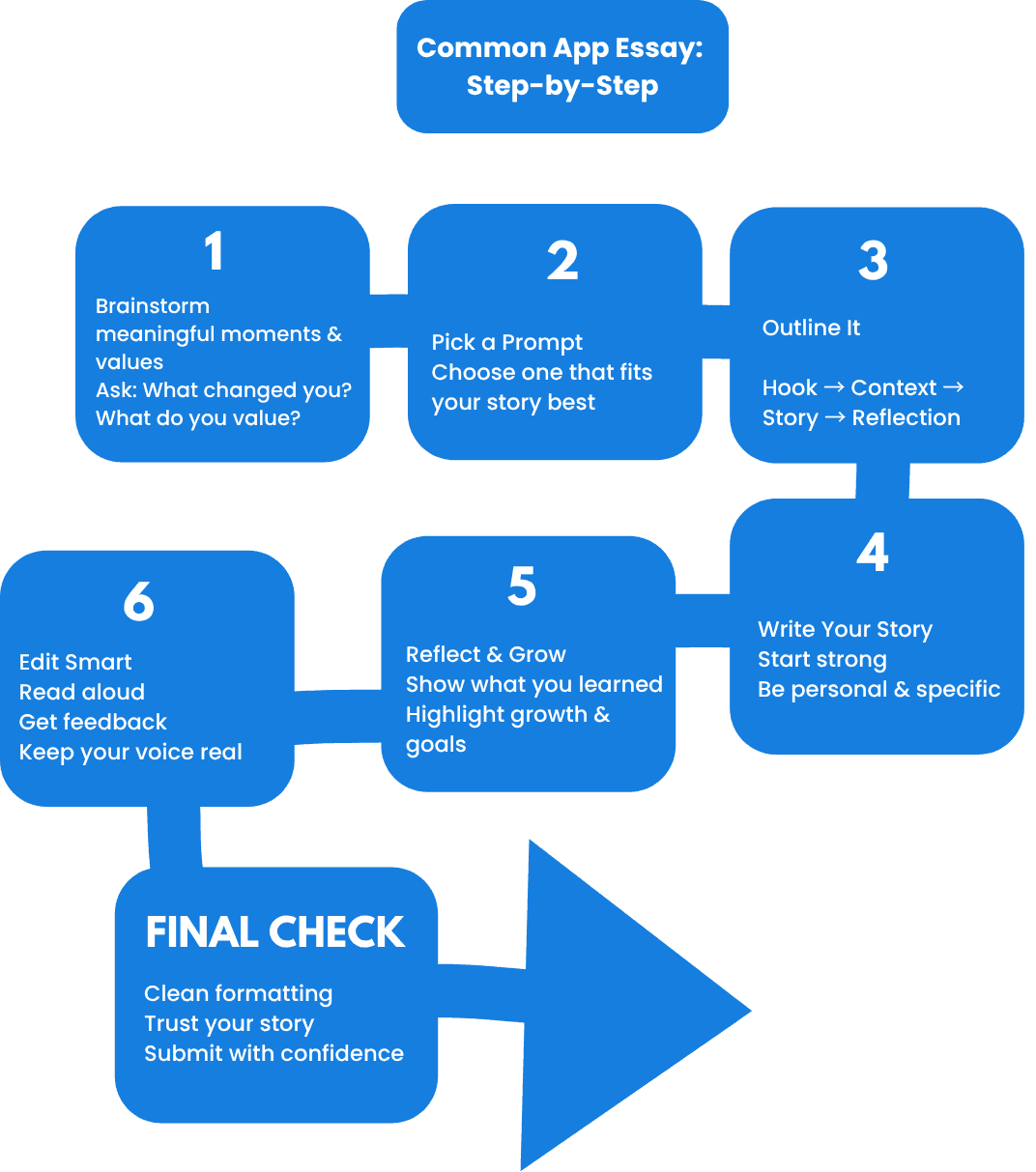
Now that you’ve seen what a strong Common App essay looks like, it’s time to start crafting your own! Writing your personal statement can feel like a big task, but breaking it down into smaller steps makes the process much more manageable—and even fun. Here’s a step-by-step guide to help you build an essay that’s not only well-written but truly you.
Step 1: Brainstorm Experiences and Values
Think about moments in your life that have shaped who you are. These don’t have to be dramatic or life-altering—they just need to be meaningful to you. Reflect on what you’ve learned, how you’ve changed, and what values guide you today.
Reflection Questions: – What experience changed you the most? – What’s a personal challenge you’ve overcome? – What do you value deeply, and why?
Step 2: Choose a Prompt That Resonates
Look through the current Common App prompts. Don’t overthink it—choose the one that gives you the most space to tell your story. If your story doesn’t fit neatly into one prompt, that’s okay. Go with the one that feels most natural.
Step 3: Outline the Essay Structure
Before jumping into writing, sketch a simple outline:
Hook (start strong!) Background/context The core of your story Reflection and takeaway This will help you stay focused and keep your narrative clear and compelling.
Step 4: Write a Strong Hook and Personal Story
Your opening should draw the reader in—consider starting with an image, a moment, or a surprising statement. Then, walk them through your experience, keeping the story personal and specific.
Step 5: Reflect and Show Growth
This is the heart of your essay. Admissions officers want to know how the experience changed you. What did you learn? How have you grown? How has this shaped your goals?
Step 6: Edit for Clarity, Tone, and Flow
Once you’ve got a draft, take a break and come back to it with fresh eyes. Read it out loud. Make sure it sounds like you. Ask someone you trust for feedback—and be open to revising! This is where your essay really comes to life.
Final Advice and Submission Tips
You’re almost there! Before you hit submit, here are a few final tips to make sure your essay is polished and powerful:
- Check the formatting. Use a simple, readable font and avoid odd spacing or formatting issues when pasting into the Common App.
- Read it out loud. You’ll catch awkward phrasing or repetition you might miss otherwise.
- Get feedback. Ask a teacher, counselor, or friend to read your essay. Be open to constructive criticism.
- Stay true to your voice. Don’t try to sound overly formal or perfect. Your authenticity is your strength.
- Submit with confidence. You’ve worked hard—trust that your story matters.
Next step
Planning a bachelor's application?
We support students from the first "what should I study?" to the day they arrive on campus, with strategy, application expertise, and global university insight.
See bachelor's guidanceKeep reading
Related guides
Want to find out more?
Message us on WhatsApp for a quick answer, or book a free consultation. No pressure either way.