
Essays & Interviews
Your Guide to Strengthening Your College Application: Essays, Interviews, and Personal Context
Additional Information section, the “Why This College?” essay, and the college interview question about your contributions to campus.
By the Zenith Education team

Additional Information section, the “Why This College?” essay, and the college interview question about your contributions to campus.
Each of these components serves a unique purpose: the Additional Information section lets you share personal context or achievements that don’t fit elsewhere; the “Why This College?” essay gives you space to connect your goals with a specific school’s offerings; and the interview question about campus contributions helps show what kind of community member you’ll be.
In this guide, we’ll walk you through how to approach each of these sections thoughtfully and strategically—so you can stand out for all the right reasons. Whether you're explaining a challenge, showing why a college is your perfect fit, or highlighting what you’ll bring to campus life, you'll find clear advice and examples to help you make your application shine.
Using the Additional Information Section Strategically
The Additional Information section of the Common App is a hidden gem. Used wisely, it allows you to provide crucial context—whether it's explaining academic disruptions, highlighting achievements you couldn’t fit elsewhere, or sharing unique parts of your journey. Handled poorly, though, it can come off as cluttered or repetitive. We’ll walk you through how to make it count.
Wait—What Is the Additional Info Section, and Where Do I Even Find It?
Before we get into the details of this section, let’s take a moment to explain what the Additional Information section is all about and why it’s important!
The Additional Information section is a little freeform text box on the Common App where you can share anything you’d like the admissions committee to know about you. This is your chance to include:
- Any extenuating circumstances that may have affected you.
- Achievements you’re proud of but didn’t get to highlight elsewhere.
- Context for any parts of your application that could use a bit more explanation.
Think of it as a way to give the admissions committee a fuller picture of who you are, your experiences, and your unique circumstances. It’s also an opportunity to clarify anything that might be unclear or incomplete in your application.
For example, did you face a significant medical issue that impacted your grades during a specific year? Or did you spend a lot of time outside of school working on a personal project or helping your family? This is the perfect place to share those important details!
To find the section, log in to the Common App website by clicking on the “Common App” tab. Next, head over to the sidebar and choose “Writing.” Just scroll down a bit past the “Personal Essay” section until you reach “Additional Information,” and give that a click. You’ll see a friendly question asking if you’d like to share any details about circumstances or qualifications that aren’t included in your application. Go ahead and select “Yes.” A text box will pop up for you to share what you need!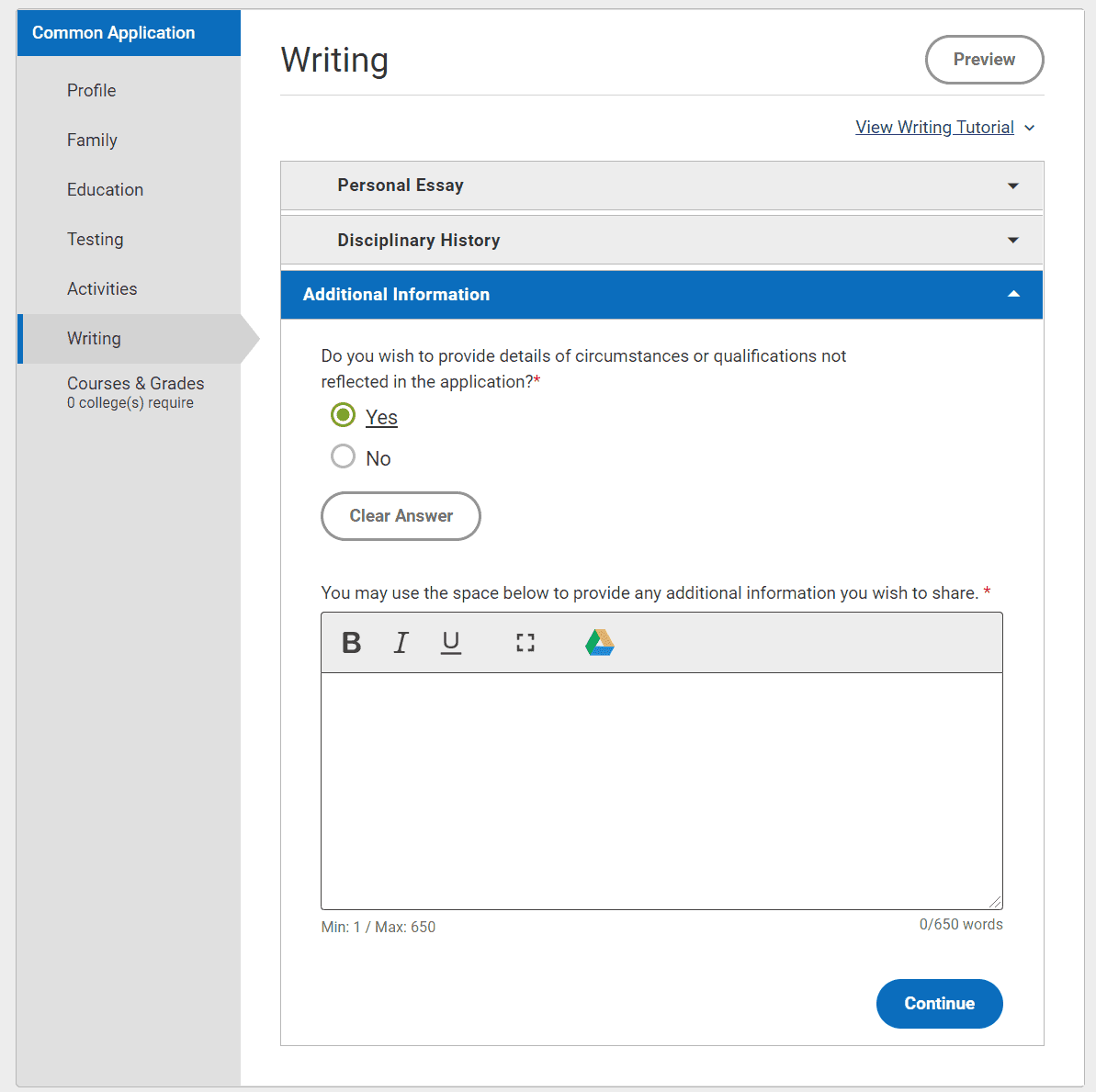
Just a reminder: as of 2023, you have the chance to share how COVID-19 has impacted you! If you select "Yes" to the first question, a helpful text box will appear for you to share your thoughts. We’d love to hear from you!
What’s Actually Worth Putting in the Additional Info Section?
Take a moment to view your application as a whole. Is there anything you feel is missing? Are there parts of your story that you’d like admissions officers to know about that don’t really fit into the other sections? This is your chance to share those important details!
Here are some ideas of what you might want to include in the Additional Information section:

Explaining Gaps in Your Academic Journey: If there are any important gaps in your academic history because of health issues, family matters, or other reasons, feel free to share those here.
Your Course Choices: Did you take some unusual or super challenging courses? This is your chance to explain what inspired those choices!
Standardized Test Scores: If your SAT or ACT scores don’t truly reflect your abilities, it’s helpful to give a bit of context. You can mention if you feel anxious about tests or if something challenging happened on test day.
Highlighting Academic Rigor: Have you engaged in learning experiences outside of your usual courses? This is the spot to share all the interesting things you’ve done!
Examples:
1. Online Courses: I completed "The Science of Well-Being" through Yale on Coursera. The course helped me explore cognitive science and psychology from an academic angle, which deepened my interest in how research can inform real-world well-being.
2. Academic Curriculum and Rigor: My school runs an Independent Study Program that allows students to design their own projects. I created a research project on urban climate resilience, which involved analyzing city heat data and proposing mitigation strategies. This project was reviewed by both my science and geography teachers. On my transcript, it appears as “ISP: Environmental Science,” and includes a notation that highlights interdisciplinary honors work.
Courses Taken:
- Astrobiology and the Search for Extraterrestrial Life – University of Edinburgh (via FutureLearn), completed August 2023, with Distinction
- Introduction to Data Science – University of Michigan (Coursera, May 2022), with final grade: 96%

Big Commitments: If you've been involved in some significant extracurricular activities that took up a lot of your time (like looking after a family member, running a business, doing research, or working on a personal project), this is the place to explain what you’ve been up to and how it’s impacted you.
Leadership Roles: If you’ve taken on leadership responsibilities in your activities, share more about what those roles entailed and why they were meaningful to you!
Example:
Community Tutoring Project:
I started a free weekend tutoring program at my local library for middle school students who needed academic support post-pandemic. What began as one-on-one math help evolved into a small team of high school volunteers I now coordinate. I also developed lesson plans and partnered with a local nonprofit to secure free school supplies for the students.
Music + Mental Health Advocacy:
As president of the music club, I organized “Mindful Music” sessions—live student performances during exam season aimed at reducing stress and promoting mental wellness. I collaborated with the school counseling team and led a fundraising effort to purchase calming instruments and create a wellness corner in our student center.

Life Challenges: If you've faced any personal hurdles that impacted your studies or extracurricular activities—like family issues or personal crises—this is a chance to share a bit about those experiences.
Diversity and Identity: Here is where you can highlight aspects of your background, identity, or experiences that add to your unique perspective and diversity.
Example
First-Generation College Student:
Navigating the college admissions process has been challenging since I’m the first in my family to apply to university. Without direct guidance at home, I’ve relied heavily on online resources, school counselors, and mentorship programs to understand everything from financial aid to application timelines.
Family Responsibilities:
For the past two years, I’ve helped care for my younger siblings after school while my parents work late shifts. Balancing schoolwork with these responsibilities has taught me time management and resilience, especially during exam periods when routines were unpredictable.
Notice how the student shares their struggles in a straightforward way while also taking charge of their journey to overcome these challenges!

When showcasing your impressive extracurriculars, remember to include them in both the Activities section and the Honors tab of the Education section. Here’s a chance to share a bit more details about your accomplishments!
For instance, if you’ve listed a research paper or major competition in the Activities or Honors sections, this section allows you to offer more depth—such as a summary of your work, the skills it involved, or the broader context behind it.
Example:
Historical Research Fellowship – Final Paper Summary Title: Borders and Belonging: Migration Policy and Identity in Post-War Europe
As part of a summer fellowship with the Center for Global History, I conducted independent research on European migration policy between 1945 and 1970. My paper explores how early post-war immigration laws in France and Germany shaped national identity narratives, especially in relation to former colonial populations. I examined primary sources, including policy documents, newspapers, and speeches from political leaders, to analyze how public discourse framed migrants either as economic contributors or cultural outsiders.
My research argues that these early narratives laid the groundwork for present-day integration debates. I presented my findings at the program’s closing symposium and am currently revising the paper for submission to a bachelor's policy journal.
What Not to Put in the Additional Info Box (Seriously, Don’t Do These)
The Additional Information section is a fantastic chance to add some extra flair to your application, but there are a few things to keep in mind. Serge Nader, the CEO of Zenith, encourages everyone to take a thoughtful approach when filling out this section. He suggests not treating it like a chance to write another long essay or list all your accomplishments. Instead, think about showcasing the achievements and experiences that really highlight who you are and the unique impact you've made. Remember, it's all about quality over quantity—keeping it compelling and personal will help you stand out!
Here are some tips on what to avoid
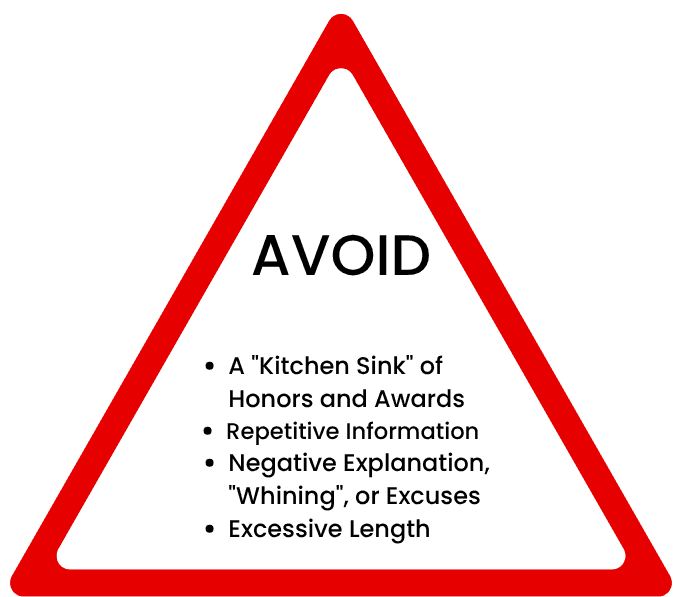
A “Kitchen Sink” of Honors and Awards
If you’ve achieved some impressive milestones like publications, major projects, or recognitions outside of school, save those for the Activities or Honors sections of the Common App. If they’re not included there, take a moment to think about why. Use the Additional Information section to provide context instead of introducing brand new information.
Repetitive Information
One common mistake is repeating details that are already in your application. Admissions officers have your transcript, extracurriculars, and awards in front of them, so you don’t need to say them again here. This is your chance to share something unique or to clarify a specific situation!
Negative Explanations, “Whining,” or Excuses
It’s okay to talk about academic or extracurricular challenges, but do so in a straightforward way. Try not to dwell too much on the negatives; instead, focus on how you’ve grown, bounced back, or what you’ve learned from those experiences. Admissions officers want to see how you’ve faced challenges head-on.
Excessive Length
Keep in mind that the Additional Information section shouldn’t turn into a long essay or a continuation of your personal statement. Admissions officers appreciate clear and concise content, so aim to keep your explanations simple and to the point without adding unnecessary fluff.
How Long Is Too Long? (And What’s the Sweet Spot)
Keep your Additional Information section to just one page, if possible! Admissions officers appreciate concise information, and anything beyond that might not get the attention it deserves.
Do I Really Have to Fill This Out? (Spoiler: Nope, Not Always)
You actually don’t need to worry about filling out the Additional Information section of the Common App! Feel free to leave it blank unless you have something very important to share. You can usually cover everything admissions officers need to know in the main sections of the application.
Crafting an Impactful “Why This College?” Essay and Acing the “What Will You Contribute to Campus?” Interview Question
The “Why This College?” essay—a deceptively simple yet critical prompt that asks you to connect your interests and values to what a particular school offers. Think of it like building a relationship: colleges want to know why you’ve chosen them and how you see yourself growing within their community.
The interview question “What will you contribute to campus?” is your chance to show you're more than just a strong student—you’re someone who will enrich the college environment. With the rise in holistic admissions, interviewers are looking for applicants who will engage actively, bring unique perspectives, and help build a vibrant, inclusive community.
We’ll help you answer these questions, avoiding vague clichés and instead crafting a response that’s genuine, specific, and memorable.

Cracking the Code: What Schools Want in Your “Why This College” Essay
Think of it like this: If your partner asks you, “What do you love about me?” you wouldn’t say something generic like, “Because you’re famous” or “Because you’re near the beach.” Instead, you’d share what makes your relationship special, highlighting how your unique personalities come together like a perfect team.
That’s exactly the mindset you should bring to your “Why This College?” essay. Colleges want to know two things:
- What makes their school special in your eyes?
- And how do you fit into that picture?
Instead of writing a generic love letter to the college, ask yourself:
- What do I really hope to gain from this school—academically, personally, or professionally?
- What can I bring to this campus that’s unique to me?
- What opportunities (programs, professors, clubs, resources) am I truly excited about?
- How can my past experiences and strengths help me thrive—and help others—once I’m there?
Think of this essay as your bridge to the school—a space where you can show admissions officers why this match makes sense, and why it matters to you.
Curious What the “Why This College” Essay Looks Like? Here’s a Peek
The prompts for the "Why This College" essay can differ from one school to another. Here are a few examples you might run into:
NYU:
- We would like to know more about your interest in NYU. What motivated you to apply to NYU? Why have you applied or expressed interest in a particular campus, school, college, program, and or area of study? If you have applied to more than one, please also tell us why you are interested in these additional areas of study or campuses. We want to understand – Why NYU? (400 word maximum)
Schools like NYU provide a bit more direction in their prompts, helping you know what categories to discuss. With more space, you can dive deeper into each point they want you to cover!
University of Michigan:
Describe the unique qualities that attract you to the specific bachelor's College or School (including preferred admission and dual degree programs) to which you are applying at the University of Michigan. How would that curriculum support your interests? (550 words)
Michigan’s prompt focuses heavily on how their specific programs align with your goals. This is a great chance to connect your academic passions to what the university offers.
Boston University:
What about being a student at BU most excites you? (250 words)
BU keeps the prompt concise, encouraging you to reflect on what aspects of the student experience you’re most drawn to—from academics to culture to location.
Why This Essay Isn’t Just a Box to Check
Colleges review applications using a holistic approach, which means they look at many aspects of your application: academic performance, standardized test scores, letters of recommendation, and extracurricular activities.
The “Why This College?” essay adds a personal touch that numbers can’t convey. It's your chance to show off your personality, dreams, and how you’d fit into the college community. This is your opportunity to shine and explain why you’re a unique addition to their campus!
Inside the Minds of the Admissions Committee
To really nail your “Why This College?” essay, try to put yourself in the shoes of the admissions committee. They’re not just going through a pile of applications—they’re forming a vibrant and diverse class! They want to find students who will succeed academically and enrich the campus culture.
Keep in mind that this essay is about what you can bring to the college, as well as what you hope to gain from it. Imagine you’re chatting with the admissions committee, convincing them that you’d be a fantastic fit for their school.
The Secret Sauce for a Standout “Why This College?” Essay
If there's one important takeaway from all this, it’s this: Your essay should be more than just a compliment list for the school or another rundown of your achievements. Instead, it’s about highlighting who you are and what the college offers align beautifully together. Have fun with it, and let your true self shine through!
Why Do Colleges Even Ask What You’ll Contribute?
Just like the classic college interview question, “tell me about yourself,” when interviewers ask, “What would you contribute to your future college campus community?” they really want to learn what makes you special! Whether you’re aiming for Ivy League schools or colleges that are easier to get into, remember that competition is tough out there. Having good grades and great extracurriculars is important, but it’s not the whole picture.
Understanding why they ask about your future contributions can really help you prepare a strong answer. This question is all about figuring out how you’ll fit in and add to the college experience. Admissions officers are excited to see how enthusiastic you are to engage in campus life and what role you envision for yourself in their community. In fact, even if your GPA isn’t perfect, shining in this question can give you a great shot at getting into some colleges! So, make sure to let your personality and passion come through!
Research: Your Secret Ingredient for a Memorable “Why This College?” Essay and “How Will You Contribute to Your Future College Campus Community?” Answer
Let’s be real—admissions officers have seen all kinds of essays and heard all kinds of answers, and they can spot generic ones from a mile away. Relying on tools like ChatGPT won’t cut it, and nothing shows a lack of interest more than vague, recycled responses.
Now that you’re aware of why admissions committees ask about why you chose them and your future contributions to the campus community, it’s time to dive into preparing for your replies!
To craft a truly engaging essay, you need to dive into what makes the college special—the culture, values, and unique opportunities it offers. Additionally, your interview answer should reflect your unique personality, but we suggest one primary approach: Research.
How to Do College Research Without Falling Asleep
Level 1: Beginner Tips
1. Check Out the College Website: Start your journey by visiting the official college website. It’s a treasure trove of details about academic programs, faculty, campus facilities, mission statements, and the values the school stands by. Make notes on what catches your eye! Just remember, it’s not about copying this info verbatim in your essay—think of it as a springboard for your ideas.
2. Take Virtual Tours and Attend Webinars: If you can, nothing beats seeing a college in person! But if that's not possible, don’t miss out on virtual tours! They’re a fantastic way to get a taste of campus life, student experiences, and what the college is all about. Try resources like:
- The “A Day in the Life” YouTube series from top colleges
- CampusTours
- Tours directly on the college website
3. Chat with Current Students and Alumni: If you have a chance, reach out to current students or alumni. Many colleges have friendly representatives who love to talk to prospective students. Just check their website or give them a quick call to learn how to connect with them!
4. Read Student Reviews: Websites like Niche and College Confidential have real student reviews and discussions. These can give you a feel for what students think. Just remember to keep an open mind and take their opinions lightly!
Level 2: Advanced Tips
1. Search for Unique Courses: Type in “unique courses at [university name]” on Google. For instance, if you're a word game lover, Princeton offers a course called “Wordplay: A Wry Plod from Babel to Scrabble.” Or maybe you’re a champion procrastinator—then UPenn’s “Wasting Time on the Internet” could be right up your alley!
2. Discover University Traditions: Look up “[university name] traditions.” You might find fun things like University of Oxford’s May Morning or University of Chicago’s Scav Hunt. While it’s not wise to base your whole essay around these, they can inspire you and help you represent the school’s character!
3. Give the Admissions Office a Call: Seriously, don’t hesitate to call! You can chat with someone who might answer your questions or even end up reading your application. Just make sure to ask thoughtful questions that reflect your personal interests instead of the basics you can easily find online.
4. Find a Course Syllabus: If you dig around a bit, you may find a syllabus for a course at the school. Mentioning something specific from it could really add a nice touch to your essay.
Taming the Chaos: A Simple Way to Organize Your Research

As you gather all this great information, organizing it will make your life so much easier! Try categorizing your research into the following areas:
Academics
- Majors & minors
- Cool academic programs
- Professors you’d love to learn from
- Research or internship opportunities
- Teaching style or class size info
Campus Life
- Clubs, sports, and orgs you’d join
- Fun campus traditions or events
- Student facilities (gyms, libraries, labs, etc.)
- What the student community is like
Location & Surroundings
- Where the school is and what’s nearby
- The weather (seriously—it matters!)
- Proximity to cities, nature, or work opportunities
- Local culture or things to do off campus
Admissions & Financials
- Acceptance rate + average test scores
- Application requirements + deadlines
- Financial aid and scholarship info
What Makes It Stand Out
- Unique programs (like Honors or Study Abroad)
- Notable alumni or famous traditions
- Social impact, sustainability, or global programs
Your Personal Take
- Your first impressions from a tour or virtual session
- Notes from chatting with current students or alumni
- How the campus “felt” to you
- What made you smile, pause, or get excited
How to Keep It All Together
- Google Doc or Word Doc: Create one doc per school, and use headers + bullet points to sort your thoughts.
- Spreadsheet: If you’re a columns-and-rows person, make a sheet with your categories and compare schools side by side.
- Color Code It: Assign each category a color to highlight key info across your notes.
- Folder System: Set up a folder for each college and stash files, screenshots, and resources inside.
- Note-Taking Apps: Apps like OneNote or Notion let you build digital notebooks that keep everything searchable.
- Binder (Yes, Old School!): Prefer paper? Use dividers for each school and category—perfect for printed brochures and handwritten notes.
With this organized approach, you’ll have a clear overview of all the colleges you’re interested in, making it a breeze to reply to any question thrown at you.
How to Figure Out What You Bring to the Table
After researching the Campus Community, there are two steps to take:
Reflecting on Your Unique Contributions
Once you have a grasp of the college’s core values, take some time to reflect on your own passions and talents that align with those values. Think about why you chose this school and what special contributions you can make. You may have already started this thought process while writing your Common App essay, so revisit those notes for ideas!
It’s important to share your achievements, but also think about how they translate into what you can do on campus. For instance, if you’ve been involved in community service, share how you plan to continue that work through student groups at the college. By linking your past experiences to future contributions, you show that you’re ready to make a positive impact!
Don’t forget to balance personal stories with broader relevance! While specific details are important, make sure to highlight how your contributions will benefit the wider campus community.
Rehearsing and Perfecting Your Delivery
Now it’s time to practice your delivery! Engage in mock interviews with friends, teachers, or mentors to refine your response and ensure it feels natural. Ask for feedback to enhance clarity and impact. You don’t want to sound robotic by memorizing a script—focus instead on key points you want to get across. Keeping your answer around two minutes can help maintain the interviewer’s interest. With some practice, you'll be ready to deliver a confident and memorable answer!
When answering the question “What will you contribute to your future college community?”, start by expressing your interests or skills and connect them to opportunities on campus. For example: “In high school, I was deeply involved in our literary magazine, and I’m excited to contribute to the creative writing scene at X University by joining the student-run journal.” Include specific details, like, “I’ve read several issues of the journal and love how it uplifts diverse voices—something I care deeply about as a writer focused on underrepresented perspectives.” Wrap it up by saying, “By contributing to campus publications, I hope to help foster a more inclusive and expressive community at X University.”
Lastly, consider working with a college advisor to boost your chances in the interview. They can help conduct realistic mock interviews, provide personalized feedback, and share tips that will make you feel even more comfortable during the process.
“How Will You Contribute to Your Future College Campus Community?” Sample Answer
One of the things that excites me most about attending X University is the chance to be part of a community that values creativity, collaboration, and diverse perspectives. I’ve always believed that what you bring to a community matters just as much as what you take from it, and I’m eager to contribute in ways that reflect who I am.
In high school, I co-founded a student-run podcast club. At first, it was just a fun idea between friends who loved storytelling. But it quickly grew into a platform where students could share personal experiences, cultural traditions, and even interview local leaders about issues that mattered to us. Our most listened-to episode featured an open discussion about mental health, and it sparked real conversations in classrooms and hallways afterward. That experience taught me how much people crave connection and authenticity—and how small efforts can make a real impact.
I plan to bring that same spirit to X University. Whether it’s starting a creative media project, organizing student panels, or simply being the person who asks thoughtful questions in class, I want to be someone who encourages others to speak up and share what makes them unique. I also look forward to joining student organizations that focus on media, cultural dialogue, and social impact.
To me, contributing to campus life means being open, curious, and willing to build something meaningful with others. I’m excited to find those late-night conversations, spontaneous collaborations, and shared goals that make a campus feel like a true community.
Want a Killer “Why This College?” Essay? Start Here
Before you get lost in research, think about these two guiding questions:
Question 1: “What makes the school special in your eyes?”
Every college has its own vibe. Your job is to figure out what really grabs your attention—something that makes you think, “Yes, I can see myself here.” Maybe it’s a unique major, a one-of-a-kind research center, an awesome campus tradition, or a professor doing work you admire. Whatever it is, make it personal. Colleges want to know: Why us, specifically? Not just because they have “great academics” or “study abroad”—but because there’s something irreplaceable about them for you.
As Serge points out, “Colleges want to know what’s irreplaceable about them in your eyes. General answers like internships or study abroad won’t stand out—they’re too common. What are you excited about that you can’t find anywhere else?”.
Once you nail down that question, move on to the next.
Question 2: “How will this help me grow into who I want to be?”
Don’t just list cool features—show why they matter. Think about your goals, interests, and the kind of student (and person!) you’re becoming. How will this program, experience, or environment push you forward? Help you stretch, explore, or level up? That’s what admissions officers want to see: how their school fits into your story.

Example: A Winning “Why Columbia” Essay
Let’s look at how one student beautifully answered both questions in their “Why Columbia” essay:
“Curiosity and discipline have shaped my academic identity, and at Columbia, I would be able to expand both through immersive research and dialogue. The interdisciplinary nature of the Data Science Institute excites me—I want to explore how predictive models can be applied ethically in public policy and urban planning. Columbia’s unique Urban+Social Policy concentration, combined with opportunities like the Columbia Bachelor's Scholars Program and proximity to real-world data in New York City, would allow me to work on pressing urban issues firsthand. I hope to join a community that views learning not only as scholarship, but as civic action.”
Question 1: “What makes the school special in your eyes?”
This student shines a light on Columbia's interdisciplinary strengths, especially with the Data Science Institute and its emphasis on practical applications. The Urban+Social Policy concentration is such a unique program that isn't widely available at many other schools. Plus, being in New York City means students have access to real urban data and current policy challenges right at their doorstep! They also show their familiarity with the Columbia Bachelor's Scholars Program, signaling how deeply they’ve researched what the university has to offer.
Question 2: “How will this help me grow into who I want to be?”
In their essay, the student warmly introduces themself as both curious and disciplined—qualities that fit perfectly with Columbia's challenging academic atmosphere. They are not just interested in studying data science; they are excited about using it to tackle real-world urban and ethical issues, demonstrating their eagerness to make a difference beyond the classroom. Rather than merely learning for the sake of it, they want to take action! They wrap up with a beautiful idea of learning as “civic action,” showing that Columbia’s educational approach aligns beautifully with their vision for the future.
Thorough research is key to writing an engaging "Why This College?" essay. Use these two questions to guide your focused exploration of your chosen school!
Creating a List That Makes Your Essay 100% You
Let’s talk about being “personalized!” After you’ve done some good research, try to come up with at least three heartfelt reasons for wanting to attend this particular school. If you can’t think of any, it might be a sign to reconsider your application!
So, jot down your unique reasons for choosing this school, and then you can start building your essay around those ideas.
A Simple Game Plan for Your “Why Us?” Essay
Writing your "Why This College?" essay is a fantastic opportunity to show how your personal and academic dreams connect with what the college offers. Admissions officers are excited to hear you explain why you think this college could be the perfect place for you to grow and succeed. Be sure to mention specific programs, classes, or cool opportunities that the college provides and how they relate to your goals. Whether it’s access to amazing professors, state-of-the-art research facilities, or unique extracurricular activities, spotlight the things about the college that make it so special for your future.
Here’s a suggestion for how to put your essay together:
1. Start off by sharing why you’re interested in this particular college.
2. Next, include some details about what caught your attention about the college. Share a couple of reasons why it feels like a great match for your interests and aspirations.
3. Wrap it up by explaining why you would be a fantastic addition to the college community.
Make sure your essay flows well and is to the point. Offer authentic reasons why this school matches your talents and dreams. With some thoughtful planning and a bit of research, you can create a standout essay that really helps your application shine!
How to Hook Your Reader in the Introduction of the "Why This College" Essay

Admissions officers love essays that grab their attention right from the start. You want them eager to learn more about you! Here are some strategies to kick off your essay:
1. Share a Personal Story: Start with a brief, personal experience that relates to your interest in the college. It could be a moment that sparked your curiosity or when you realized that the college's unique offerings matched your dreams.
Example: "When I visited King’s College in Cambridge, something just clicked. I remember walking through the courtyard and watching students debate over coffee. It felt like the kind of place where I could grow—academically and personally."
2. Use a Relevant Quote: Sometimes, a well-chosen quote or an interesting fact can make for a delightful opening. Make sure it connects directly to your reasons for choosing the college.
Example: "Education is the most powerful weapon which you can use to change the world." – Nelson Mandela. That quote stayed with me as I learned about UCT’s commitment to social justice and innovation in post-apartheid South Africa. I see myself not just studying at the University of Cape Town, but contributing to its mission of meaningful change.”
3. Pose a Thought-Provoking Question: Engage your readers with a question that makes them think and relates to your aspirations and the college. This encourages them to reflect on the question and look for answers in your essay.
Example: “What if the place where you study could also be the place that shapes who you become?”
This student continues to recount the experience that clarified their desire to study architecture and connects it to specific aspects of Cornell’s fantastic architecture program.
“Why This College” Essay: What to Do—and What to Avoid

What to DO:
- Connect Your Goals and Values: It’s important to link your personal aspirations with the college’s mission. Talk about how the school's commitment to diversity, community service, or other values speaks to you. Share your own experiences that show your dedication to these beliefs!
- Share Your Academic Goals: Let the college know how your intended major fits in with what they do best. This is a great way to show that you’ve done your homework!
- Highlight Your Growth Journey: Discuss how the unique opportunities at this college can help you grow both personally and academically. Whether it’s through research, leadership programs, or being part of a lively campus community, explain how these experiences will shape you.
- Mention Specific Programs or Professors: Don’t hesitate to bring up particular courses, programs, or professors that excite you. Mention any innovative projects, inspiring faculty, or unique interdisciplinary courses that really caught your eye!
- Talk About Extracurriculars: This is your chance to express which campus groups you’re looking forward to joining. Share your interests in clubs or organizations and how you envision contributing to campus life. Admissions teams love to see your excitement about getting involved.
- Highlight Special Opportunities: If there are specific internships, research projects, or study abroad programs that you find appealing, mention them! Explain how these experiences can make your educational journey even richer.
- Show Knowledge of Resources: Share how specific libraries, research centers, or academic support services can benefit your studies. It shows that you’re thinking ahead!

What to AVOID:
- Skip the Generic Stuff: Avoid discussing the school’s size, location, or weather. Lots of schools have these features, so focus more on what makes this college special to you!
- Stay Clear of Vague Statements: Instead of using general phrases like "esteemed institution," be specific! It adds authenticity and shows your genuine interest in the school.
- Ditch the Clichés: Try to steer clear of phrases like "dream school" or "once-in-a-lifetime opportunity." Share your unique stories and connections instead—this will make your essay stand out!
- Don’t Just Focus on Prestige: It’s great to acknowledge the school’s reputation, but make sure to also express your excitement about what the college offers beyond rankings. Dive into the specific details that matter to you.
- Avoid Repeating Yourself: Make sure not to restate things that you’ve already mentioned in other parts of your application. Every word counts, so keep things fresh!
- Take the Time to Edit: After writing, don’t forget to proofread. Catching typos and errors can make a big difference! You might even want a friend to review it for you.
Your Takeaway Tips
Every part of your college application is a chance to tell your story—but a few sections give you extra space to really make it personal. Whether you’re filling out the Additional Information section, writing a thoughtful “Why This College?” essay, or preparing to answer the classic interview question about what you’ll bring to campus, the goal is the same: show who you are, what you value, and why you belong in that school’s community.
The Additional Information section is there to support your story—not repeat it. Use it to highlight context, challenges, or achievements that might not fit elsewhere. It’s a powerful tool, but it’s totally okay to leave it blank if you’ve already shared what admissions officers need to know.
The “Why This College?” essay is your opportunity to connect your goals with what a specific school offers. With some research and reflection, you can craft an essay that not only shows why the college is right for you—but also why you’re right for them. It’s also a great way to figure out what you truly want in a school and make sure your choices match your dreams.
And when it comes to interview questions like “What will you contribute to campus?”, keep your answer honest and hopeful. Show that you’ve thought about your role in a college community—how your experiences, interests, and personality will add something meaningful to the life of the school.
In the end, the strongest applications come from students who know themselves and aren’t afraid to share that. Be specific. Be sincere. And most of all—be you.
Next step
Planning a bachelor's application?
We support students from the first "what should I study?" to the day they arrive on campus, with strategy, application expertise, and global university insight.
See bachelor's guidanceKeep reading
Related guides
Want to find out more?
Message us on WhatsApp for a quick answer, or book a free consultation. No pressure either way.