
Destinations & Planning
Studying in France: From Parcoursup to Prestigious Programs
Parcoursup is your go-to platform for navigating higher education opportunities in France! With over 19,500 post-baccalaureate programs listed, it’s all about making the application process smoother and more streamlined for you.
By the Zenith Education team

Parcoursup: Your Gateway to Higher Education in France
What Exactly Is Parcoursup—and Why Should You Care?

Parcoursup is your go-to platform for navigating higher education opportunities in France! With over 19,500 post-baccalaureate programs listed, it’s all about making the application process smoother and more streamlined for you. Whether you’re looking at selective programs like preparatory classes or prestigious Instituts d’Etudes Politiques, or non-selective university degrees, there’s something for everyone.
Each program features its own card that you can explore via a handy interactive map, complete with search and filtering options to help you find the perfect fit. Think of Parcoursup as the bridge connecting you to the educational programs you’re interested in. You’ll create a profile that admission panels can review when you choose the programs you want to apply to.
Just a friendly heads up: Parcoursup is focused on the application and admission stages. Once you’re accepted, any administrative registration will happen later, directly with the institution. Happy exploring!
Parcoursup Timeline: What to Know and When to Do It
Here’s What You Need to Know:
- First things first, you’ll want to create an account on the Parcoursup platform to get started.
- You can choose up to 10 programs that you’re interested in, along with an extra 20 “sub-wishes” for even more options!
- Don’t worry—your wish list is private, so universities and program directors won’t see what you’ve picked.
- Also, keep in mind that there’s no ranking among your choices; they’re all equal!
Mark These Dates on Your Calendar:
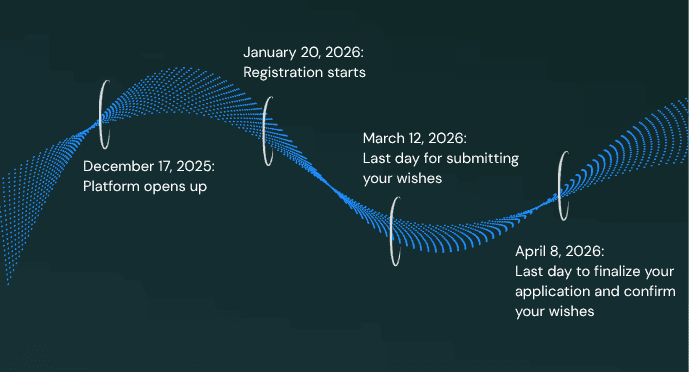
- December 17, 2025: The platform opens up! You’ll be able to explore all the detailed info about the courses available.
- January 20, 2026: Registration officially starts. Time to enter your wishes!
- March 12, 2026: This is the final day for submitting your wishes. After this date, you can’t change your choices, but you can still tweak your application materials like letters and essays.
- April 8, 2026: This is the last day to finalize your application and confirm your wishes.
How Will Universities Look at Your Application?
When it comes to evaluating your application, universities will consider:
- Your high school report card, including your grades and teacher evaluations.
- Your “fiche avenir,” which features a general assessment from your school head.
- Your five application essays, which should include your educational plans.
Just a heads-up: some special programs might also ask you to complete additional tests, like English proficiency tests (TOEFL, IELTS), competitive exams (ACCESS, Sesame), or even interviews to discuss your motivation.
You’ve got this!
Let’s Break Down the Parcoursup Application Step by Step
The Parcoursup application is made up of four main sections that we want to walk you through:
1) My Profile: In this section, you’ll enter or double-check your personal details, like your name, marital status, contact information, and who your legal representatives are. If applicable, don’t forget to fill out the sections on “Scholarships,” “Disability/Special Needs,” or “Athlete/Artist.”
2) My Schooling: Here, you’ll showcase your academic journey so far, including your high school transcripts from the last two years. You’ll also provide a summary of your advanced or elective courses, along with any predicted or completed exam results, such as A-Levels, IB scores, AP results, or other national qualifications. Generally, you won’t need to make changes, but it’s a good idea to review for any mistakes.
3) My Activities: This part includes four short essays (up to 1500 characters each) on topics that allow you to shine:
- “My experience in management or leadership”
- “My civic engagement”
- “My professional experience”
- “Openness to the world – sports and cultural practices, specific backgrounds”
Take your time crafting these essays since they’ll be read by the admission committees after they look at your academic results.
4) My Wishes: In this section, you’ll find an interactive map to explore and add your academic preferences. To make a wish official, you’ll need to write a personalized essay called the “projet de formation otive” (one for each wish) that’s also 1500 characters long. These essays are important, so be sure to put in the effort to make them stand out!
5) Extra Elements for Specific Procedures: Some programs may ask for additional materials, such as:
- Self-evaluation questionnaires for law and science bachelor’s programs, featuring around 25 multiple-choice questions designed to gauge your knowledge about the course you’re eyeing. For law, for instance, questions might cover spelling and your understanding of political and legal systems (like election dates and the number of deputies in parliament).
- English tests like TOEFL/IELTS, which are mandatory for some international programs, such as those at Dauphine London or Madrid.
- Additional essays for certain programs, such as social issue essays for the IEP (Instituts d’Études Politiques) or specific DUTs.
- Cover letters of 4,000 characters or more are required by some selective preparatory classes (like Stanislas, Sainte Geneviève, and Saint-Louis de Gonzague). These letters are a big deal, so you’ll want to write them carefully! You can usually find specific guidelines on the websites of these prep schools.
How Many Programs Can You Apply To? (Hint: It’s More Than You Think)
You can apply for up to 10 programs on Parcoursup, but the good news is that you can actually apply to way more than 10! Some programs have “sub-wishes,” which means you can choose multiple options under one main wish. For example, if you choose the “Prépa ECG” wish for commercial preparatory courses, you can list up to 10 different preparatory classes as sub-wishes. Since you can have a total of 20 sub-wishes, you could even apply for both business and engineering prep schools by picking 10 sub-wishes for each!
There’s also a fun feature called “multiple wishes” that lets you apply to several programs using just one wish, and the best part is that these won’t count against your 20 sub-wish limit! For instance, the “Concours Sésame” wish is a great option, allowing you to apply to up to 50 programs with just one wish. The same goes for the “PASS IDF” wish for medicine! So, you have plenty of exciting options to explore!
What Do Schools Actually Look at on Parcoursup?
The way applications are ranked can vary quite a bit from one program to another. Each program has its own criteria and assigns different weights to various elements, and they choose either to review applications automatically or by hand on a case-by-case basis, depending on their process.
Typically, the automatic review uses the decision support tool from Parcoursup, but some programs might use different methods to rank their applications. Manual reviews usually happen later in the process, either after an initial screening or for programs that receive fewer applications.
Your application is very important—it’s the centerpiece of your evaluation. It’s the main thing that gets assessed, unless you’re applying to certain selective courses that require additional written or oral exams, like Sesame, ACCESS, Avenir, or Parallèle.
1° Grades as the first filter
Your school grades will be the first thing reviewed. By looking at your grades, you’ll get through that initial screening. Keep in mind that your grades will be weighted based on which subjects matter the most for the program you’re applying to.
2° The “fiche avenir” and essays
After your grades, the assessments on the “fiche avenir” and your essays come into play. These elements are what help distinguish candidates who have similar academic backgrounds. Just a heads-up, these parts can be essential for certain courses and might even matter as much as your grades. For example, at Sciences Po or in some competitive double degree programs, your application essays are given a lot of attention and can play a big role in the selection process.
Nailing Your “Projet de Formation Motivé”: 5 Tips for Success
Creating a well-thought-out educational plan is important to support each of your choices on Parcoursup. So, you’ll want to put together a training proposal for every wish, keeping it to a maximum of 1500 characters. This is your chance to showcase your skills, enthusiasm, and how your academic or professional goals align with the program you’re aiming for!
At Zenith, we believe that writing this essay can be guided by five tips:
1. Highlight What Makes Each Program Special: Take some time to research each program’s unique features and mention them in your text. This shows the jury that you’ve done your homework!
2. Showcase Your Unique Qualities: Think about what sets you apart from other candidates, like your achievements, internships, or special skills. It’s all about standing out in a crowd!
3. Share Your Career Aspirations: Even if you’re still figuring things out, mentioning your career goals helps the jury see that your plan has a clear direction.
4. Organize Your Thoughts: With just 1500 characters to work with, make sure your ideas flow logically and clearly. A well-structured essay makes a big difference!
5. Keep It Simple and Clear: There’s no need for fancy words or complicated phrases. A great essay is straightforward, concise, and written in clear, proper French.
What Happens After You Hit Submit? Here’s the Next Step
Once your application has been approved, it’s time for the next exciting phase of Parcoursup! Here’s the timeline you’ll want to keep in mind:
- June 3, 2026: Get ready! This is when you start receiving your first responses.
- June 11, 2026: The complementary phase kicks off. You’ll have the chance to express up to 10 new wishes based on the spots that are still open.
- July 8, 2026: This date marks the end of the main phase. It’s your moment to pick one of the admission offers and complete your registration at the school.
- September 13, 2026: The complementary phase wraps up, and if you haven’t received an offer yet, this is when you’ll get your final admission proposals.
Zenith Has Your Back from Start to Finish
At Zenith, we’re here to make your Parcoursup application journey smooth and enjoyable! Our friendly team of experts in bachelor's admissions is ready to support you every step of the way. Here’s what we’re happy to offer:
- Help you choose your 10 wishes and sub-wishes with confidence
- Guidance on writing your application essays that really shine
- Support with all the necessary administrative tasks
- Intensive preparation for any exams that might be required
- Coaching to ace your motivation interviews
Let’s work together to make your application stand out!
The ACCÈS Exam: Your Gateway to Top Business Schools in France
Why the ACCÈS Competition Could Be Your Big Break

If you’re looking to enter a post-bac business school in France, the ACCÈS competitive entrance exam is one of the main ways to do it, and it’s part of the Parcoursup platform! This is a great opportunity for final-year students who want to join the prestigious Grande École programs at three fantastic institutions:
1. IÉSEG – often seen as the top choice for post-bac schools in France
2. ESSCA
3. ESDES
The exam is split into two parts: first, there are written tests, and if you qualify, you’ll move on to the oral exams. Plus, if you’re interested in studying in English or want to pursue a double degree, you can check out exciting options like IÉSEG’s “International Business and Law” program.
ACCÈS in a Nutshell: How It Works
Here are five things you should know:
- If you’re looking to apply, make sure to head over to Parcoursup and choose the “Concours ACCES” wish.
- The great news is that the ACCES competition lets you apply to three different schools, but it only counts as one wish. How convenient is that?
- Each year, around 6,500 hopefuls apply for just 2,400 spots, so make sure you stand out!
- In terms of acceptance, you have about a 7.62% chance at IESEG and around 41% at ESSCA, but keep your spirit high!
- Remember, the jury won’t look at your academic record; they’ll only focus on how well you do on the written exams.
Here are some key dates to mark on your calendar:
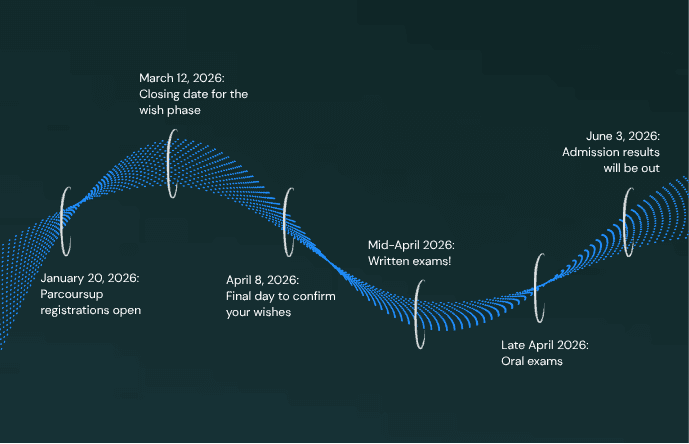
- January 20, 2026: Parcoursup registrations open, and you can start making your wishes known—exciting times!
- March 12, 2026: This is the closing date for the wish phase. After this, you won’t be able to change your wishes, but you can still update your application materials like motivation letters and essays.
- April 8, 2026: The final day to confirm your wishes and wrap up your Parcoursup file is here!
- Mid-April 2026: Get ready, it’s time for the written exams!
- Late April 2026: Oral exams are around the corner—good luck!
- June 3, 2026: The moment of truth! Admission results will be out, so stay tuned!
Step-by-Step: Completing Your ACCÈS Application on Parcoursup
The Parcoursup application is made up of four main sections that we want to walk you through:
1) My Profile: In this section, you’ll enter or double-check your personal details, like your name, marital status, contact information, and who your legal representatives are. If applicable, don’t forget to fill out the sections on “Scholarships,” “Disability/Special Needs,” or “Athlete/Artist.”
2) My Schooling: Here, you’ll showcase your academic journey so far, including your high school transcripts from the last two years. You’ll also provide a summary of your advanced or elective courses, along with any predicted or completed exam results, such as A-Levels, IB scores, AP results, or other national qualifications. Generally, you won’t need to make changes, but it’s a good idea to review for any mistakes.
3) My Activities: This part includes four short essays (up to 1500 characters each) on topics that allow you to shine:
- “My experience in management or leadership”
- “My civic engagement”
- “My professional experience”
- “Openness to the world – sports and cultural practices, specific backgrounds”
Take your time crafting these essays since they’ll be read by the admission committees after they look at your academic results.
4) My Wishes: In this section, you’ll find an interactive map to explore and add your academic preferences. To make a wish official, you’ll need to write a personalized essay called the “projet de formation otive” (one for each wish) that’s also 1500 characters long. These essays are important, so be sure to put in the effort to make them stand out!
For this process, just pick the option “Concours ACCES” and then you can choose the schools you’d like to apply to as your sub-selections.
Feel free to reach out if you have any questions or need help with any of these sections!
Breaking Down the Written Tests (And How to Tackle Them)
The written exams are a vital part of your application process—think of them as the key to unlock the door to the oral exams. Your results from these exams determine your eligibility for the next round, so doing your best is essential!
The competitive entrance exam includes several tests that are standard across all schools, but keep in mind that the importance of each test, known as the “coefficients,” can vary from one school to another. Here’s a quick look at how they stack up:
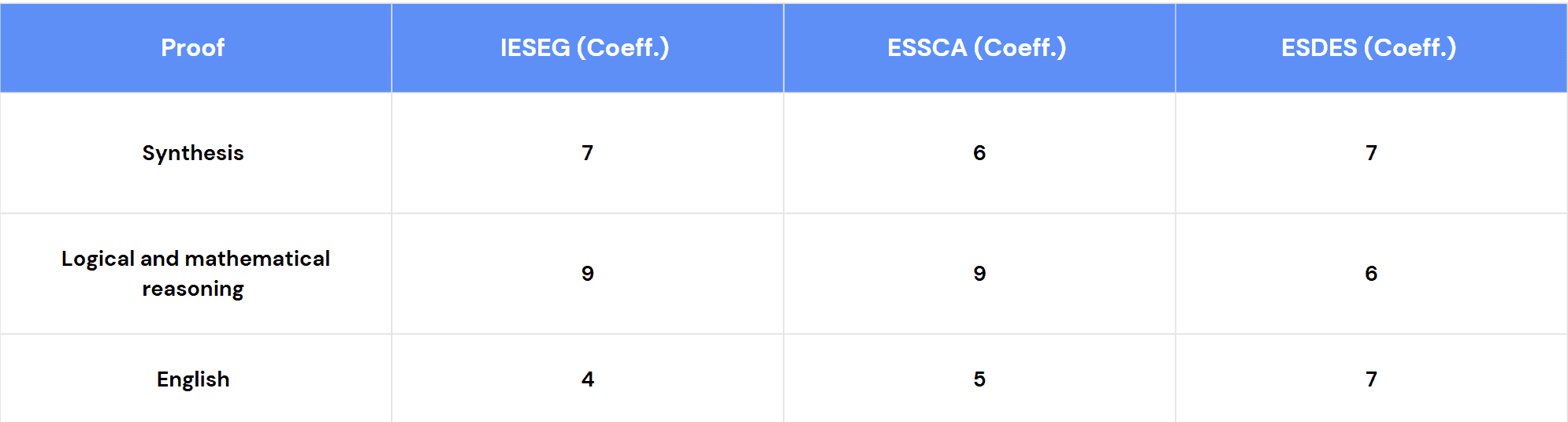
- Synthesis Test
This test is all about your ability to craft a summary. You’ll have three hours to write a 350-word summary based on a collection of 12 documents—these could include texts, drawings, or graphs—centered on a relevant or interesting topic. The focus here isn’t on academic knowledge, but rather on your comprehension, written expression, and ability to synthesize information. The goal is to create a cohesive overview of the documents instead of merely summarizing each one.
2) Logical and Mathematical Reasoning
In this section, you’ll show off your understanding of basic math concepts from high school and how you can apply them to practical exercises. The test covers a variety of topics like functions and geometry. It consists of three sections, each with five questions, totaling 15 questions. Each question presents four statements that you’ll need to evaluate as true or false. Remember, the layout has no strict rules—it’s all about your reasoning skills!
Feel free to use the electronic calculator provided on the exam platform! Just a reminder that personal calculators aren’t allowed.
Here’s what the sections focus on:
- Logical Reasoning: Solve engaging logical puzzles using your quick thinking.
- Mathematical Reasoning: Use your math skills and knowledge from high school to tackle questions.
- Mathematical Problems: Work through interconnected questions that mimic real business scenarios.
Your score starts from a base level, from which points can be deducted for incorrect or unanswered questions. If you manage to get all four statements in the same question right, you’ll snag some bonus points!
3) English Test
This part of the exam lasts an hour and includes 75 questions split into three parts.
- Part 1: You’ll tackle 40 questions where you’ll pick out grammatically correct sentences from four options provided.
- Part 2: You’ll read two texts about social topics and answer 10 multiple-choice questions to show your understanding of the issues discussed.
- Part 3: This section includes 25 questions, each featuring a sentence with a missing part and four options to choose from to complete it.
4) Cultural Openness (Discontinued in 2023)
In the past, there was a test that included 75 general knowledge questions covering various topics like History, Geography, Science, Politics, Economics, Society, Arts, and Media, which you had to finish in 45 minutes. Each question had four statements, leading to a fun mix of true and false propositions. However, this test was discontinued in 2023, so it won’t affect you anymore.
Nail Your Interviews: What to Expect and How to Prepare
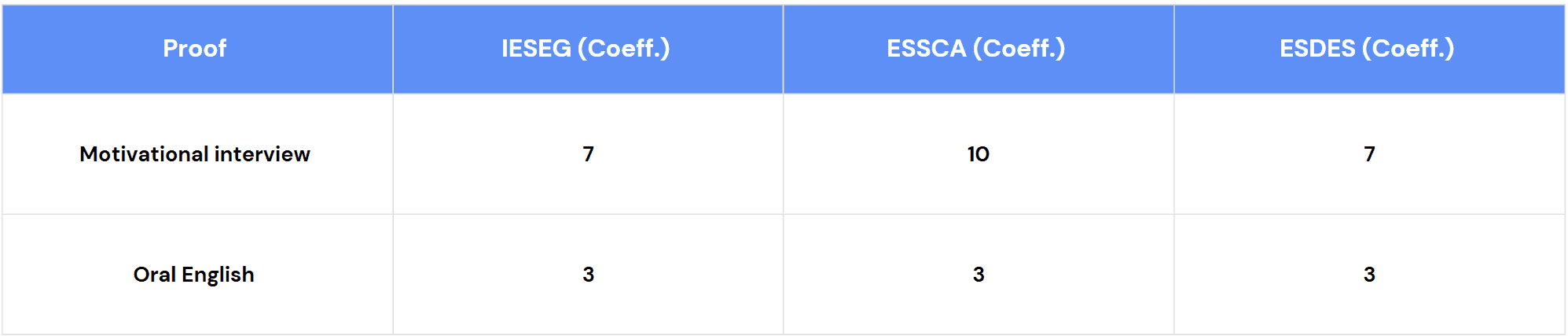
We’re almost at the finish line! The last steps involve two oral interviews—one in French and one in English. We’ll take the scores from these interviews and combine them with your written scores to determine your final ranking. Here’s a quick look at the coefficients for the oral tests:
How Zenith Can Help You Ace ACCÈS
At Zenith, we’re here to make your admission process and preparation for the ACCES exam smooth and enjoyable! Our friendly team of experts in bachelor's admissions is ready to support you every step of the way. Here’s what we’re happy to offer:
- Help you choose your 10 wishes and sub-wishes with confidence
- Guidance on writing your application essays that really shine
- Support with all the necessary administrative tasks
- Intensive preparation for the ACCES exam
- Coaching to ace your motivation interviews
Let’s work together to make your application stand out!
Ready, Set, Sesame!
What’s the Sesame Competition All About?
If you're considering post-bac business schools in France, one exciting option is the SESAME competitive entrance exam, which is conveniently part of the Parcoursup platform. This exam opens the door for final-year students to apply to the Grande École and BBA (Bachelor in Business Administration) programs offered by 16 fantastic institutions, totaling 19 different programs.
Here are some of the main programs you might want to check out:
1. ESSEC Global BBA (4 years)
2. EMLyon Global BBA (4 years)
3. CESEM Neoma (4 years)
4. KEDGE International BBA (4 years)
5. SKEMA BBA in Global Management (4 years)
The SESAME exam has two parts: first, you'll tackle some written tests, and if you do well, you’ll move on to the oral tests. What’s really great about these BBA programs is that they not only come with the recognition of well-respected schools but also offer amazing international opportunities. For example, Global BBAs and double diplomas, like NEOMA's CESEM, give students the chance to study on campuses in different countries.
Dates You Won’t Want to Miss
Here are six things you’ll want to keep in mind:
- Make sure to apply through Parcoursup by selecting the "Sesame competitive entrance exam" in your wish list!
- The Sesame exam is super handy because it lets you apply to 16 different schools and 19 unique programs, all counting as just one wish list entry.
- Not only does it give you access to 19 programs, but there are also over 50 sub-wish lists when you consider all the different tracks available.
- Each year, about 8,000 to 10,000 hopeful candidates go for around 5,500 available spots—so you’ll be in great company!
- Just a heads up, there are only 450 spots at ESSEC and 250 at Neoma’s CESEM program, so it’s definitely competitive.
- Unlike the ACCES exam, your academic record will be taken into account, so make sure it shines!
And don’t miss these important dates:
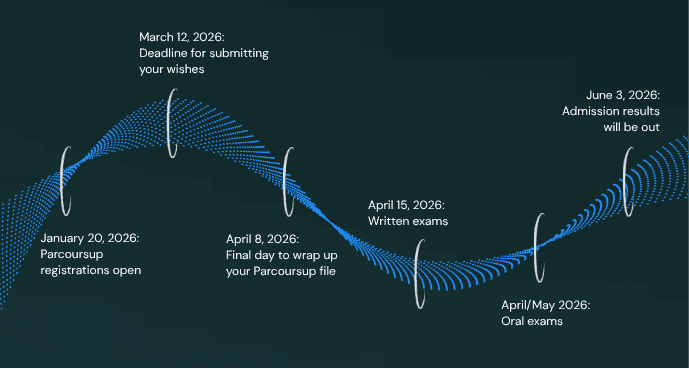
- January 20, 2026: Parcoursup registration opens—perfect time to start crafting your wish list!
- March 12, 2026: This is the deadline for submitting your wishes, but you can still tweak your application materials like motivation letters and report cards.
- April 8, 2026: Final day to wrap up your Parcoursup file and confirm your wishes.
- April 15, 2026: Get ready for the written exams!
- April/May 2026: Time for the oral exams!
- June 3 2026: Exciting news—admission results will be out!
How to Fill Out Your Parcoursup File Like a Pro
The Parcoursup application is made up of four main sections that we want to walk you through:
1) My Profile: In this section, you'll enter or double-check your personal details, like your name, marital status, contact information, and who your legal representatives are. If applicable, don't forget to fill out the sections on "Scholarships," "Disability/Special Needs," or "Athlete/Artist."
2) My Schooling: Here, you’ll showcase your academic journey so far, including your high school transcripts from the last two years. You’ll also provide a summary of your advanced or elective courses, along with any predicted or completed exam results, such as A-Levels, IB scores, AP results, or other national qualifications. Generally, you won’t need to make changes, but it's a good idea to review for any mistakes.
3) My Activities: This part includes four short essays (up to 1500 characters each) on topics that allow you to shine:
- "My experience in management or leadership"
- "My civic engagement"
- "My professional experience"
- "Openness to the world - sports and cultural practices, specific backgrounds"
Take your time crafting these essays since they'll be read by the admission committees after they look at your academic results.
4) My Wishes: In this section, you’ll find an interactive map to explore and add your academic preferences. To make a wish official, you’ll need to write a personalized essay called the "projet de formation motivé" (one for each wish) that's also 1500 characters long. These essays are important, so be sure to put in the effort to make them stand out!
For this process, just pick the option "Concours Sesame" and select all the programs you’d like to apply for as sub-wishes. The great news is that you only need to write one motivation letter for all your sub-wishes (up to 50) in the Sesame competition.
Feel free to reach out if you have any questions or need help with any of these sections!
Mastering the Written Exam
The written exams are a key part of your application, so it's crucial to do well on them! Your results will greatly influence your chances for the oral exams, so it's best to aim for success. Don’t forget, your application file is also important, so make sure it’s in good shape.
The competitive entrance examination is made up of three main sections, known as "sequences." Here’s an overview of what to expect:
Sequence 1: Understanding (1h30)
This section is divided into three parts:
1) Contemporary Issues (40 questions in 30 minutes)
In this test, you’ll tackle questions about current events and important social issues happening around the world. The questions will focus on events from the last 10 months leading up to the competition. This is a great chance to show off your curiosity and general knowledge! You’ll have 30 minutes to answer 40 multiple-choice questions, each with four options but only one correct answer.
2) Mathematics (20 exercises in 40 minutes)
Here, you’ll get to showcase your math skills! You’ll need to solve simple problems involving mental arithmetic, fractions, and percentages. Just like before, there will be 20 multiple-choice questions with four options and one right one.
3) Digital Skills (20 questions in 20 minutes)
This 2023 addition aims to check your knowledge of digital topics and how quickly you can think on your feet! Expect questions on five key areas:
- Information and Data (data research and management)
- Content Creation (like developing documents and understanding algorithms)
- Communication and Collaboration (how we interact in the digital space)
- Protection and Security (digital security and data protection)
- The Digital Environment
Sequence 2: Communicating (1h30)
This section is also divided into three parts and will use the same multiple-choice format as before.
1) French (40 questions in 30 minutes)
In this test, you’ll tackle grammar, conjugation, vocabulary, and comprehension in French. Some questions will even touch on French literary culture, so it’s a good chance to show your prowess!
2) English (40 questions in 30 minutes)
This section will test your grammar, verb tenses, vocabulary, and some tricky false friends. You’re expected to have an upper high school level of English—around B1 to B2 on the CEFR scale—so make sure you’re comfortable with reading, writing, and understanding more complex texts!
3) Second Language (40 questions in 30 minutes)
Alongside English, you'll choose one additional foreign language from a fun selection of ten options (like German, Arabic, Chinese, Spanish, Italian, Portuguese, and more!).
Sequence 3: Documentary Analysis (2h)
This test will consist of 20 questions spread across three categories:
1) Locating Questions: These are your straightforward comprehension questions that will ask about specific content in the provided documents, and the answers will be clear.
2) Analysis Questions: These questions are a little trickier and will require you to think critically. Here, you'll have to deduce some answers since several could be correct.
3) Synthesis Questions: In this section, you’ll have to identify responses that best summarize the content of the documents studied. You’ll select the best proposals for the introduction, the main body parts, and the conclusion.
For the identification and analysis questions, there are no penalties for wrong answers—so no stress there! As for the synthesis questions, you’ll earn points based on this scoring system:
- Full points if all answers are correct
- Half points if at least half are correct
- No points if less than half are correct.
Good luck, and remember to stay calm and do your best!
What Goes Into Your Application File?
Each applicant will receive a score based on the materials they submit through Parcoursup.
What goes into calculating your file score? Here are the main factors:
1. Your results from any standardized or pre-university exams (like national pre-tests or predicted grades)
2. Your academic results from your final two years of high school
3. Evaluations or recommendations from your main teachers and school administration
Get Ready With Zenith: Your Sesame Prep Partner
At Zenith, we’re here to make your admission process and preparation for the Sesame exam smooth and enjoyable! Our friendly team of experts in bachelor's admissions is ready to support you every step of the way. Here’s what we’re happy to offer:
- Help you choose your 10 wishes and sub-wishes with confidence
- Guidance on writing your application essays that really shine
- Support with all the necessary administrative tasks
- Intensive preparation for the Sesame exam
- Coaching to ace your motivation interviews
Let’s work together to make your application stand out!
Discover the ESCP Bachelor: One Degree, Three Campuses, Endless Opportunities
How to Join the ESCP Bachelor in Management Program
If you’re interested in pursuing a Bachelor in Management, you’ll be excited to hear that ESCP has created a fantastic program, following the footsteps of schools like ESSEC, EDHEC, and EMLyon. This program is taught in English and has a unique international twist! Over the course of three years (180 ECTS), you’ll get to experience life on one of ESCP's five vibrant campuses: Paris, London, Madrid, Berlin, or Turin.
There are four ways to apply for this program:
- Directly through the ESCP platform
- Via Parcoursup
- Through UCAS (the British equivalent of Parcoursup)
- And via CommonApp (the American equivalent of Parcoursup)
We highly recommend going for the direct application on the ESCP website. It opens up in November, which is much earlier than April for Parcoursup, and your application will be given extra attention as well. So, this section will focus on this direct application process just for you!
A quick note: You can only apply through one of the four options available. Also, if you’re accepted through direct application, you’ll need to kick off your studies at one of ESCP’s international campuses—you won't be able to start at your country’s campus.
Deadlines You’ll Want to Keep an Eye On
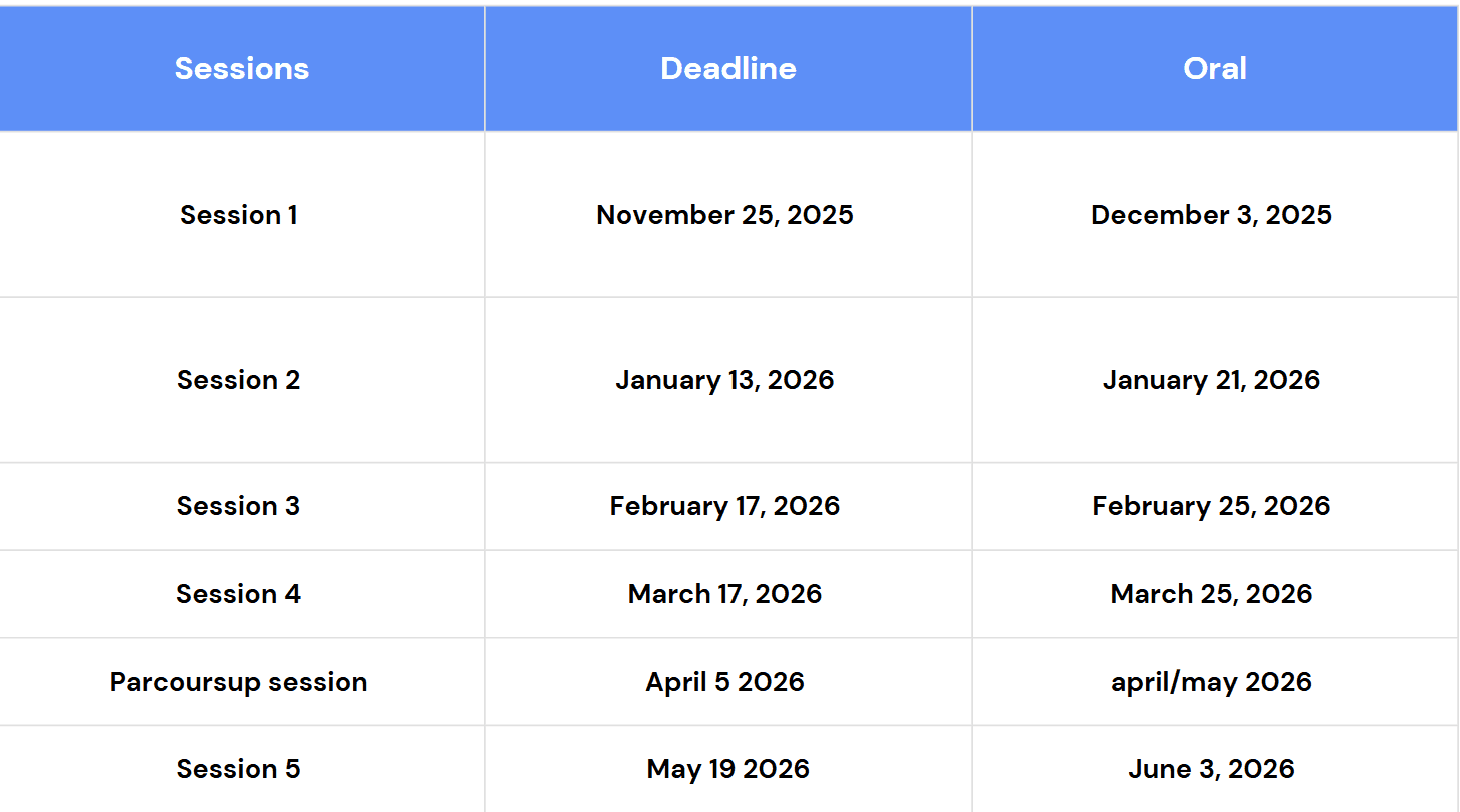
Applying for the ESCP Bachelor's degree is easy! We have a clear schedule that's divided into six sessions to help you plan your application.
Submitting Your Application Online: Step-By-Step
To help make your admission to ESCP a breeze, we’ve put together some steps to follow from their website. Just remember, applicants need to create a complete and accurate administrative file.
Here’s how to get your file ready:
1. Fill in your personal details—simple and straightforward!
2. Upload a copy of your passport or identity card.
3. Add your report cards from years 10 and 11 of high school, and if you have them, your early results from your final year of high school.
4. Share your CV in English.
5. Write a cover letter in English and upload it.
6. Include your English test results (like TOEFL, IELTS, Cambridge, PTE, etc.).
7. Lastly, feel free to upload any extra documents that could support your application, such as certificates or recommendation letters.
Spotlight: What You Need to Know About the English Test
To apply, candidates are asked to share a score from one of these English tests: TOEFL IBT, IELTS Academic, or Cambridge English. Don’t worry, the score requirements at ESCP are quite reasonable for a program that’s taught entirely in English: you’ll need a 6.5 out of 9 for IELTS, 90 out of 120 for TOEFL, or 180 for Cambridge (CAE C1).
Just a heads up, if you’re unable to attach an English test score with your application, that’s okay! You’ll just need to provide one when you’re ready to confirm your spot. We’re here to help you through the process!
Final Step: Your Admission Interview

This stage of the application process is extremely important! It’s all about seeing if you’re a good fit for ESCP’s standards, both in terms of academics and who you are as a person. You’ll sit down for a half-English, half-French interview on Zoom, which will last about 30 minutes. The atmosphere is pretty relaxed, but generally, the examiner will kick things off by asking you to introduce yourself. You’ll share a bit about your personal journey and academic background, as well as your reasons for wanting to join ESCP.
After that, they’ll dive into your CV and ask about your experiences, internships, and any extracurricular activities you’ve been involved in, including how you did in high school. Toward the end, they’ll likely ask some more personal questions, such as your favorite book, movie, or sport. They might even want to hear your thoughts on a recent news event!
To help you do well in this interview, it’s essential to prepare ahead of time. Spend some time crafting clear and thoughtful answers to the questions you think might come up. Make sure you know your experiences inside and out, as well as the details about the ESCP Bachelor’s program.
And here’s the good news: Zenith is here to support you! You’ll have several one-on-one sessions where we’ll help you polish your profile and practice with mock interviews, so you’ll feel confident and ready to shine!
What’s Next After the ESCP Bachelor?
Many Bachelors and BBAs from French schools like ESSEC and EDHEC sometimes feel a bit overshadowed by the Parcours Grande École (PGE), which you can access through classes prépa or other admission routes. While it’s true there’s a noticeable difference in prestige between Bachelors and PGEs, it doesn’t mean that Bachelors aren’t great options! In fact, as the job market becomes more global, the gap is starting to close. The ESCP Bachelor really stands out in this area. Its international program is well-respected by admissions teams at top foreign Master’s programs, and students from this program often find themselves accepted into renowned institutions like LBS, Bocconi, IE Madrid, UCL, and LSE.
Get Ready With Zenith: We’re Here to Help!
At Zenith, we’re here to make your ESCP Bachelor admission process smooth and enjoyable! Our friendly team of experts in bachelor's admissions is ready to support you every step of the way. Here’s what we’re happy to offer:
- Personalized advice on finding the best admission path for your unique profile
- Guidance in crafting a standout cover letter for your ESCP application
- Assistance in putting together an impressive CV
- Support with all the necessary administrative tasks
- Preparation for the TOEFL or IELTS exam to boost your confidence
- Intensive coaching to get you ready for the admission oral
Let’s work together to make your application stand out!
Next step
Planning a bachelor's application?
We support students from the first "what should I study?" to the day they arrive on campus, with strategy, application expertise, and global university insight.
See bachelor's guidanceWant to find out more?
Message us on WhatsApp for a quick answer, or book a free consultation. No pressure either way.