
Test Preparation
Essential Exams for Studying Abroad: TOEFL and IELTS Explained
As you start exploring universities around the world, getting familiar with standardized test requirements can really help you prepare and dodge any surprise…
By the Zenith Education team

As you start exploring universities around the world, getting familiar with standardized test requirements can really help you prepare and dodge any surprises! Since these requirements can differ from country to country, program to program, and university to university, it’s great to know what to expect. Here’s an overview of the most common tests and some tips for navigating them. Zenith Education is here to help you choose and prepare you for the right test to gain admission into your dream school.
English Language Proficiency Tests
If you’re an international student looking to apply for programs taught in English, you’ll probably need to show off your English skills:
TOEFL (Test of English as a Foreign Language)
This test is very popular in the U.S., Canada, and many places in Europe and Asia. The most common version is the internet-based TOEFL iBT.
IELTS (International English Language Testing System)
This one's a favorite in the UK, Australia, New Zealand, and it’s growing in acceptance in the U.S. and Canada. It comes in two versions: Academic and General Training, but universities usually want the Academic one.
Many Master's programs look for candidates who have a good level of English. In today’s job market—whether you’re eyeing a career in banking, law, consulting, or any business—English skills are essential, and schools are fully aware of this.
That’s why a solid academic record now goes hand in hand with achieving good scores on standardized English tests. Tests like TOEFL and IELTS can be a bit daunting, especially for students whose English skills often lag behind.
Quick Tip: Lots of universities might waive these tests if you’ve studied in English or meet certain academic criteria, so it’s a good idea to check each university’s website for specifics!
UK University Tests: UCAT, BMAT, LNAT, and Oxbridge Exams
- UCAT (University Clinical Aptitude Test) – This one’s a must for many medical schools in the UK.
- LNAT (National Admissions Test for Law) – Required by some UK universities for their law programs.
- Oxbridge Admissions Tests – If you’re aiming for Oxford or Cambridge, be prepared for subject-specific tests (like TSA, MAT, PAT, HAT) as part of their competitive admissions process. Make sure to register for these early, as they need to be completed before the UCAS deadline (usually in October)!
Other Things to Keep in Mind
In many European universities, the focus is often on final school results (like IB, A-Levels, or national qualifications), although some programs might ask for extra entrance exams, especially for fields like medicine. If you’re applying to programs in languages other than English (like French or German), you may need to take exams like DELF (French) or TestDaF (German) to show your language skills.
Remember, test requirements aren’t one-size-fits-all! As an international student, it’s important to:
- Start your research early and take a good look at each university’s website.
- Register on time for any exams you need to take.
- Use your scores wisely, particularly in test-optional scenarios.
Being informed about which tests you need can make the application process a lot smoother and help you save time and money while making your application shine. If you're feeling unsure about which tests you need for your goals, feel free to reach out and chat about it!
IELTS
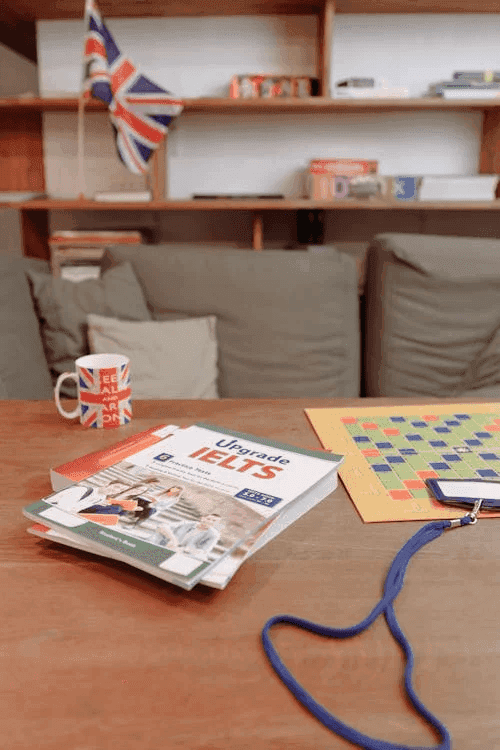
IELTS PRESENTATION
The IELTS (International English Language Testing System) is a standardized test created to assess your English language skills if you’re applying to universities in English-speaking countries for both Bachelor's and Master's degrees. It’s recognized by thousands of universities worldwide, making it a great choice for anyone looking to study abroad. Each year, around 3.5 million people take this test, which puts it among the most popular English language exams alongside TOEFL, Cambridge Assessment English, and the newer Duolingo Test.
1. Overall Test Structure
While there are various formats of IELTS, let's focus on the IELTS Academic version, which lasts about 2 hours and 45 minutes. The test is broken down into four sections, each scored on a scale of 9, and your overall band score is the average of these four sections. Here’s a quick look at the test structure:
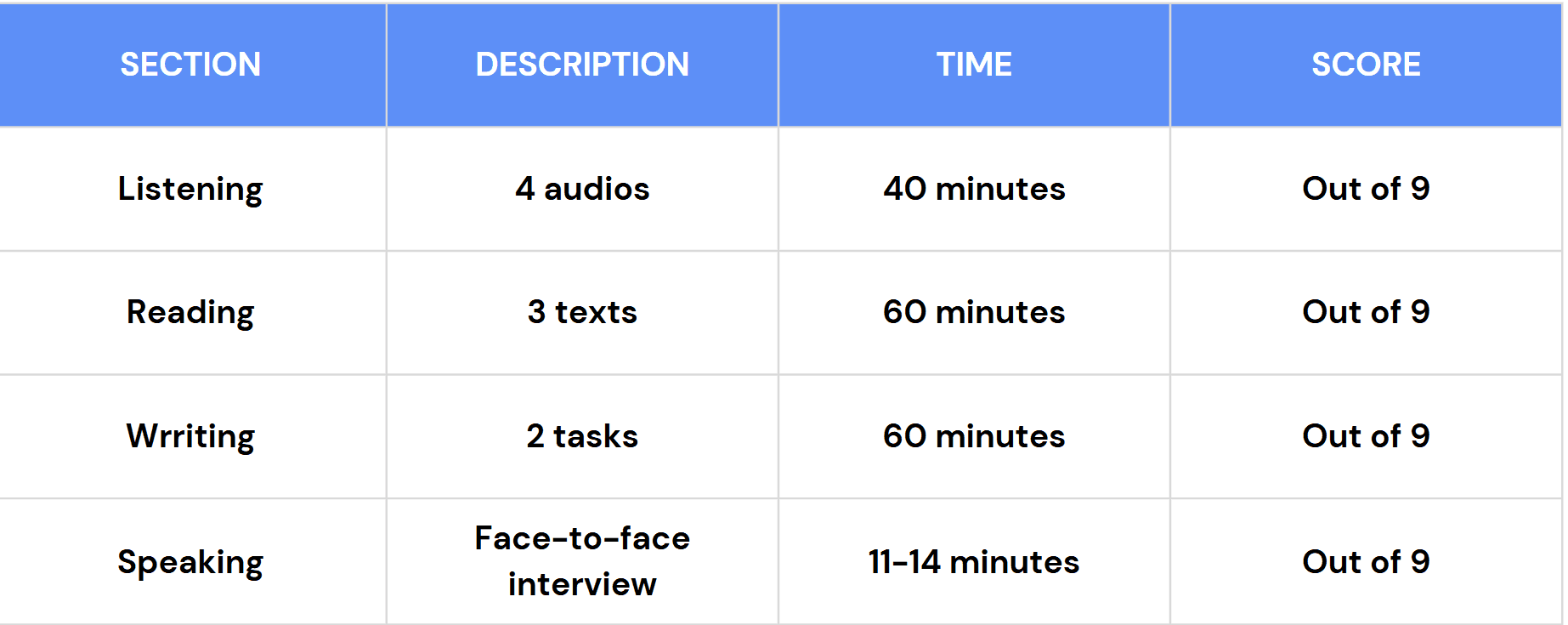
It’s a comprehensive test, so it does require some concentration, but don’t worry! The "Speaking" section might feel a bit intimidating since it involves talking to a real person, but just think of it as a chance to show off your skills in a relaxed setting.
SECTION 1: LISTENING SECTION
The Listening section of the IELTS is made up of four separate parts, with 10 questions in each one, all wrapped up in 40 minutes! You’ll spend 30 minutes answering the questions and then have an extra 10 minutes to write down your answers on the answer sheet.
1. In the first audio, you’ll hear a conversation between two people chatting about everyday topics, like planning a birthday party or sharing stories about trips they’ve taken.
2. The second audio features a solo speaker discussing an interesting topic, such as how the city’s infrastructure is maintained or introducing a new government initiative.
3. Up next is a conversation between two speakers, which could be two students talking to each other or a student having a chat with their teacher.
4. Finally, the last audio is a monologue that dives into an academic subject.
You’ll only get to listen once, so make sure to pay attention! Each part kicks off with a brief introduction that gives you some context and introduces the speakers. There won’t be much time to look over the questions, but they’re organized in the same order as the information in the recording. This means the info you need for question 1 will come before what you need for question 2.
At the end of the test, you’ll have 10 additional minutes to neatly transfer your answers to the answer sheet. Just a heads up: make sure to double-check your spelling and grammar, as points can be deducted for errors.
SECTION 2: READING SECTION
The Reading section features three texts, adding up to about 2,500 words. These selections come from a mix of sources—like books, journals, magazines, newspapers, and online articles—and are suitable for everyone, even if they touch on some tricky scientific topics.
You'll encounter different types of questions, including multiple-choice and short-answer ones. Your job will be to find specific information in the texts, grasp what the author is saying, interpret diagrams, write summaries, and check that certain details match up with the content. Just a heads up: be careful with your spelling and grammar, as mistakes could cost you points!
SECTION 3: WRITING SECTION
The writing section includes two tasks: Task 1 (150 words in 20 minutes): In this task, you'll get the chance to describe a graph, table, diagram, map, process, or schematic using your own words. Task 2 (250 words in 40 minutes): For this task, you’ll share your thoughts on a general issue or answer an open-ended question. Just make sure to support your answer with evidence, reasoning, and some examples! Keep in mind that if your response is too short or doesn’t quite stay on topic, you might lose points. It’s also important to write in a formal style; using notes, lists, or "bullet points" isn’t allowed.
SECTION 4: SPEAKING SECTION
The speaking test is a face-to-face chat between you and the examiner, lasting about 12 minutes and divided into three sections:
Section 1: Introduction (4 to 5 minutes)
This is a great time to share a bit about yourself! You’ll be asked questions about your home, family, work, studies, hobbies, and interests. You might also talk about why you’re taking the IELTS, and discuss general topics like your favorite clothes, music, or how you use the internet.
Section 2: "Long Turn" (3 to 4 minutes)
Here’s where it gets fun! You’ll get a minute to prepare for a randomly selected topic. The instructions will give you some helpful points to include in your speech. After your prep time, you’ll speak on the topic for one to two minutes. The examiner will then ask you a couple of questions to keep the conversation flowing!
Section 3: Discussion (4 to 5 minutes)
In this last section, you’ll dive deeper into a discussion with the examiner, usually related to the topic from the previous section. It's a great opportunity to express your ideas and share your thoughts, with the examiner guiding the conversation through their questions.
WHAT IS A GOOD IELTS SCORE?

The final IELTS score is calculated by averaging the scores from each section, with results being whole numbers (like 7.0) or half points (like 7.5). When you calculate the average, if it lands on 0.25, you'll round it up to the nearest half point. If it ends with 0.75, you'll round it up to the next whole number.
Generally speaking, a score of 7 out of 9 is considered pretty good for gaining admission to a reputable university in the UK. That said, some of the more competitive programs might ask for a 7.5, and they could also have minimum score requirements for each section.
As a rule of thumb, you usually need at least a score of 6 out of 9, making sure you have no less than 5.5 in each section to be eligible for quality programs. Here are a few examples of programs and their IELTS requirements:
- ESADE Bachelor in Business Administration: 7, with a minimum of 6.0 for each section
- McGill Desautels Faculty of Management: 6.5, with at least 6.0 in each section
- LSE Bachelor in Management: 7, with a minimum of 7 for each section
- Amsterdam University College: 7, with at least 6.5 in each section
- Maastricht University Bachelor in International Business: a minimum of 6.0
- UCL BASc in Arts & Sciences: 7.5, with a minimum of 7.0 for each section
Good luck, and don’t hesitate to reach out if you have any questions about the process!
HOW TO PREPARE EFFECTIVELY FOR THE IELTS?
At Zenith, we’re excited to support you every step of the way as you get ready for the test! We have a variety of personalized tutoring packages with our skilled IELTS teachers. They’re here to help you tackle each section with confidence and aim for the best score possible!
TOEFL

TOEFL PRESENTATION
The TOEFL (Test of English as a Foreign Language) is a standardized test that helps assess how well you can use English, especially if you're planning to apply to university programs in English at the Bachelor's or Master's level. This American test is widely accepted by countless universities around the world. Every year, about 2.3 million people take the TOEFL, making it one of the top English tests out there, alongside IELTS, Cambridge Assessment English, and the newer Duolingo Test. Plus, there's some exciting news: the test format was updated, with a fresh structure introduced in July 2023!
1. Overall Test Structure
The TOEFL comes in different formats, but the two you’ll want to focus on for university applications are:
- The TOEFL IBT (Internet-Based Test)
- The TOEFL IBT Home Edition
The test has four main sections, with each one scored out of 30, giving you a total of 120 points. With the new streamlined format, you can breeze through the test in about 2 hours! Here’s a quick overview of its structure:
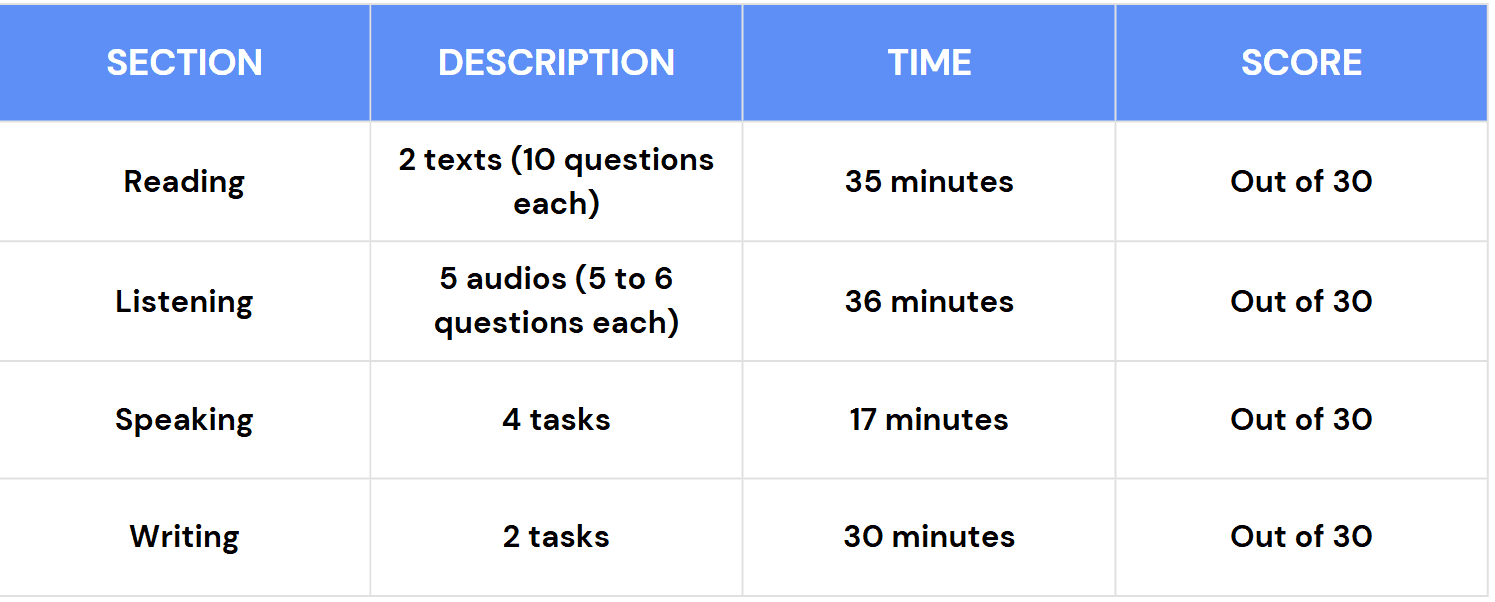
The TOEFL does require some concentration, but it’s totally manageable. Many candidates find the “Speaking” and “Writing” sections a bit daunting since they focus on verbal and written expression. However, with some practice, you can definitely tackle them!
SECTION 1: READING SECTION
In the reading section, you’ll find two engaging texts, each about 5 to 6 paragraphs long, covering a mix of interesting topics like history, geology, climatology, economics, and psychology. These texts read like excerpts from a scientific article or thesis and are often presented in an engaging story-like manner. After reading each one, you’ll get to answer 10 fun questions related to them.
SECTION 2: LISTENING SECTION
In the listening section, you’ll listen to audio clips that last between 3 to 5 minutes. There are two main types of recordings you’ll hear:
- Campus Conversations: These are dialogues that involve situations between students and teachers or staff members.
- Subject Readings: In this segment, a teacher will explain a chapter or concept from subjects like Biology, History, Geography, Astronomy, or Climatology. They may also have a quick chat with students during this time.
After each audio session, there will be 5 to 6 questions for you to answer. Just a heads-up: once you finalize an answer, you can’t go back to change it. So, it’s very important to stay focused while listening! The audios can sometimes feel a bit lengthy and tedious, and don’t be surprised if one of the questions asks about a small detail.
SECTION 3: SPEAKING SECTION
In the Speaking section, you’ll be chatting into your computer’s microphone, which will record your answers for the graders. This part has four tasks:
1. Open-ended Question: You’ll get 15 seconds to think before sharing your thoughts for 45 seconds.
2. Campus Situation Question: First, you’ll read a text for 45 seconds about something happening on campus (like a new library opening or changes to the university newspaper), then you’ll listen to a conversation between two students discussing it. After that, you’ll have 1 minute to summarize both the situation and what the students think, with 30 seconds to prepare.
3. Scientific Reading Question: Here, you’ll read a text about a scientific concept or phenomenon (such as light refraction or genetic changes in plants) for 45 seconds. Then, you’ll listen to a lecture snippet where a teacher gives you examples of how that concept works. You’ll need to explain the concept and how it’s applied in your own words for 1 minute, after 30 seconds of prep time.
4. Final Audio Question: In this section, you’ll listen to a 1-minute audio and then recap what you heard in your own words. You’ll have 20 seconds to prepare. The audio will usually include a teacher explaining a concept, along with some examples.
Take a deep breath and own this section! Make sure to jot down notes while listening, and remember to express everything you hear in your own way to help you score well.
SECTION 4: WRITING SECTION
In the Writing section, you’ll get a chance to showcase your writing skills while also flexing your critical thinking and argumentation abilities. This section has two tasks:
1. Integrated Writing (225 words in 20 minutes): First, you’ll read a short text that introduces a question or a phenomenon, followed by three paragraphs, each offering a different explanation or theory. After that, you’ll listen to an audio where a teacher reviews each of these theories, pointing out their flaws or limitations. Your job will be to summarize the three theories and discuss how valid they are, all within 225 words and 20 minutes. Feel free to refer back to the text as much as you need, but keep in mind you’ll only get one listen to the audio.
2. Writing for an Academic Discussion Task (100 words in 10 minutes): For the final task, you’ll express your thoughts on a social topic. You’ll have a brief moment to respond to two classmates who have differing opinions about the issue, and it’s important to mention their views in your response.
WHAT IS A GOOD TOEFL SCORE?

The TOEFL score is made up of the scores you earn in each section, adding up to a total of 120. A score of 100 is generally considered a solid benchmark for getting into a good university in the UK. However, if you’re aiming for more competitive programs, you might want to aim higher, with some requiring scores of 109 or more and certain minimums for each section.
For most universities, having at least a score of 90 is essential, along with a minimum of 20 in each section to ensure you’re set up for success in your program. Here’s a friendly look at some programs and their TOEFL score requirements:
- ESADE Bachelor in Business Administration: Between 90 and 100 minimum
- McGill Desautels Faculty of Management: At least 100
- McGill Faculty of Arts: Minimum of 90, with 21 in each section
- LSE Bachelor in Management: 100, with a 27 in Writing, 25 in Reading, 24 in Listening, and 24 in Speaking
- Amsterdam Bachelor in Business Administration: Starting at 92, needing 22 in each section
- Maastricht University Bachelor in International Business: A minimum of 80
- UCL BASc in Arts & Sciences: Aiming high with 109, plus 25 in each section
Good luck with your studies!
Preparing for the TOEFL?
At Zenith, we’re excited to support you on your test preparation journey! We’ve got a variety of private tutoring packages with our friendly and knowledgeable TOEFL teachers, ready to help you approach each section with confidence and aim for your best score ever!
Next step
Planning a bachelor's application?
We support students from the first "what should I study?" to the day they arrive on campus, with strategy, application expertise, and global university insight.
See bachelor's guidanceWant to find out more?
Message us on WhatsApp for a quick answer, or book a free consultation. No pressure either way.