
Test Preparation
MCAT Scores Explained: What’s Good, What’s Great, and What You Need
Are you wondering what a great MCAT score looks like? Or maybe you’re not quite sure if your score is up to par? If you’re curious about what you need to get into medical school, you’re in the right place! I’m here to help answer all your questions and guide you on what score you should aim for to reach your goals. Don’t miss out—take a look at our detailed guide below!
By the Zenith Education team

What’s a Good MCAT Score?
When it comes to determining a good MCAT score, there are a couple of ways to look at it. First off, based on the latest trends in medical school applications, if you score between 510 and 511 or higher, you’re in a good place! Ideally, you want to avoid having any section scores below 127. And if you’re aiming for something exceptional, a score above 520 is fantastic!
The second perspective is a bit more tailored: a good MCAT score is one that meets or exceeds the average score of the medical schools you’re interested in. Remember, I said “average accepted MCAT score,” not the minimum scores that schools often publish. Those aren’t what you should be aiming for! So it’s definitely worth your time to research and find out what the current average scores are for your target schools and a great resource for this is the MSAR tool.
Understanding how the MCAT is Scored
The MCAT scoring system can seem pretty complex, but let’s break it down in an easy way! Your score is mainly based on how many questions you answer correctly. The best part? Wrong answers won’t hurt your score, so don’t hesitate to guess if you’re unsure. Just make sure you answer every question!
Each correct response in a section turns into a scaled score between 118 (the lowest) and 132 (the highest), and all four section scores are added together. This means the lowest possible total MCAT score is 472, while the highest is 528.
Here's a nifty tip: the scoring process uses something called equating, which balances things out to ensure fairness across different test forms. This means that two students who are equally prepared but take different versions of the exam can still score comparably, even if the difficulty varies a bit. Just to clarify, this doesn’t mean scores are graded on a curve; it just guarantees that every raw score has the same meaning, no matter when or who you’re testing with.
On the day your MCAT scores are released, you’ll get a total of five scores: one for each of the four sections and one overall score.
MCAT Score Ranges
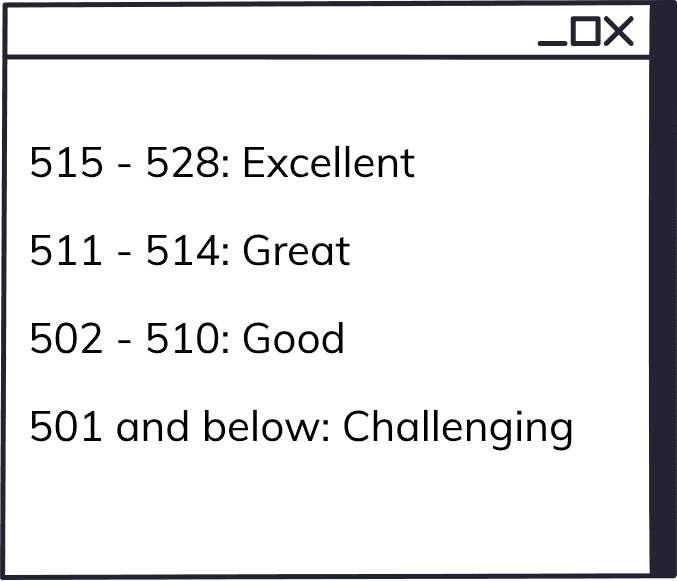
- 515-528: If you’re in this range, you’re doing great! This is the most competitive score range, and if you fall here, you’re likely to get an interview. Plus, your score will look really impressive compared to other applicants.
- 511-514: This is still a solid score! While it might not be the highest, it’s competitive enough to give you a good shot in the admissions process.
- 502-510: Scores in this range are considered average. It’s not exactly something to shout about, but it won’t raise any major concerns with most admissions committees. Just keep in mind that the top schools might not look at this score as a strong point, but it does show you have a decent foundation for medical school.
- 501 and below: If your score is in this range, it’s a bit concerning. Some medical schools might still consider you if you have other outstanding parts in your application, but generally, this score could make acceptance a tougher challenge.
MCAT Percentile Scores
Let’s take a look at MCAT percentiles! Just a quick note: these percentiles aren’t about how many questions you got right; they show how you did compared to others who took the test. For example, if I scored a 518 on the MCAT, that means I did better than 95% of my fellow test takers – pretty exciting, right? Check out the table below to find out what your MCAT percentile is!

MCAT Score Calculator
What is the Highest Possible MCAT score
The highest possible score you can achieve on the MCAT is 528! It might sound unbelievable, but each year, a handful of students actually reach this perfect score—around 0.015% to 0.035% of test-takers, according to the AAMC. I’ll share some tips on how you can aim for this score soon!
Is 515 a Good MCAT Score?
Absolutely! A 515 places you in the 90th percentile, making you a strong candidate for most medical schools. This score is so impressive that it can even help balance out a lower GPA. For example, if you have a 3.0 GPA along with a 515 score, you’re looking at about a 42.5% chance of getting accepted, which is great! In comparison, if your GPA is 3.0 but your MCAT score is 512, your chances dip to around 34%. However, if you have a higher GPA of about 3.6 and that 515 MCAT score, your acceptance probability jumps to over 65%. So, yes—scoring a 515 is definitely something to be proud of, and it can really boost your chances of getting into medical school!
How to get a high score on the MCAT

1. Make a Detailed Study Plan
Kick off your prep by taking a practice MCAT under real test conditions to figure out where you stand. From there, create a study plan that encompasses about 300 to 350 hours of study time. Make sure to cover all the MCAT topics, including lots of practice questions and full-length tests. Focus on the high-yield topics that tend to show up on the exam—keeping your study efforts really targeted.
2. Practice Makes Perfect
I can’t stress enough how important practice is! Start by reviewing the content from day one and steadily add practice questions as you go along. Dedicate a good chunk of time to working through practice problems, taking full-length tests, and really diving into your answers to learn from your mistakes.
3. Focus on Test-Taking Strategies
Knowing the material is just one part of the equation—the MCAT also requires some solid test-taking techniques. You should know that even if you knew your stuff, you have to apply it well in the MCAT format. Work on skills like time management, critical thinking, and problem-solving to get the most out of your performance on exam day. Practice reading complex texts and answering inference questions, which would help you enhance your reading comprehension and analytical skills.
4. A Little Advice on Course Selection
If you can, I’d recommend enrolling in courses that relate to the MCAT to set yourself up for success! Courses such as biochemistry and organic chemistry give you a stronger foundation and save you from teaching yourself everything from scratch.
5. Quality Over Quantity with Resources
When you first dive into my MCAT prep, you might feel overwhelmed by all the resources out there—books, courses, question banks, you name it! You might think that using more resources would be better, but you’d end up scattered and confused. Focusing on reputable, high-yield materials like the official AAMC stuff and the UWorld MCAT QBank would make your study time way more effective. So, trust the process and keep it simple!
6. Finding Balance is Key
Lastly, preparing for the MCAT is a marathon, not a sprint. It’s very important to strike a good balance between studying and taking care of yourself. Make sure you get enough rest, eat well, and stay active to keep your mind sharp. You should also keep track of test dates and deadlines to ensure you are organized and ready to apply to medical schools when the time comes.
Some Additional MCAT Study Tips for a High Score
Review Regularly: Take moments throughout your day to revisit what you studied the day before, especially the areas where you struggled. Consistent revision helped me retain information better. You don’t need a formal setting for this; you can review during your commute, whether it’s on the bus or subway. Use small pockets of time to reinforce what you learned recently.
Analyze Mistakes: When going over your answers, reflect on why you got them right or wrong. For incorrect answers, revisit the specific topic or concept to strengthen your understanding.
Engage in Self-Dialogue: It might sound a bit quirky, but you should try asking yourself key questions to ensure you grasp an MCAT concept fully:
- How would I explain this to a friend?
- Can I identify a real-life situation where I could apply this concept?
- How does this concept connect with what I’ve already learned? This technique greatly enhanced my comprehension of MCAT subjects.
Implement Active Learning Techniques: Although it may be tiring to hear, simply reviewing material isn’t enough to achieve a score of 515 or higher! Employ active study methods such as summarizing your learnings and creating diagrams or charts to compare ideas. Validate your summaries with lecture notes, textbooks, or any other study materials. These methods truly solidified my understanding.
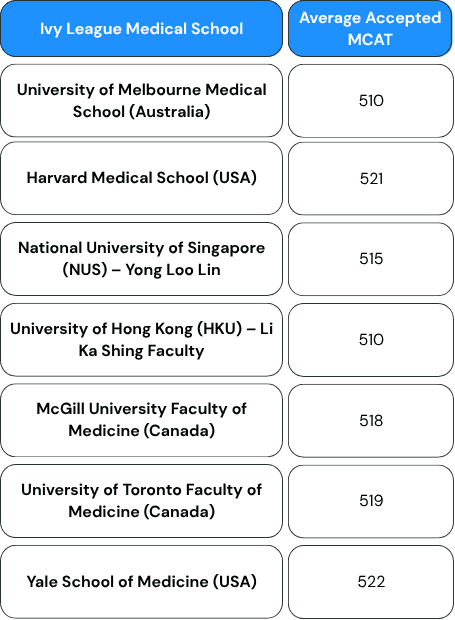
What MCAT Score is Required for Ivy League Medical Schools like Harvard?
Here are the most recent average accepted MCAT scores for students entering Harvard and other Ivy League institutions:
Accepted MCAT Scores at Ivy League Schools
What is a good MCAT score in Canada?
A score of 512-513 is seen as a pretty good MCAT score in Canada! Just keep in mind that medical schools often have specific preferences based on where applicants are from. For example, the University of Saskatchewan College of Medicine tends to have lower MCAT requirements for in-province students compared to those from out of province. Most medical schools in Ontario don’t have these kinds of preferences, but the Schulich School of Medicine at Western University might be a bit lenient with a lower score for applicants from southern Ontario. Plus, it’s worth noting that many medical schools in Canada don’t require the MCAT at all! So, the way MCAT scores are viewed in Canadian medical school admissions can be a bit complicated, but aiming for a score of 512 or higher will definitely give you a competitive edge.
What’s a Bad MCAT Score?
Now, about a 500 score on the MCAT—it's not the strongest score out there. It might make it challenging to be a competitive candidate for most medical schools, even the ones that are considered easier to get into. If you find yourself in this situation, you might want to explore applying to Caribbean medical schools or considering a retake of the MCAT. You've got options!
How Long Are MCAT Scores Valid?
Most medical schools will accept your MCAT scores if they’re 2 to 3 years old, but anything older might require you to retake the test. It’s a good idea to check with each school you're considering to see their specific rules around MCAT score validity.
How Do Medical Schools Use MCAT Scores?
This is such an important question! If only there were an easy rule to follow. Here’s a friendly overview of how different medical schools approach MCAT scores during admissions:
Some schools use your MCAT score as an initial screening tool. This means they might weed out applicants with lower scores at the start, making it easier to dive into the rest of your application. If your score meets their threshold, they’ll then look at your other application materials.
Other schools say they take a holistic approach, meaning they evaluate your MCAT score, GPA, personal statement, and more all together. This can be great news, as a lower MCAT score might be balanced out by strengths in other parts of your application!
Then there are schools that don’t use the MCAT in a competitive way (how great is that?). They mainly want to see that you meet their minimum score requirement and aren’t comparing you to others. They just want to ensure you have a solid grasp of the necessary scientific knowledge and skills.
Some schools also focus more on certain MCAT sections than others. For example, a few schools are candid about giving extra weight to the CARS section. In fact, some only look at your CARS score and ignore the other three sections—looking at you, McMaster!
If you get a chance, try to find out how the schools you’re interested in use the MCAT in their admissions process. You might find useful info on their websites, or the Medical School Admissions Requirements (MSAR) can have insights too. Plus, connecting with former admissions committee members can be super helpful! Many of them were applicants just like you and may be willing to share their knowledge to help you through this process.
FAQs
1. What’s a good MCAT score?
A good MCAT score really depends on the medical school you’re applying to. For example, if the average score for accepted students at your dream school is 513, it’s a good idea to aim for that or higher! Try not to compare your score with others; instead, focus on your own journey and growth as you prepare for the MCAT.
2. What’s a perfect MCAT score?
Scores over 517 are usually seen as excellent, and the highest possible score is 528. While you don’t need a perfect score to get accepted, aiming high can always help you stand out!
3. What’s the average MCAT score for accepted students?
For MD programs, the average MCAT score is around 511.7, and for DO programs, it’s about 504.6.
4. Are there specific courses I can take to get ready for the MCAT?
Absolutely! Taking certain medical school prerequisites can really help with MCAT prep. Most of the topics covered in the exam are included in the introductory science courses you’ll take during your bachelor's studies.
5. What if I don’t do well on one section of the MCAT?
It’s important to remember that schools look for consistent performance across all sections of the MCAT. If one section is significantly lower, they might see it as a sign that you need to strengthen that area.
6. When is the best time to take the MCAT?
Consider scheduling your test once you're regularly scoring in the 90th percentile on practice exams. Most importantly, take it when you truly feel ready to tackle the exam!
7. How long are my MCAT scores valid?
Most medical schools will accept MCAT scores from the last 2 or 3 years. Be sure to check the specific requirements for each program on their websites to get the most accurate information.
8. How do I send my MCAT scores to medical schools?
Once you complete the MCAT and your scores are released, you can easily send them to your chosen schools through the AAMC online portal. Just keep an eye on the testing schedule to know when your scores will be available!
Next step
Planning a bachelor's application?
We support students from the first "what should I study?" to the day they arrive on campus, with strategy, application expertise, and global university insight.
See bachelor's guidanceWant to find out more?
Message us on WhatsApp for a quick answer, or book a free consultation. No pressure either way.