
Test Preparation
SAT 101 for International Students
These standardized tests are used by many U.S. universities for admissions. The SAT focuses on Reading, Writing, and Math, while the ACT covers English, Math, Reading, Science, and has an optional essay.
By the Zenith Education team

U.S. Admissions: SAT, ACT & Test-Optional Policies
SAT / ACT
These standardized tests are used by many U.S. universities for admissions. The SAT focuses on Reading, Writing, and Math, while the ACT covers English, Math, Reading, Science, and has an optional essay. Many competitive schools recommend or consider these even if they aren’t required.
Test-Optional Movement
Since 2020, quite a few U.S. universities have embraced test-optional or test-blind policies. With test-optional, you get to choose whether or not to submit your scores, while test-blind means they won’t look at scores at all. That being said, submitting strong scores can still give your application a nice boost, especially for scholarships. It’s always a smart move to check the policies for each university to see if submitting scores might work in your favor!
SAT Presentation
The SAT (Scholastic Assessment Test) is a standardized exam widely used for bachelor's admissions in the United States and recognized by many international universities. It’s designed to measure your college readiness by testing your critical thinking, problem-solving, and foundational academic skills. While some U.S. colleges are going test-optional, many top schools still consider SAT scores in their admissions process.
Overall Test Structure
The SAT was recently redesigned to be fully digital starting in 2024 for international students (and in 2025 for U.S. students). The new format is shorter and adaptive, meaning the difficulty of later sections adjusts based on your performance in the earlier ones. It takes about 2 hours and 14 minutes, and the total score ranges from 400 to 1600.
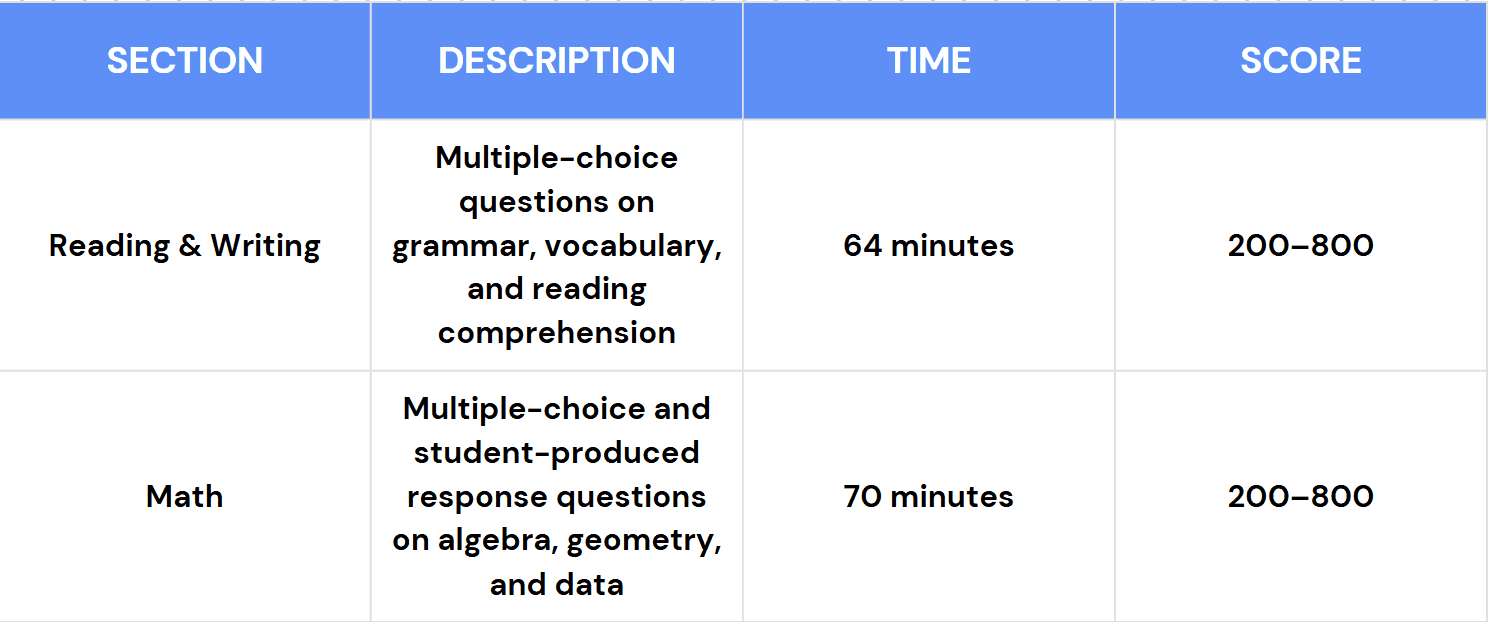
The two section scores are added together to get your final score out of 1600.
SECTION 1: READING & WRITING
This section combines grammar and reading skills in a streamlined format. You’ll answer 54 multiple-choice questions across two modules, each lasting 32 minutes.
Each question is based on a short passage. You’ll need to:
- Interpret arguments and evidence
- Revise sentences for clarity and correctness
- Analyze vocabulary in context
- Correct grammar, punctuation, and sentence structure
Passages may come from literature, science, history, or social studies.
SECTION 2: MATH
This section includes 44 questions over two modules. It’s calculator-friendly, and questions cover:
- Linear and quadratic equations
- Geometry and trigonometry
- Statistics and probability
- Word problems and data analysis
You’ll also encounter "grid-in" questions where you supply your own answer.
What Is a Good SAT Score?
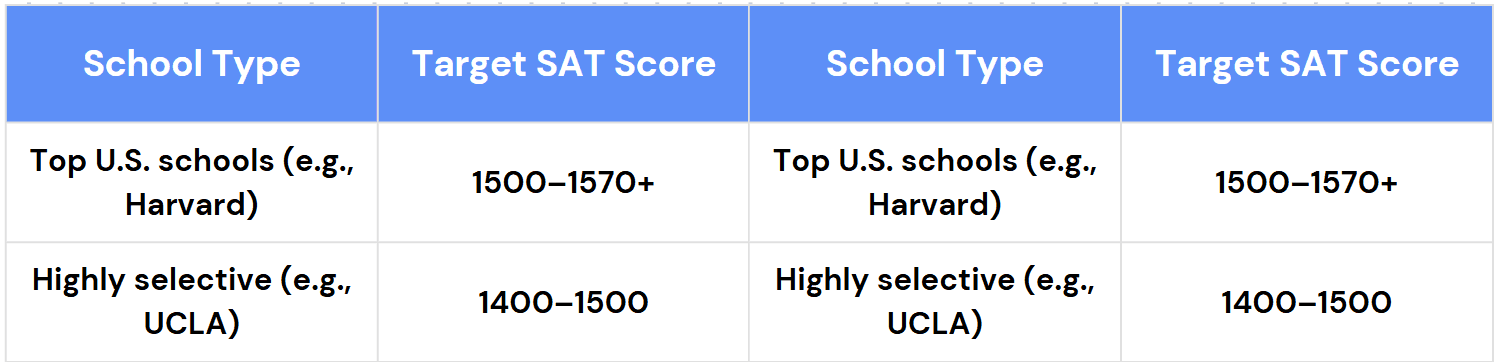
Your total score (400–1600) combines your Math score (200–800) and Reading & Writing score (200–800). Here’s a breakdown:
SAT Score Reporting Policies
Have you ever wondered whether colleges can see how many times you’ve taken the SAT? It's a common question!
The answer depends on the score reporting policies of the colleges you apply to. Here are the key options:
1. Score Choice
With Score Choice, you have the power to select which SAT scores you want to send to colleges. This means you can highlight the scores that showcase your skills and give you a better shot at admission.
2. All Scores
Some colleges ask you to submit every SAT score. This means they’ll have access to your complete testing history, including every time you've taken the SAT. But don’t panic! These colleges usually focus on your highest scores, especially if they superscore.
3. Single Highest Sitting
A few schools only consider your best one-day score.
Even if a college sees all your scores, admissions officers understand that students retake the SAT to improve. It rarely works against you!
What is Superscoring?

Superscoring is a student-friendly policy used by many colleges. If you’ve taken the SAT more than once, they combine your highest section scores across all test dates to create your best possible total score.
Example: Let’s say you did really well in Math on your second try but nailed the Reading and Writing sections on your first attempt. If a college uses superscoring, they’ll combine your best scores from each section, giving you a higher overall score!
This approach helps colleges appreciate that students can shine in different areas. It allows them to evaluate applicants based on their best performances, giving everyone a fair chance to highlight their abilities, even if they didn’t hit their ideal scores in one sitting.
Not all colleges superscore, so always check each school’s policy by searching for “[School Name] SAT Superscore Policy.”
Do Colleges See How Many Times You Took the SAT?

Only if you let them! If you use Score Choice, colleges will only see the scores you choose to send. If a college requires all scores, then yes, they’ll see every attempt.
But remember: most colleges care more about your best scores than how many times you took the test.
Test-Optional Policies
Since COVID-19, many colleges have adopted test-optional policies. This means you don’t need to submit SAT scores, and not submitting them won’t hurt your application.
Still, high scores can help—especially for competitive programs or merit scholarships. Always check your target schools’ current testing requirements!
Top Universities That Require All SAT Scores
Here are a few examples of top schools that want your complete SAT testing history:
- University of Pennsylvania: Encourages full testing history; uses superscoring.
At UPenn, while you can use Score Choice to pick which scores to send, they really encourage applicants to include their entire testing history for both the ACT and SAT. This way, they can get a fuller picture and avoid any mix-ups. Plus, they use a neat method called superscoring where they take your highest scores from the Reading and Writing sections and combine them with your highest Math score to create your best possible "superscore."
- Stanford University: Requires test scores and superscores across all test sittings.
Starting with the 2025–2026 application cycle, Stanford will require SAT or ACT scores from all first-year and transfer applicants. You can easily self-report your scores when you apply, but just a heads up—if you decide to enroll, you'll be required to submit official score reports. The great news is that Stanford superscores both the SAT and ACT! They’ll take your highest section scores from different test dates, so be sure to share your full testing history—it could really work in your favor. Plus, they’re happy to accept both the original and redesigned ACT during the transition.
- Cornell University: Some colleges require all scores; others are test-optional.
For the fall 2025 application season, a few Cornell colleges won’t require test scores at all, including:
- College of Agriculture and Life Sciences
- College of Architecture, Art, and Planning
- Cornell SC Johnson College of Business (both schools)
Other colleges, like the College of Arts & Sciences and the School of Industrial and Labor Relations, have a "test-recommended" policy. If you do choose to submit scores, remember to send them all, as Cornell also uses superscoring to evaluate test results. Starting in fall 2026, though, everyone will need to send in their standardized test scores, no matter which college they’re applying to. Just check their website for the latest details on which programs are test-free or test-optional.
- MIT: Requires all sittings; creates a superscore.
You’ll need to take either the SAT or ACT. When applying, just self-report your scores, but make sure to include all your test sittings—don’t leave out any! The good news is that MIT will create a superscore for you by taking the best section scores from your different test dates. You only need to send in the official score reports once you enroll. Remember to complete those required exams before November 30 for Early Action or December 31 for Regular Action.
- Caltech: Starting in 2025, will require all SAT scores and use superscoring.
Starting in Fall 2025, Caltech will be reintroducing the SAT or ACT requirement for all first-year applicants! When you apply, you'll need to report all of your official test sittings, and Caltech will create a superscore by taking the highest scores from each section across all your test dates. Don’t worry—there's no need to include the writing section of the ACT. This approach helps Caltech find those passionate about STEM who are well-prepared academically, making the application process even more meaningful!
You can find a complete list in the College Board’s official resources.
Should You Retake the SAT?
Retaking the SAT can be a great idea—but it depends on your goals.
Pros:
- Score improvement
- Demonstrates growth and persistence
- Benefits from superscoring
Cons:
- Time-consuming
- Possible stress
- May not always improve your score significantly
Think about your college list and current score. If you're close to your target range, retaking it with a study plan might give you a boost.
Bottom Line
Can colleges see how many times you’ve taken the SAT? Sometimes—but it won’t ruin your chances.
- If your school allows Score Choice, they’ll only see what you send.
- If they require all scores, they’ll see every test, but they often use superscoring.
- Many schools are now test-optional, so you may not need to send scores at all.
Your SAT score is just one piece of your application. Strong grades, essays, and extracurriculars also matter a lot.
And remember: one score doesn’t define your potential.
Preparing for the SAT?
At Zenith, we're excited to support you on your test preparation journey! We’ve got a variety of private tutoring packages with our friendly and knowledgeable SAT teachers, ready to help you approach each section with confidence and aim for your best score ever!
Next step
Planning a bachelor's application?
We support students from the first "what should I study?" to the day they arrive on campus, with strategy, application expertise, and global university insight.
See bachelor's guidanceWant to find out more?
Message us on WhatsApp for a quick answer, or book a free consultation. No pressure either way.