Finance 2.0: How AI is Rewriting the Rules of Money
Artificial Intelligence (AI) is changing everything—from how we shop and study to how we save, invest, and borrow money.
By the Zenith Education team
A Guide for Curious Teens
What’s Happening to Jobs in Finance?
Artificial Intelligence (AI) is changing everything—from how we shop and study to how we save, invest, and borrow money. In finance, AI is creating new tools and technologies that are reshaping jobs, transforming services, and even replacing some traditional roles.
According to a recent global survey, almost 85% of finance professionals believe AI is having a positive impact on their work. At the same time, there are concerns—about fairness, privacy, and job loss.
This guide will help you understand:
How AI is already used in finance
What “FinTech” and “DeFi” are and why they matter
How jobs in finance are changing
What skills will be valuable in the future
What challenges and ethical issues we need to watch out for
AI in Finance Today: Where Is It Used?
Here are 6 major areas where AI is already being used in the financial world:
Algorithmic Trading & Market Predictions
AI can analyze stock markets way faster than people. It finds trends, makes predictions, and can even place trades automatically.
Example: Goldman Sachs once had 600 human traders—now they have just 2. The rest of the work is done by AI and 200 engineers.
Risk Management & Credit Scoring
AI doesn’t just look at your credit score—it can also study your spending habits and even your social media to decide if you’re a good candidate for a loan.
Example: When you use “Buy Now, Pay Later” platforms like Klarna, it’s AI deciding whether you’re eligible.
Fraud Detection & Cybersecurity
AI scans billions of transactions to catch suspicious activity before fraud happens.
Example: In 2023, AI helped banks stop over $10 billion in fraud.
AI in DeFi & Blockchain
AI helps check smart contracts for errors and prevent hackers from exploiting DeFi systems (more on DeFi below).
Example: HSBC uses AI to track money laundering risks.
Customer Service & Chatbots
AI assistants can answer questions about your account, give you financial advice, or even help you apply for loans.
Example: 80% of companies plan to use AI chatbots by 2025.
Portfolio Management & Robo-Advisors
Instead of going to a financial advisor, you can use an AI app to manage your investments based on your goals.
Example: Robo-advisors like Wealthfront manage billions in investments without human input.
Breaking Down the Finance Industry: FinTech vs. DeFi
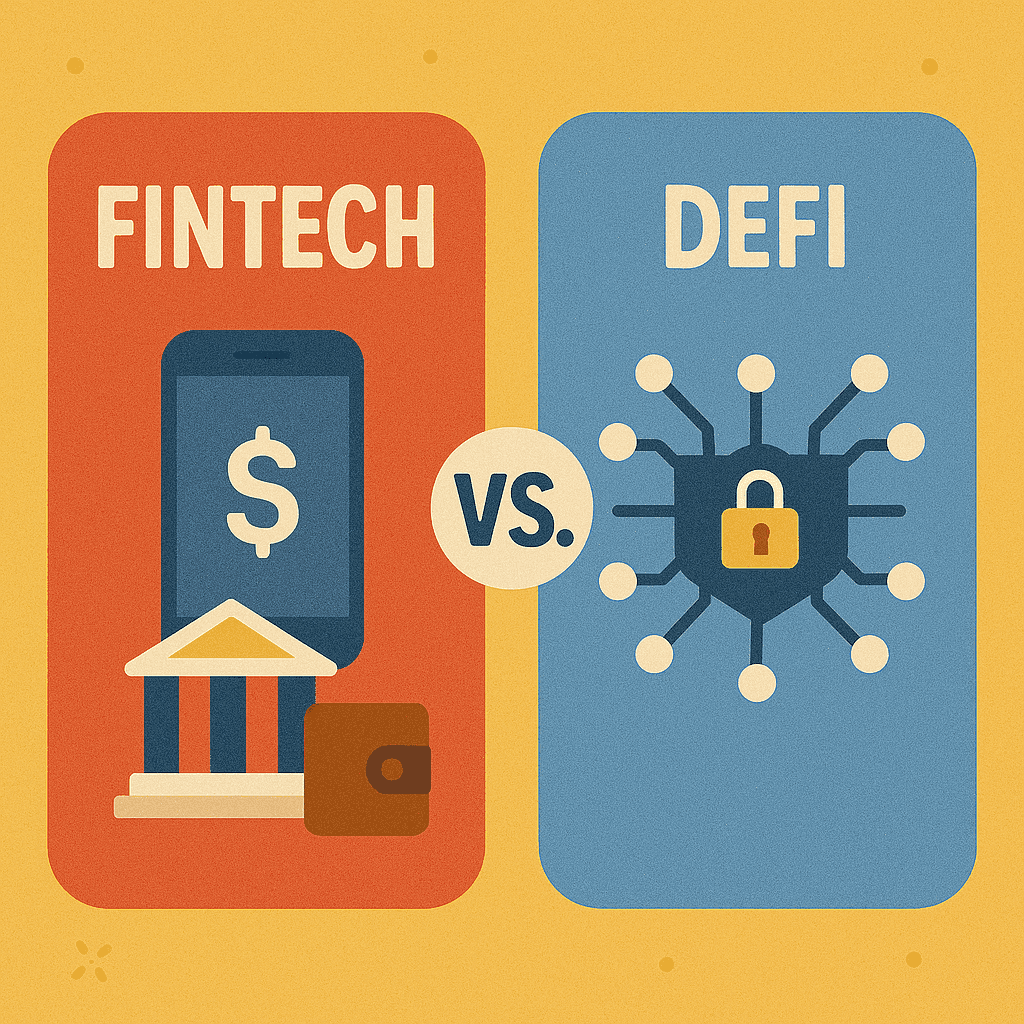
Finance is no longer just banks and spreadsheets. Two powerful trends—FinTech and DeFi—are changing how we use money.
FinTech = Finance + Technology
FinTech includes companies like PayPal, Stripe, and Revolut. They use technology to make banking easier and faster.
Digital Banking: Apps instead of bank branches
AI Investment Tools: Like robo-advisors
Online Lending: Platforms like Klarna
InsurTech: Smart insurance using AI
Jobs Disappearing: Bank tellers, loan officers, claims processors
New Jobs Appearing: Cybersecurity analysts, FinTech developers, fraud analysts
DeFi = Decentralized Finance
DeFi lets people borrow, lend, trade, and invest without banks, using blockchain technology.
Everything is controlled by smart contracts, which are self-running programs stored on the blockchain.
Examples:
Aave & Compound: Borrow/lend crypto
Uniswap: Trade coins peer-to-peer
Stablecoins (USDT, USDC): Like digital dollars
Jobs Disappearing: Bankers, credit agents, brokers
New Jobs Appearing: Smart contract developers, DeFi analysts, blockchain auditors
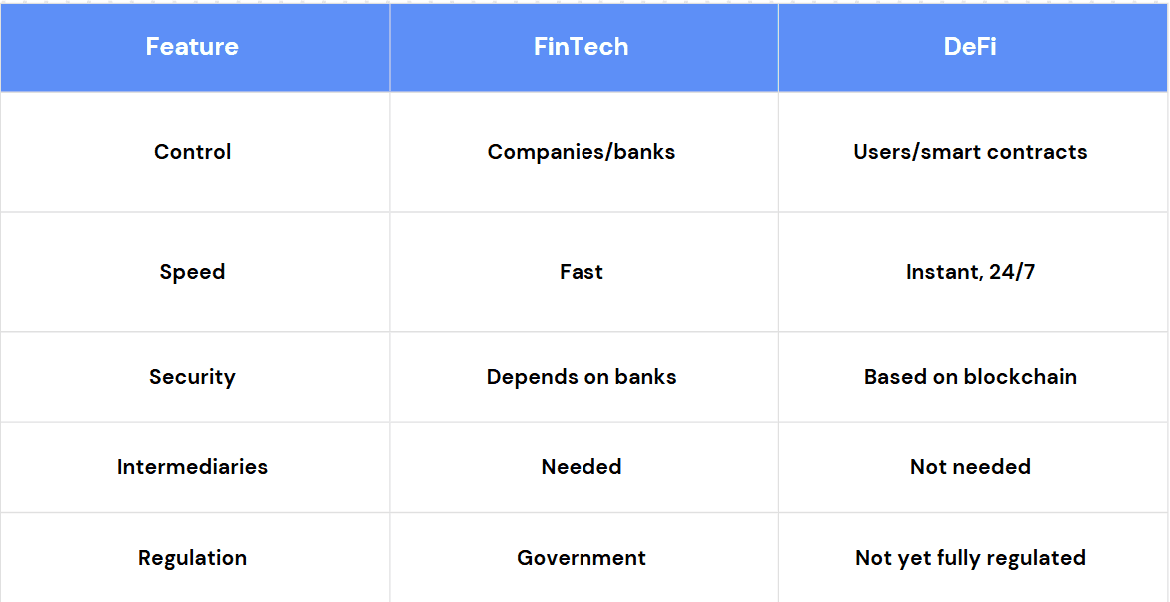
FinTech vs. DeFi (Quick Chart)
The Role of AI in DeFi and FinTech
AI powers a lot of what FinTech and DeFi can do:
AI bots help with automated trading
AI audits detect bugs in smart contracts
AI fraud tools catch hackers and scammers
RegTech uses AI to help companies follow laws
AI can make DeFi safer, but it also needs human experts to guide and improve it.
How Are Jobs in Finance Changing?
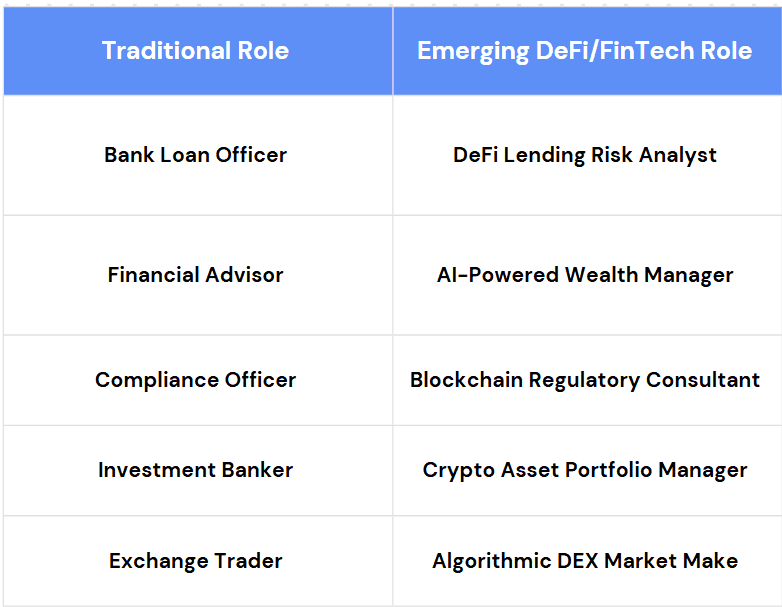
AI and DeFi aren’t just transforming systems—they’re changing careers too.
Here are some of the new finance roles that are becoming more popular:
1. Blockchain & Smart Contract Developers
Write the code that powers DeFi apps
Skills: Solidity, Python, security, cryptograph
2. DeFi Risk Analysts
Analyze threats, liquidity risks, and smart contract flaws
Skills: AI risk modeling, blockchain forensics, finance
3. AI-Powered Financial Advisors
Use machine learning to build portfolios, predict markets
Skills: Investment theory, AI models, crypto strategies
4. Crypto Compliance Experts
Make sure DeFi platforms follow local and global laws
Skills: Blockchain regulation, AML, law
5. Decentralized Governance Consultants
Help communities make decisions for DeFi platforms (called DAOs)
Skills: Token economics, policy, political science
Challenges and Ethical Questions
AI isn’t perfect—and there are serious risks.
Bias in AI
AI can inherit discrimination from past data.
Example: Apple Card gave women smaller credit limits than men—even with the same income.
Lack of Transparency
Some AI systems work like a “black box”—even the creators don’t fully understand them.
Example: A trading algorithm once caused a $440 million loss in 30 minutes because no one could stop it in time.
Privacy Risks
AI needs tons of personal data. But who keeps it safe?
Example: One UK bank’s AI flagged legit accounts as fraud, freezing money for weeks.
Deepfakes & Scams
AI-generated video and voice can fool people into sending money.
Example: In 2024, $25 million was stolen in Hong Kong using deepfake tech.
Summary: The Future = Hybrid Finance
Finance isn’t becoming 100% digital overnight—but the future is clearly hybrid:
Traditional banks will use DeFi-like tools for faster, cheaper services
AI will help regulators catch bad actors in real-time
Jobs will mix finance, tech, and law like never before
Want a career in this field?
Here’s what you’ll need:
Some knowledge of finance
Comfort with AI and code
Awareness of law and ethics
A willingness to keep learning
Final Thought: From Banking to Blockchain
AI and DeFi are changing finance just like smartphones changed communication. If you understand these shifts now, you’ll be better prepared for the opportunities ahead.
Whether you want to be an analyst, developer, regulator, or entrepreneur, the future of finance is wide open—and AI will be your co-pilot.