From Script to Screen: The AI Revolution Transforming Media Production
A Guide for the Next Generation of Filmmakers and Storytellers
By the Zenith Education team
AI Hits the Big Screen
Artificial Intelligence (AI) is changing how we live and work—and the media industry is no exception. From editing films to choosing which movies appear in your Netflix feed, AI is everywhere. In fact, a recent survey of 150 media professionals showed that 79% of companies are using or testing AI right now. But what does that really mean for the future of media? And what does it mean for you?
What’s Coming?
In the next 5 years, AI will speed things up and improve how we make movies, shows, and music.
In 10 years, jobs will change—some will disappear, others will be created, and people will need to learn new tech skills.
In 15+ years, AI may even help make decisions in creative roles. But we’ll need to stay focused on ethics, fairness, and privacy.
How Algorithms, AI, and Streaming Are Changing the Game
The Hidden Mechanics
AI is changing how movies and media are created, edited, and delivered. For example:
Netflix and Disney+ use AI to recommend shows.
Adobe Sensei helps edit videos automatically.
Cinelytic can even predict if a movie will succeed at the box office!
How AI is Infiltrating Every Stage of Media Production
Pre-Production
AI can analyze thousands of scripts instantly to predict what viewers will love.
It helps choose actors and plan filming schedules.
Production
AI-powered cameras adjust lighting and focus automatically.
Some systems record actors’ movements without the need for special suits.
Post-Production
AI can edit videos, fix sound, and add special effects faster than humans.
Marketing & Distribution
AI finds the perfect time and place to release films.
It even creates trailers and social media content to promote them.
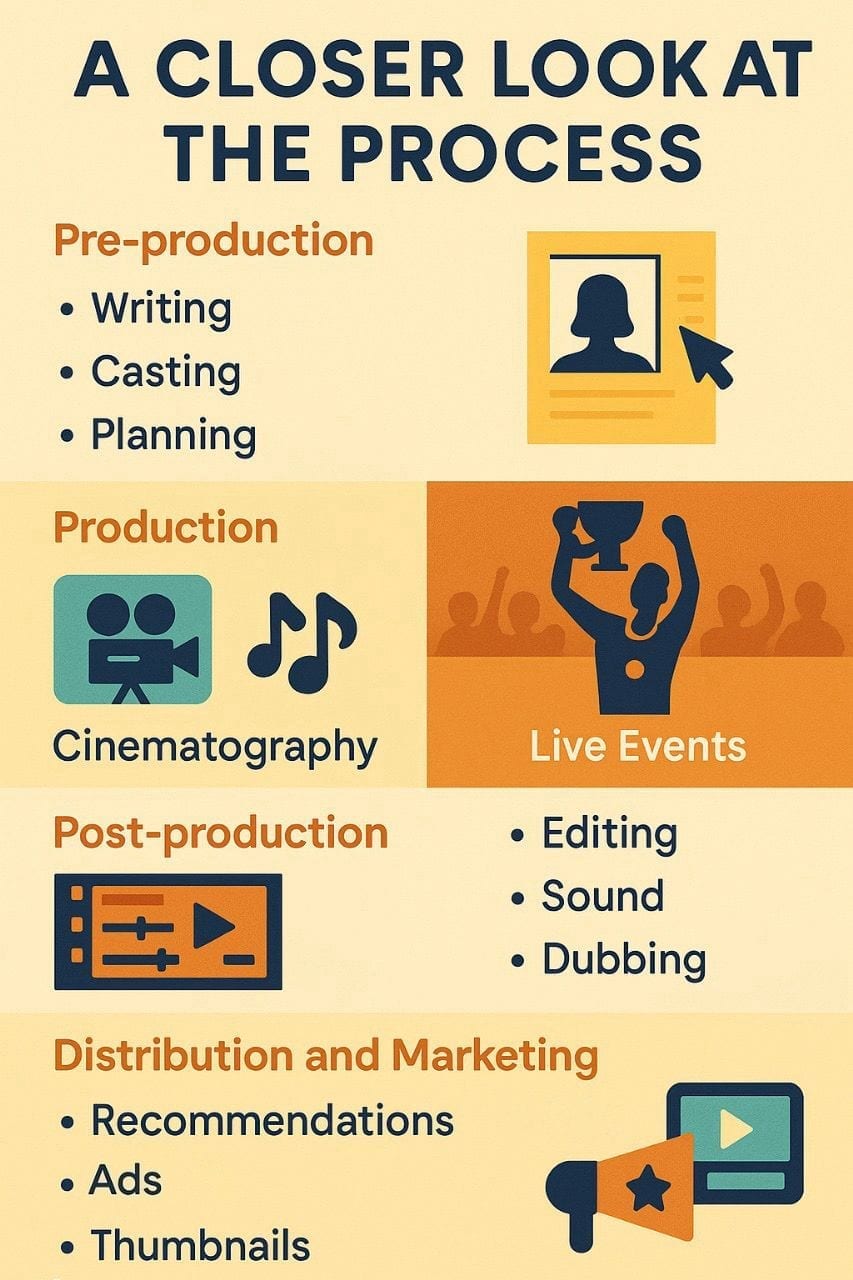
A Closer Look at the Process
Pre-production
Writing: AI helps write scripts and analyze what kinds of stories work.
Casting: Tools match actors to roles using facial recognition and past performances.
Planning: AI helps make schedules and budgets more efficient.
Production
Cinematography: Tools like Unreal Engine and Move.ai make filming easier and more creative.
Live Events: At the Tokyo Olympics, AI-controlled cameras followed athletes perfectly—no humans needed!
Sound and Music:
Tools like AIVA create music in any genre.
LANDR automatically improves audio quality.
Post-production
Editing: AI edits videos, adds effects, and color-corrects scenes.
Sound: Tools remove background noise and improve dialogue.
Dubbing: AI translates and syncs voiceovers to actors’ lips in different languages.
Distribution and Marketing
Recommendations: AI suggests shows and movies based on what you like.
Ads: AI helps studios target specific audiences.
Thumbnails: Netflix even changes the thumbnail image you see based on what you’re most likely to click!
The New AI-Powered Jobs
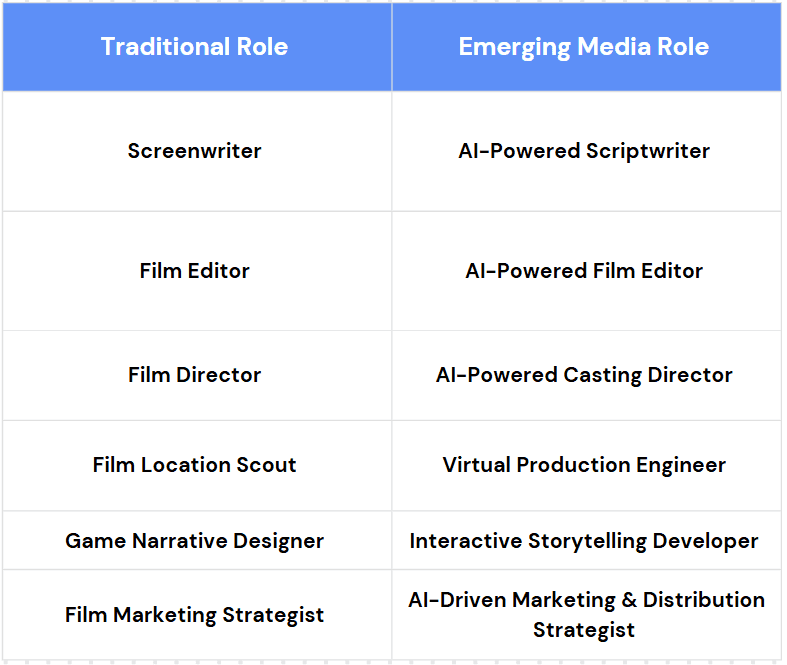
AI is changing what jobs look like in media. Here are some new roles:
Virtual Production Engineer – Creates virtual worlds using tools like Unreal Engine.
AI Film Editor – Uses AI to speed up editing and add cool effects.
AI Scriptwriter – Helps write and improve scripts with smart language tools.
AI Marketing Strategist – Analyzes audience behavior to create effective ad campaigns.
AI Casting Director – Matches the right actor to the right role using data.
Interactive Story Developer – Designs choose-your-own-adventure stories and games using AI.
Each job combines creativity with technology, and they all need both technical skills (like knowing software) and soft skills (like teamwork and problem-solving).
Challenges & Ethical Dilemmas
The Dark Side of AI
Bias:
AI can unintentionally promote stereotypes because it’s trained on old or biased data.
Casting tools might favor certain actors unfairly.
Deepfakes:
AI can change voices and faces in movies.
Example: In The Brutalist, AI changed actors’ accents post-production, which sparked debate about authenticity.
Copyright Issues:
AI tools can copy artistic styles, raising legal questions.
Example: People criticized AI-generated art that mimicked the unique style of Studio Ghibli.
Authenticity:
Some filmmakers worry that relying too much on AI could ruin the creative process.
Everything Everywhere All at Once clarified that all effects were made by humans—not AI.
What Can Be Done?
Zenith suggests:
Clear rules around AI use.
Fixing bias in algorithms.
Respecting artists’ rights and originality.
Balancing technology with human creativity.
The Future: Human + Machine
AI will not replace people in media—but it will change the way they work. Here’s what to expect:
Faster content creation with tools that help from writing to editing.
Immersive experiences in VR and AR where the audience can interact with the story.
Hyper-personalization where AI tailors content just for you.
For Future Media Professionals
Learn how to use AI tools.
Understand data and visual effects.
Stay creative and ethical.
Combine tech with storytelling skills.
Final Scene:
Media and cinema are entering a new era. If you love creativity and technology, there’s never been a more exciting time to explore careers in this industry!