
Degrees & Subjects
Master in Management: Your Gateway to Global Business Success
Thinking about your future in business? Whether you're coming from law, engineering, or the humanities, a Master’s in Management (MiM) could be your ticket to a top-tier business career—no business background required.
By the Zenith Education team
Thinking about your future in business? Whether you're coming from law, engineering, or the humanities, a Master’s in Management (MiM) could be your ticket to a top-tier business career—no business background required. In this guide, Zenith Education breaks down everything you need to know about MiMs, from admission routes and test prep to international opportunities and insider tips for getting into schools like HEC, ESSEC, and ESCP. Let’s explore how you can turn your academic story into a business success.
Let’s Talk About Business School: A Smarter Way In
Each year, many students choose to step away from HEC preparatory courses (CPGE) to explore parallel admissions to some of the top business schools. This option is really appealing because it offers flexibility and opens doors to the three prestigious Parisian institutions (HEC, ESSEC, and ESCP), along with the other Top 5 schools like EDHEC and EMLyon.
While the "classe prépa" is known for being a respected and challenging path, it does come with the stress of competitive entrance exams, which can make some students hesitant. That’s why so many are turning to parallel admissions as a great alternative!
In this article, we'll dive into the fantastic opportunities that parallel admissions provide and the exciting career paths they can lead you on. Plus, we’ll share some helpful tips and insights to boost your chances of success.
Which Business School Path Is Right for You?
France's top business schools have a variety of programs to suit different educational paths and goals, making it easier for everyone to find the right fit! There are three main types of programs to consider:
1. Bachelors
These newer postgraduate courses are available through Parcoursup and often involve taking competitive exams like the Sésame. They’re a great way to get into well-regarded programs at schools such as ESCP, ESSEC, or EMLyon. Just a heads up, though—within the same school, the Bachelor's degree is usually seen as a bit less selective and prestigious compared to the Grande École program.
2. MSc (Masters of Science or Specialized Masters)
If you’re looking to dive deeper into a specific field like Finance, Marketing, or Entrepreneurship, the one-year MSc programs are perfect! They’re designed for students who already have a degree and some professional experience, helping you build specialized skills to jump into the job market right after.
3. MiMs (Masters in Management) or "Grande École" Programs (PGE)
Now, let’s talk about the MiMs or PGEs—the star programs of France's leading business schools! These programs typically last between 2 to 3 years, and you can get in through two main routes:
- La prépa HEC (CPGE): This involves 2 to 3 years of preparatory classes, after which you enter the MiM in the first year (L3), followed by a year of M1, an optional gap year, and then a year focused on your specialization (M2).
- Parallel admissions: If you didn’t go through preparatory classes but have done a Bachelor’s or Licence (lasting 3 or 4 years) elsewhere, you can jump right into the MiM program in your second year (M1). You’ll follow the same journey as your peers from prep school and earn the same diploma when you complete M2.
Understanding how parallel admissions work in practice is really important, so make sure to do some research if you're interested!
How and When to Apply for MiM Programs (Without the Stress)
Applying for parallel admissions to schools like HEC, ESSEC, ESCP, EM Lyon, or EDHEC can be an exciting journey! Each school has its own application platform, procedure, and criteria for admission, so it's essential to familiarize yourself with each one. Most applicants start this process during their third year of their bachelor’s degree (or fourth year for those in a four-year program), aiming to join a Master in Management (MiM) program the following academic year.
1) Application Timeline
The timeline for applications can differ from school to school, but most use a round system with four to five sessions that run throughout the year, generally from September to June, for programs starting the next September.
When's the best time to apply?
Traditionally, early rounds are thought to be the best bet since applying early shows your commitment and there are typically more spots available. That said, do keep in mind that many candidates applying early are also very competitive, making it a challenging environment. Our suggestion? Apply when you feel ready, rather than trying to find the perfect moment. A strong application is really your best friend, no matter which round you choose!
2) What Do You Need for Your Application?
When applying for a MiM program, you’ll typically need to gather a few important things:
- Your full transcript from your bachelor’s program.
- A polished CV that highlights your academic, professional, and extracurricular experiences.
- Personal essays or cover letters that explain your career goals and how they fit with the program.
- Letters of recommendation from professors or supervisors from internships.
- An English language test (like TOEFL, IELTS, or TOEIC), which is optional if you have a bachelor’s degree from an English-speaking country.
- A management test, such as the GMAT, GRE, or Tage Mage.
The Big Three: Comparing Management Admission Tests
If you’re looking to apply for parallel admissions, there are three key tests to consider, each with its unique features:
1) TAGE MAGE
The TAGE MAGE is a French-language test that scores up to 600 points, tailored to evaluate your mathematical, logical, and verbal reasoning skills. It includes six sub-tests: calculation, minimum conditions, reading comprehension, expression, reasoning/argumentation, and logical sequences. You’ll tackle 15 multiple-choice questions per sub-test, giving you a total of 90 questions over 120 minutes (including a bit of time for instructions!). You can take the TAGE MAGE twice a year—once between January and June and again from July to December—so make sure to plan accordingly. Just remember, this test is specifically for applications in France and isn’t accepted by schools in the UK, US, or other countries.
2) GMAT
The GMAT (Graduate Management Admission Test), now known as "GMAT Focus," is a widely recognized 800-point English-language exam that measures your analytical, quantitative, and verbal skills. It’s broken down into three main sections:
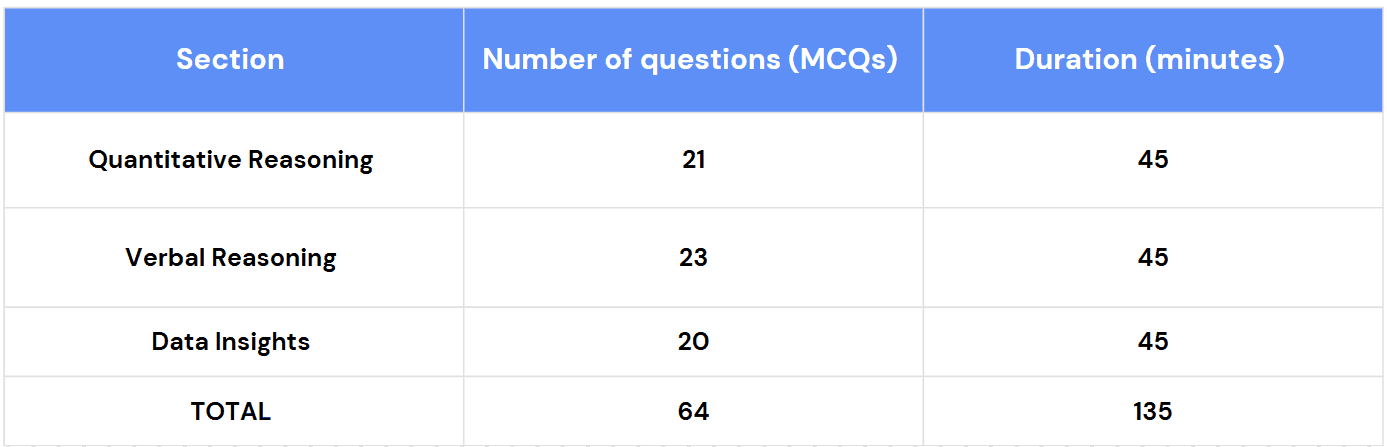
You can take the GMAT up to five times a year, with at least a 16-day break between attempts, and there’s a lifetime limit of eight tries. The GMAT is accepted by thousands of programs worldwide, making it a solid choice for anyone aiming for management or finance studies at top business schools.
3) GRE
The GRE is another great option for English-speaking candidates and serves as an alternative to the GMAT. Scored out of 340, the GRE assesses your quantitative and verbal skills, and it’s globally accepted.
As of September 22, 2023, the GRE has a fresh new format! It now lasts 1 hour and 58 minutes and includes five subsections:
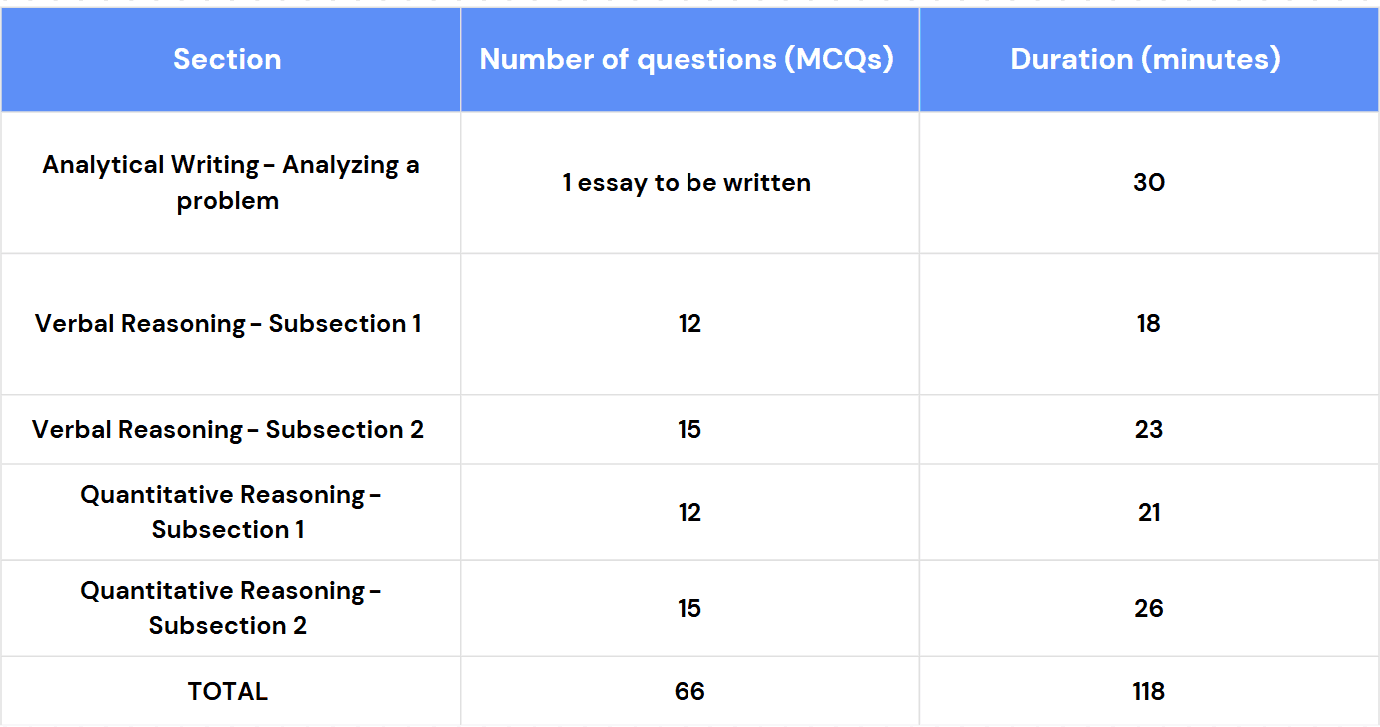
The "Analytical Writing" section always comes first, followed by the various subsections of quantitative and verbal reasoning, presented in a random order. You can also take the GRE five times a year, with at least a 21-day gap between each attempt, and a maximum of eight attempts throughout your lifetime.
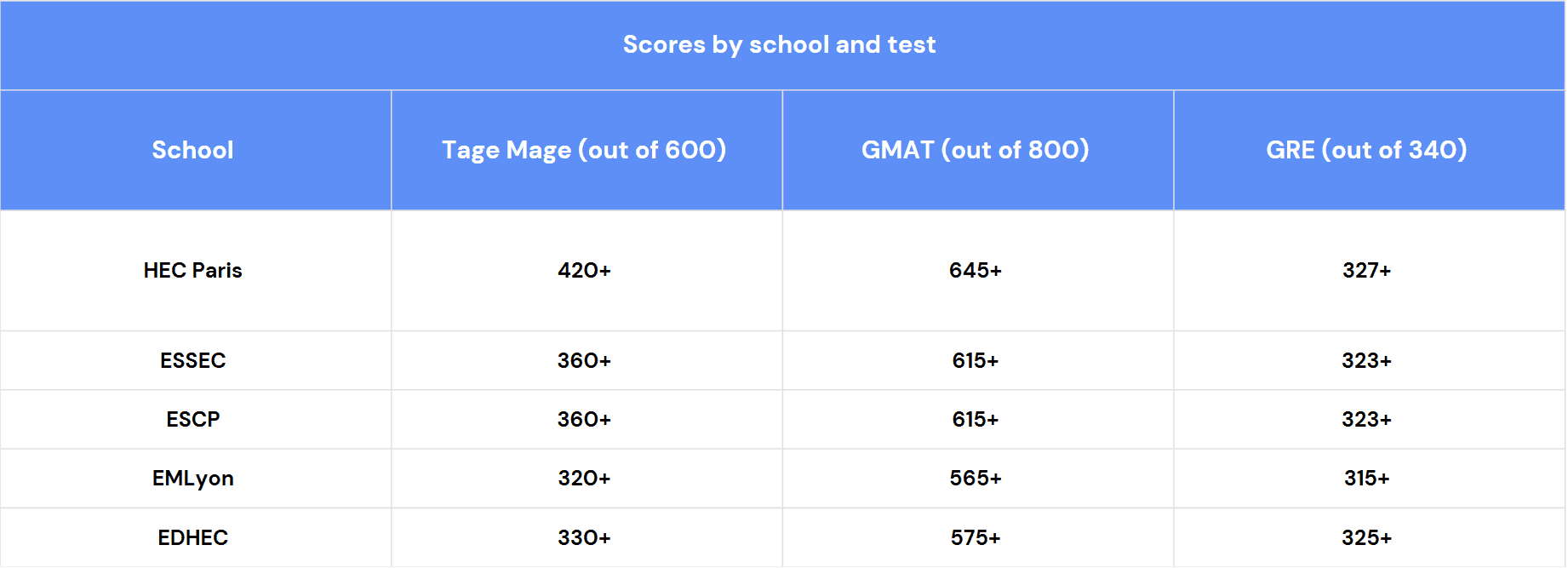
4) Score Expectations for HEC, ESSEC, or ESCP
It’s worth mentioning that schools typically don’t publicize specific score thresholds for these tests. The scores below are based on experience and should be seen as general guidelines rather than hard and fast rules. A strong academic or professional background can nicely balance out a lower score, while an excellent score won’t guarantee admission if other parts of your application don’t meet the expectations of the admissions team.
Scores by school and test
What Really Counts in Your Application?
When it comes to evaluating candidates for parallel admissions, there are four key areas that really matter in the selection process:
1. Academic Background: Admissions committees pay close attention to where you've studied and how well you've done. While the reputation of your school can be a factor, your actual results are what make the biggest difference.
2. Professional Experience: Your internships, job responsibilities, and overall experiences are important too! A clear career path that aligns with your application can really make you stand out.
3. Quality of Your Documents: A neat, well-organized CV, thoughtful cover letters, and relevant essays show that you’re serious and detail-oriented. They also reflect your understanding of the program you’re applying for, the school itself, and your future career aspirations.
4. Management Test Scores: Your scores on tests like the Tage Mage, GMAT, or GRE give schools a way to measure your analytical and reasoning skills, allowing them to compare different applicants fairly.
Once you submit your application, the schools will review everything to decide if you’re a good fit. If they love what they see, you’ll be invited for an oral admission interview — the last step in the application journey! After that, they’ll make their final decision.
French vs. International Bachelor’s: Who Has the Edge?
1) Different Quotas
Let’s start by talking about the admissions processes for French and international degrees. We have two types: admissions sur titre (AST) for those with a French degree and admissions sur titre international (ASTI) for students holding a foreign degree. While the application steps are pretty similar—like submitting a dossier, CV, management test, English test, and going through an interview—the admission quotas are quite different. French schools are becoming more open to French ASTs, but it’s still generally easier for students who studied abroad to get into a Master in Management (MiM). Schools tend to reserve more spots for applicants with international degrees, including French students who went overseas for their studies. This means that the competition can be less intense for these candidates. For example, HEC Paris admits about 35 French students each year through AST but welcomes around 350 through ASTI. At ESSEC, there are about 160 French applicants and over 200 international ones, and at ESCP, they accept between 80 and 100 French candidates while around 400 international graduates find a place. These numbers really illustrate the benefits that students with foreign degrees enjoy.
2) Differences in Prestige
When it comes to MiM admissions, there can be a bit of "academic snobbery." This often translates into a preference for foreign bachelor’s degrees over French ones. Unfortunately, applicants from French BBAs (like ESSEC, EDHEC, and SKEMA) sometimes don’t get the attention they deserve during the MiM selection process. On the flip side, degrees from places like Bocconi, IE Madrid, and ESADE Barcelona are seen in a much better light. Many admissions committees feel that French BBAs are not quite up to par, thinking students aiming for business programs in France would be better off in a pre-prep program. As a result, those coming from French BBAs can feel sidelined, as their educational choices might be viewed as strategies to avoid more rigorous paths.
But why don’t we see this bias towards students from abroad? Well, it’s simply because preparatory classes are unique to France. A top student from the UK, Italy, or Spain interested in business will go straight into well-respected programs like the BBA at ESADE or the BIEM at Bocconi. These programs are considered ideal for the best students internationally, which is why candidates from these schools, including French students, get a warm welcome from French grandes écoles when they apply for MiM programs. That said, this doesn’t affect applications to foreign Master’s programs (like those in the USA or UK), where the process is more straightforward and egalitarian.
3) Join a School in France – A Great Opportunity for International Applicants
Now, let’s focus on the "Join a School in France" admission process, which offers a fantastic opportunity for those with foreign diplomas. This route lets you apply to five renowned grandes écoles (HEC, ESCP, EM Lyon, SKEMA, and Audencia) all in one go! It really simplifies things, as you only need to submit one set of essays for all five applications. Plus, you won’t have to do extensive research on each school, since the application is the same for all of them. However, there is one drawback: you’ll have just one oral interview for all the schools, meaning if you don’t do your best, it could affect all your applications at once. Overall, it’s a unique route that many applicants find really helpful!
Beyond France: Exploring MiM Programs Around the World
While the MiM is strongly associated with French Grandes Écoles, it is far from being a purely French degree. In fact, the Master in Management (MiM) is an internationally recognized program offered by top business schools across Europe and beyond.
Why is the MiM popular internationally?
Many students prefer MiM programs as an alternative to an MBA, especially early in their careers. These programs typically last 1 to 2 years and are designed to develop broad management skills with options to specialize in fields like finance, marketing, or entrepreneurship.
Where else can you study MiM?
- United Kingdom: London Business School, Imperial College, LSE, Warwick Business School.
- Germany: WHU – Otto Beisheim School of Management, Mannheim Business School.
- Italy: Bocconi University.
- Spain: IE Business School, ESADE.
- Netherlands: Rotterdam School of Management.
- Switzerland: University of St. Gallen.
- Belgium: Solvay Brussels School.
- Nordic countries: Stockholm School of Economics, Copenhagen Business School.
Key differences from French MiM programs
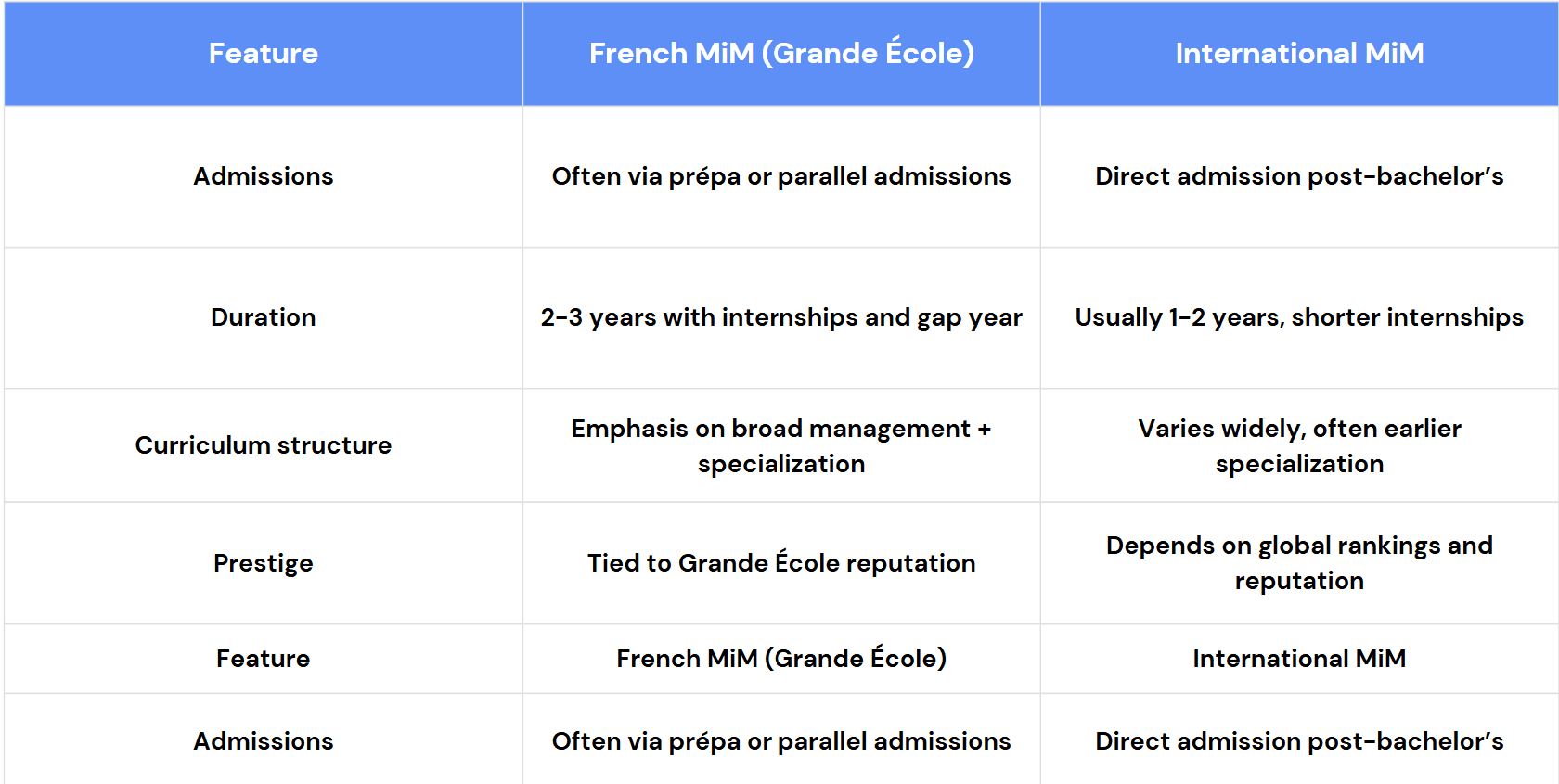
What does this mean for applicants?
If you are an international student or considering studying outside France, it’s important to know that the MiM is accessible globally and that application processes, test requirements, and program structures can differ significantly from those in France. Many international MiMs require the GMAT or GRE and place less emphasis on the French-style preparatory system.
What to Study (and Where) to Get Into a Top MiM Program
You might be surprised to learn that nearly all bachelor's students—whether you’re studying engineering, medicine, pharmacy, law, international relations, political science, communication, and more—can apply for a Master in Management (MiM) degree!
What really matters is the university you attended, your academic results, and how well your professional and academic goals align with what the school is looking for. Contrary to popular belief, you don’t need to have a background in business to pursue a MiM through parallel admissions. In fact, students who have studied business often have to explain their choice to go for a management degree, since they’ve already covered that ground in their bachelor's program. So, don’t limit yourself when it comes to your postgraduate options!
Here at Zenith, we’ve had the pleasure of helping students from fields like law, political science, and communications from various universities get into amazing schools like HEC, ESADE, or Bocconi, thanks to their stellar academic achievements. While the reputation of your bachelor's institution is definitely a factor, your grades are even more crucial. It’s better to aim for a program that might be a bit less selective, where you can really shine, instead of grappling for a spot at a prestigious university with average grades.
Take Université Paris Dauphine as an example. Its bachelor’s programs are highly regarded and attract top students. However, the grading is tough, and competition can be fierce, making it challenging to achieve high averages. While that might not be an issue when applying for a master's at Dauphine—since the admissions committees are familiar with this climate—it could be a downside when you're applying elsewhere. A score of 12 from Dauphine, which is difficult to earn, might not be valued as much as a 14 from a bachelor's program in eco-management at Assas.
So, in a nutshell, picking the right bachelor's program is extremely important because those grades will play a key role in making your transition to a master's degree a success.
Next step
Applying for a master's or MBA?
We guide students applying to postgraduate programs worldwide, from choosing where to apply to submitting a strong application.
See master's and MBA guidanceWant to find out more?
Message us on WhatsApp for a quick answer, or book a free consultation. No pressure either way.