
AI & Careers
The AI Lawyer is in: How Tech is Disrupting the Legal Profession
A High School Student’s Guide to AI in Law
By the Zenith Education team

Artificial Intelligence (AI) is everywhere these days—from the apps on your phone to the way your social media feed is sorted. But did you know AI is also changing how lawyers work?
In the legal field, AI is helping with everything from researching laws to drafting documents. Many people are excited about how AI can make legal services faster and more affordable. But it also brings up important questions about ethics, fairness, and whether some legal jobs might disappear.
Let’s break it all down together!
How Algorithms Are Handling Contracts, Research, and Even Predictions
1. Smarter Research and Document Review
Lawyers used to spend hours going through thick law books and endless contracts. Now, AI-powered tools like Kira Systems and ROSS Intelligence can scan documents quickly and find important information.
- Westlaw and LexisNexis are platforms that help lawyers search through past court cases, laws, and legal articles in seconds.
- In lawsuits, AI helps sort through thousands of emails and files (this is called eDiscovery) to find evidence—much faster than humans.
2. Better Legal Workflows
AI can now help draft contracts and legal memos using platforms like Juro or Ironclad. That means lawyers can spend less time on repetitive tasks and more time helping clients or solving big problems.
3. Predicting Case Outcomes
AI tools like Lex Machina analyze patterns from past court cases and help lawyers predict how a judge might rule. It’s not magic—it’s data science. This helps lawyers plan smarter strategies.
4. Cutting Costs
AI saves time and makes things more efficient, which reduces costs for both lawyers and their clients. One study even found that AI tools can save legal firms up to 9% in costs and boost productivity by over 50%.
Making Legal Help More Accessible
AI doesn’t just help lawyers—it also helps everyday people.
- Chatbots like DoNotPay and HelloDivorce help people handle simple legal issues (like parking tickets or divorce paperwork) for little or no money.
- AI tools can also translate legal terms for non-English speakers or assist with online dispute resolution, meaning fewer people have to go to court for small issues.
This is great news for people who cannot afford a lawyer!
The Dark Side of Legal AI
Even though AI is useful, it’s not perfect. Here are some problems:
1. It Can Make Mistakes
One lawyer used ChatGPT to help with research—and it made up fake court cases! That lawyer ended up in trouble. AI still needs human supervision to avoid serious errors.
2. Bias in AI
If the data AI is trained on includes bias (for example, racial or gender bias), the results it gives may be unfair. One tool called COMPAS, used in courts, was more likely to flag Black defendants as high-risk—even when they had similar records as white defendants.
3. Privacy Risks
AI might accidentally share private or sensitive data. Since lawyers deal with confidential information, this is a big deal.
4. Lack of Human Qualities
AI can’t think critically, show empathy, or make complex ethical decisions. Lawyers often have to comfort clients or make decisions based on emotions, fairness, or social context—something AI can’t do.
Real-Life Example
At a court in the U.S., a lawyer cited several past court cases to support his client’s lawsuit. But the defendant’s lawyer couldn’t find any of those cases. Turns out, the cases were generated by ChatGPT and didn’t exist! Even though the AI sounded confident, it was completely wrong. This showed how dangerous it can be to rely too much on AI without double-checking.
Will AI Replace Lawyers?
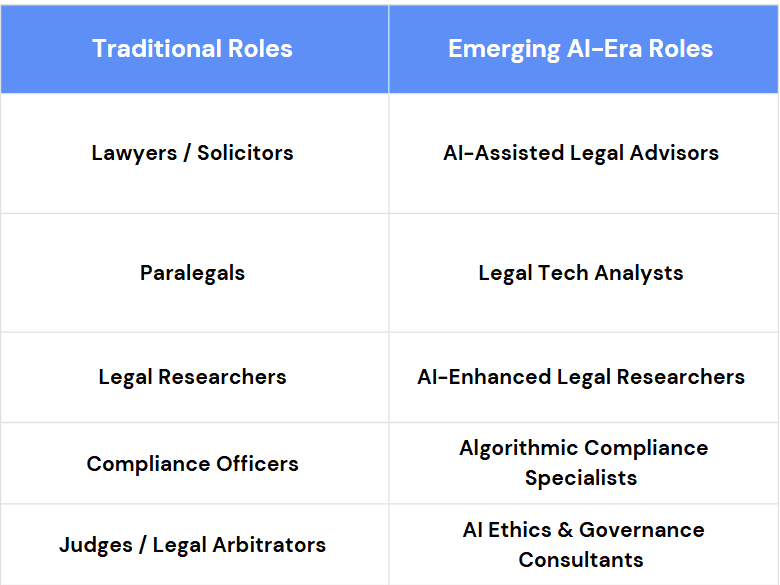
Some fear AI will take over legal jobs, especially entry-level ones like paralegals or junior researchers. But most experts agree:
AI will change roles, not eliminate them.
New jobs like legal technologists or lawyer-engineers are emerging. These professionals combine legal skills with tech knowledge. Law schools like Stanford, Berkeley, and Yale are already teaching AI and law to prepare students.
The Future of AI in Law
According to experts and companies like KPMG and Hilgers Graben, the legal teams of the future will include:
- Fewer traditional lawyers
- More tech professionals
- More automated contract tools
- More flexible, hybrid roles
At Zenith Education, we believe the next generation of lawyers will need both legal knowledge and tech skills.
We predict:
- A 10–15% drop in the number of traditional lawyers in the next 10–15 years
- A 20–30% drop in junior legal roles
- A rise in multidisciplinary professionals (law + tech)
Key Takeaways
- AI helps lawyers with research, writing, client service, and cost savings.
- It makes legal help more accessible to those who cannot afford a lawyer.
- But AI has flaws—it can be biased, inaccurate, or lack emotional understanding.
- AI will not replace lawyers, but it will change how the law is practiced.
- To succeed in the legal field, students should combine law with technology.
Final Thoughts
Law is about people—their needs, rights, and emotions. That’s something that no machine can fully replace. While AI makes law faster and smarter, it will always need the human touch to stay fair, ethical, and compassionate.
So, if you’re dreaming about law school, start thinking not just like a lawyer—but like a lawyer who understands tech. The future belongs to you.
Want to find out more?
Message us on WhatsApp for a quick answer, or book a free consultation. No pressure either way.